

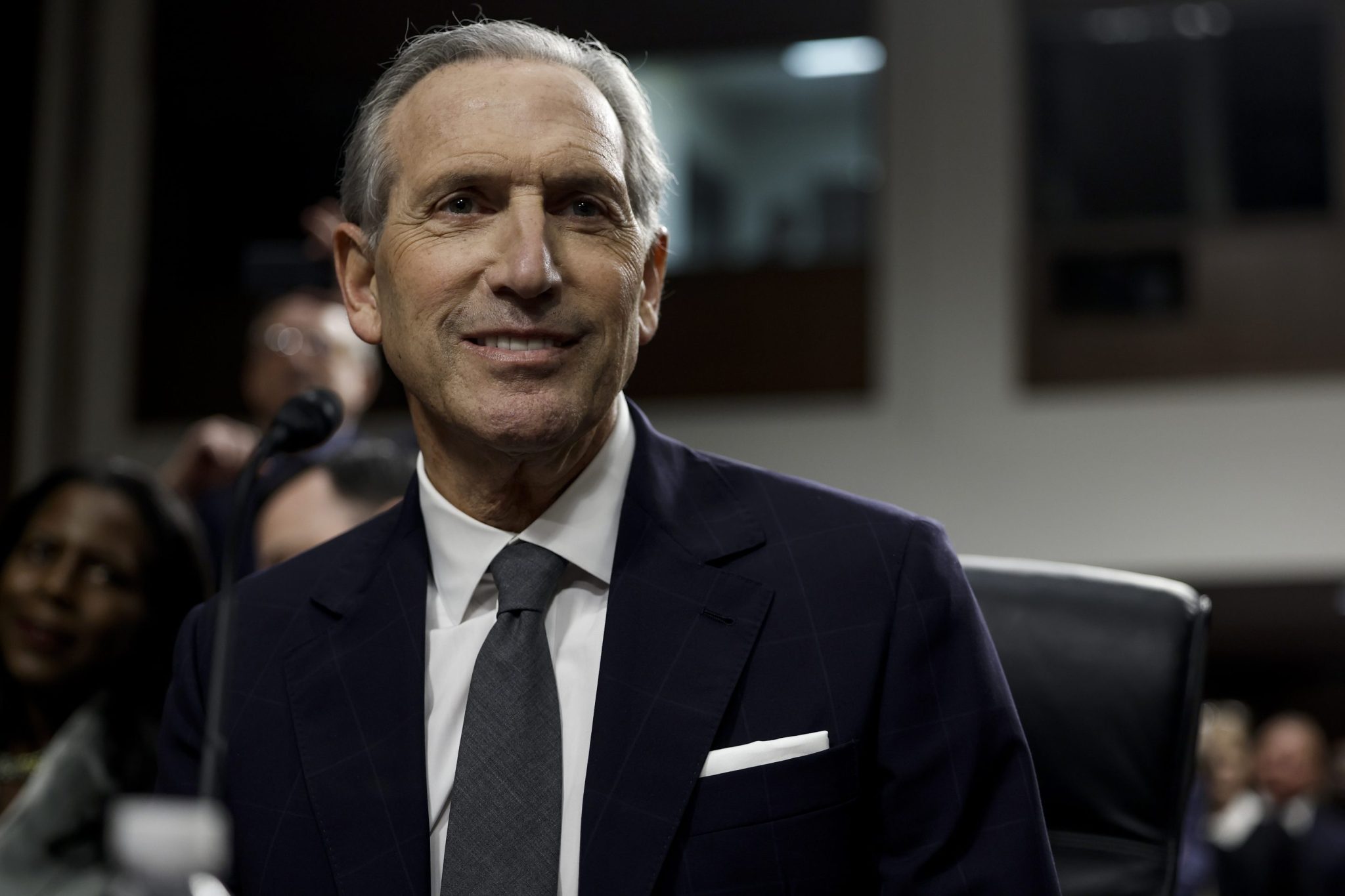
Forty-four years ago, Howard Schultz packed up his life, loaded his golden retriever, Jonas, into his 1979 Audi, and drove cross-country from New York City to Seattle with his wife, Sheri. He was headed toward a city he barely knew, but would eventually become where he built his massive coffee empire and a brand we all know today: Starbucks.
At the time, Sheri was the “breadwinner,” with a design career, Shultz said in a LinkedIn post on Wednesday. But Sept. 7, 1982, changed the course of the couple’s lives: It was the day Schultz started a new job “at a place called Starbucks.”
“Back then, the Pike Place Starbucks only sold whole bean coffee,” Schultz said. “Today, it’s the most visited Starbucks in the world. The history of the company is bound up in the very foundation, walls, and floorboards of our first store in the city’s historic market.”
And that company would make Schultz a billionaire (he’s worth about $6.6 billion today).
Building the Starbucks empire
Schultz joined Starbucks in 1982 as director of retail operations and marketing, when the company was still a small Seattle roaster selling whole-bean coffee.
The turning point in Schultz’s career came a year later when he took a trip to Milan. He was struck by the culture of Italian espresso bars—the ritual, the community, the craft. He came back to Seattle convinced that the model could also work in America. This was also the inception of the idea of “third places,” which Starbucks continues to pursue today.
But Starbucks wasn’t originally convinced the idea would work, so Schultz left the company.
“’You’re out of your mind. This is insane. You should just go get a job,’” Schultz was told, according to his own book, Pour Your Heart Into It. “In the course of the year I spent trying to raise money, I spoke to 242 people, and 217 of them said ‘no.’”
But after Schultz raised the money, he opened his own coffeehouse, Il Giornale, in 1986, and acquired Starbucks itself for $3.8 million in 1987. The company went public in 1992.
What followed was one of the great American business expansions of the 20th century: Starbucks went from just a handful of Seattle stores to more than 35,000 locations in 80 countries.
Schultz served as CEO three times: from 1987 to 2000; from 2008 to 2017; and again briefly in 2022-2023, returning each time to steady the company.
“I came back this past year because the company really did lose its way, and it lost its way culturally,” Schultz said in an interview with CNN in February 2023. Schultz’s third stint as CEO from 2022 to 2023 was largely defined by an aggressive, legally contentious battle against worker unionization.
He left Starbucks for the last time in 2023, handing the reins to Laxman Narasimhan, who only served as CEO from April 2023 to August 2024. Brian Niccol (Chipotle’s former CEO) became chief executive in September 2024.
Still, Schultz’s legacy is hard to beat. He took a regional bean roaster and turned it into a global cultural institution. Today, Starbucks has more than 32,000 stores in 80 countries, dwarfing other chains like Dunkin’ Donuts, which has about 14,000 stores globally.
He also popularized the “third place” concept, an idea Niccol is attempting to revive by bringing back handwritten notes on coffee cups, more seating in coffee shops, and more options to enjoy a coffee at an actual Starbucks location rather than only taking it to go.
Schultz took a regional bean roaster and turned it into a global cultural institution, popularizing the “third place” concept — the idea that people needed somewhere between home and work to gather, linger, and connect. He also championed employee benefits that were unusual for the service industry at the time, including health insurance for part-time workers and a free college tuition program.
And while union drama was an undercurrent of Schultz’s third tenure, in particular, Starbucks was still one of the first companies to provide comprehensive health care to part-time employees, starting in 1988.
“I knew I wanted to build the kind of company my father never got to work for,” Schultz wrote in a 2022 Instagram post. “That year, I decided we would offer full health benefits to eligible full- and part-time Starbucks employees.”
Closing the Seattle chapter
More than a year after his retirement from Starbucks, Schultz decided it was time to leave Seattle. He announced in his LinkedIn post this week that he and Sheri were leaving Seattle.
“Last year we traveled to dozens of places around the world—places we were too busy to see when building Starbucks and raising kids,” Schultz wrote. “And we have moved to Miami for our next adventure together. We are enjoying the sunshine of South Florida and its allure to our kids on the East Coast as they raise families of their own.”
The timing of Schultz’s announcement drew attention because it coincided with Washington state lawmakers advancing legislation targeting high-income earners, including a proposed wealth tax that would apply to residents with significant investment assets. Schultz’s move is reminiscent of California billionaires who have also fled the West Coast for Florida due to a proposed one-time 5% tax on billionaires.
The former Starbucks CEO hinted at the proposed tax in his LinkedIn post, although never directly denied it.
“It is our hope that Washington will remain a place for business and entrepreneurship to thrive, creating essential opportunity for those in Seattle and the surrounding areas,” he wrote.
Like others, Schultz’s destination is Miami, where he reportedly paid $44 million for a penthouse. It’s a state that has no income tax and a booming luxury real-estate market that’s also attracted Amazon founder Jeff Bezos, Meta CEO Mark Zuckerberg, Google cofounders Larry Page and Sergey Brin, and Oracle cofounder Larry Ellison.
Schultz leaves behind a massive legacy for a penthouse on the water.
“We will be forever grateful for the memories made in Seattle and the relationships built along the way,” he wrote. “To the family, friends, and partners who made Seattle our home for so many years, thank you.”
This story was originally featured on Fortune.com