

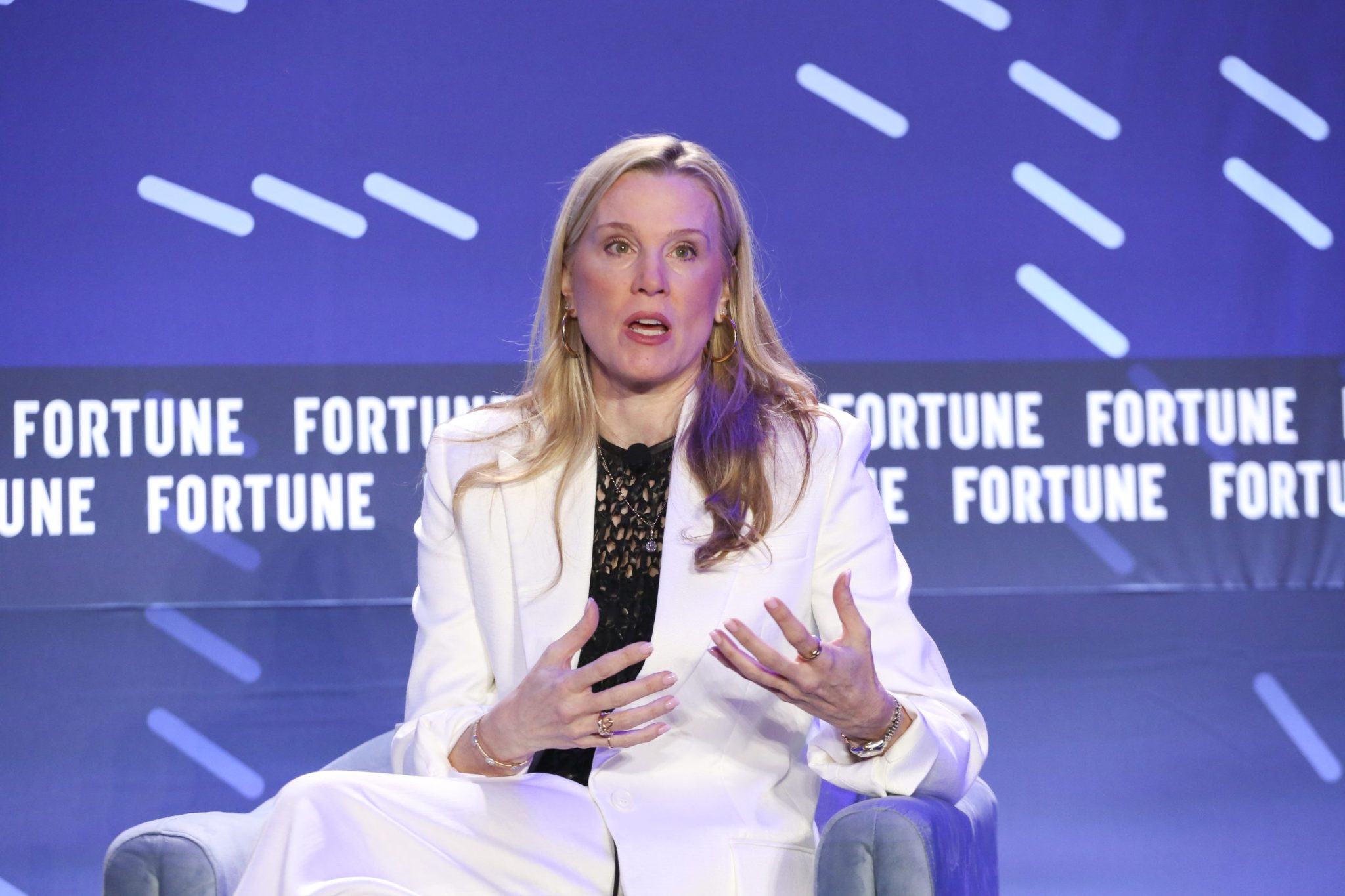
Employers are shifting their hiring requirements in the AI era; while some are seeking vibe coding and prompting skills, others are doubling down on human intuition and empathy. Becky Schmitt, the chief people officer at PepsiCo, says the legacy brand is still looking for old-school skills as it shifts gears amid its current tech transformation.
“There’s a couple things that are part of our secret sauce, and I’m sure a lot of companies would say this, but our people have hustle,” Schmitt recently said onstage at Fortune’s Workplace Innovation Summit. “How do you solve problems? How do you have that internal fortitude to work through it? How are you curious? Are you always asking questions?”
PepsiCo is known as a breeding ground for the next generation of Fortune 500 leaders, minting CEOs like Target’s Brian Cornell, McDonald’s Chris Kempczinski, and Delta Air Lines’ Ed Bastian, to name a few. And the company’s CPO wants to keep a dynamic profile in hiring and shaping great leaders at the company, whether or not they stay or move on to other titans of industry. Schmitt explains that PepsiCo is on the hunt for talent in which both parties feed into one another’s success.
“I think that it’s really about, what’s the person’s education—the one they come with, [and] the one we provide? What exposure can we give them?” the executive said. “How are we modifying our evaluation process so we’re finding these jewels wherever they sit in the organization?…It’s the kind of work all HR professionals really want to do.”
Core human skills have become a hot-ticket item among some employers as AI increasingly automates technical tasks. While tech tools write code, handle meeting notes, and synthesize documents in minutes, people’s natural talents will find new room to thrive. Seven of the top 10 skills on the rise last year were soft skills, according to a 2025 LinkedIn report, including conflict mitigation, adaptability, and public speaking. JPMorgan CEO Jamie Dimon has said that having quality communication, critical thinking, and EQ (emotional quotient) will lead talent to “plenty of jobs.” And Anthropic’s Daniela Amodei believes that the things “that make us human” will be increasingly important in an AI-driven landscape—namely, people skills, curiosity, and compassion.
However, valuing humans’ capabilities doesn’t mean that tech-savvy is off the table at the food and drink giant. For the Pepsi-Cola brand—which originated in 1893 and became a corporate entity after its 1965 merger with Frito-Lay—innovation is a core element of the company’s success. And that includes keeping up with the latest technologies while running 50-year-old factories.
“We’re all using [AI] all day long through our devices, so why would you come to work and fill out paper?” the PepsiCo executive said. “It feels like we should have a change.”
During this newfound AI transformation, Schmitt says there’s more pressure to explain things to the workforce. The CPO says the company’s main goals are to make jobs safer, more productive, and attractive, all while keeping workers in the loop. The goal is “human-centric design”: providing value through the technology while staying accountable. Ultimately, Schmitt believes that people will be the drivers of innovation, bolstered by AI-driven productivity. Implementing the tech is just one way PepsiCo is staying sharp.
“We do believe that humans are going to create new opportunities, and we believe in re-imagination, and I think that’s going to come from our people—not just from the tech—and people using tech in the right way,” Schmitt continued. “When we roll out simple things, you need adoption for it to work.”
This story was originally featured on Fortune.com