

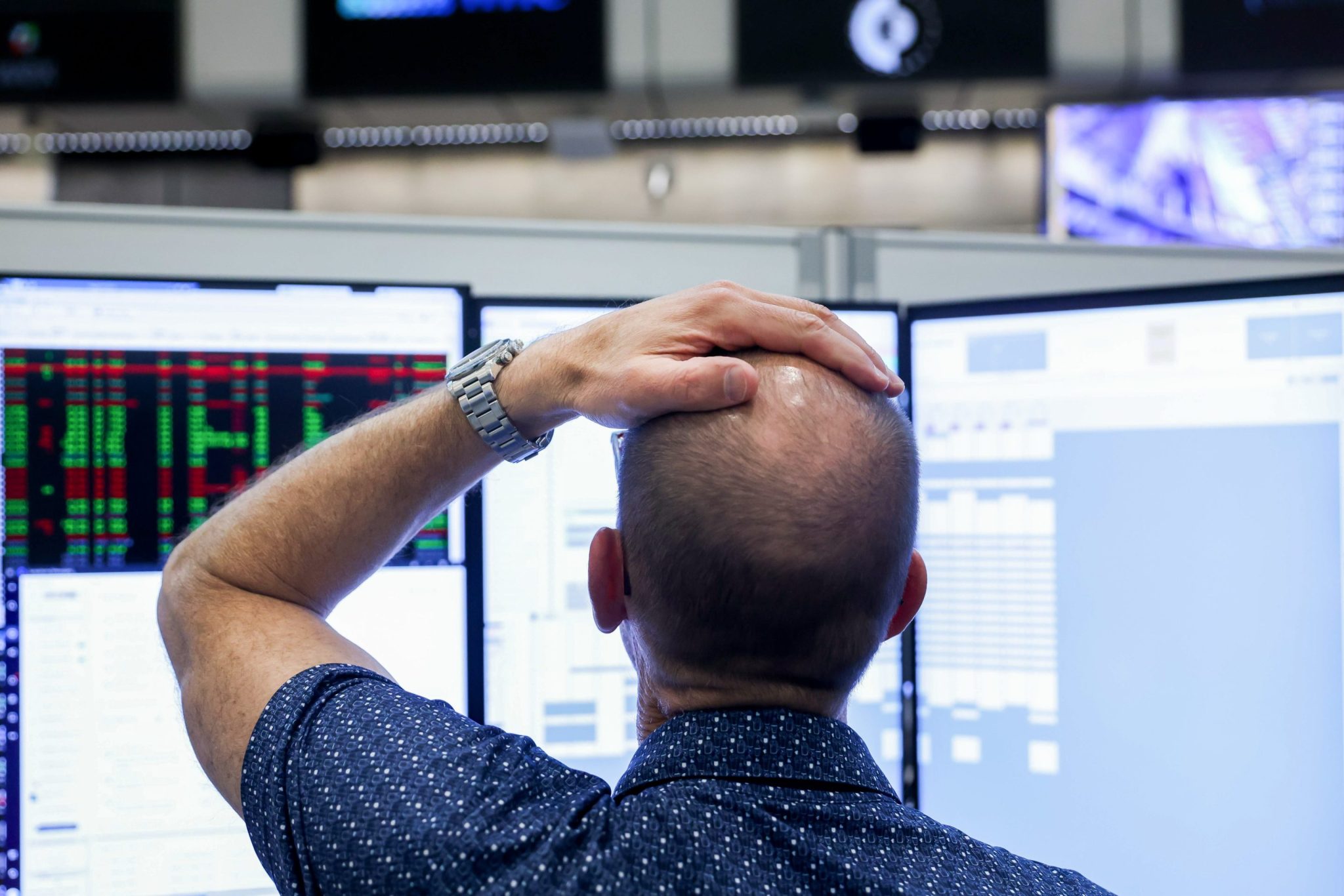
On Friday, the Nasdaq had its worst session in a year. By Monday it all seemed like a bad dream.
The chipmakers that had their worst session since 2020 on Friday (Micron, Broadcom) were Monday’s best performers, up 6.5% by midday. Wall Street appears to consider Friday as a welcome easing off of a record-setting rally, as opposed to a genuine repricing of the AI trade that other analysts warned of.
New York’s bad dream was, overnight, Asia’s waking one. South Korea’s KOSPI—the best-performing major index in the world this year—plunged as much as 8.8% at the open Monday, triggering a 20-minute trading halt, its third of 2026, and closed down 8.29%.
Samsung Electronics and SK Hynix—the two memory-chip makers that together make up roughly half of the index—fell about 10% and 8%, respectively; the won opened at a 17-year low against the dollar. Japan’s Nikkei lost 3.9%, China’s CSI 300 2.1%.
Nvidia’s Jensen Huang also called Friday’s selloff a buying opportunity, telling investors demand for AI chips keeps outrunning supply. It echoed the case he made at Nvidia’s GTC conference in March, when he projected $1 trillion in combined sales for the company’s Blackwell and next-generation Vera Rubin chips through 2027—double an earlier forecast—and called demand “off the charts.” It appears like the markets listened to him.
‘A healthy reset’
Morgan Stanley’s chief equity strategist Mike Wilson called Friday a “healthy reset,” noting markets “rarely move in a straight line” at the pace seen since the March lows, and reaffirmed an 8,000 target for the S&P 500, now trading around 7,460. Chris Larkin, an analyst from Morgan Stanley made the same point from the other side: after nine straight weeks, he wrote the market “was arguably due for at least a reset.”
“Last week didn’t derail the rally, but it may have made it more sensitive to negative surprises in the near term,” Larkin wrote in a note.
The negative surprise was positive news for the economy: a stellar May jobs report. Employers added 172,000 workers, roughly double what forecasters expected, and the strength was enough to push traders to fully price a quarter-point Fed rate hike this year, according to Oxford Economics.
That’s because a labor market that hot gives the Federal Reserve no reason to cut and some reason to hold or hike—and higher rates fall heaviest on the high-growth AI names that had led the rally. The May report was the first jobs data of Kevin Warsh’s tenure as Fed chair, and it makes it harder for him to appease President Donald Trump with a rate cut. Trump said an interview that aired Sunday on Meet the Press that the report was “great” and insisted “there’s no reason to raise interest rates,” which he said would “kill success.”
Warsh, he added, should “do whatever he wants.”
Fearing a rate hike
The reason Trump and many on Wall Street fear a rate hike is that it could uniquely hurt the AI trade. A stock that earns most of its money years out is worth less when the interest rate used to value those future earnings goes up, which is why the Nasdaq fell 4% on Friday while the Dow, with less riding on tech, lost 1.4%. The two-year Treasury yield, the most rate-sensitive point on the curve, rose on Friday to its highest since February 2025, while the 10-year pushed above 4.5%.
Treasury yields barely moved Monday, which shows markets are looking more towards inflation, Larkin says: data that will come out this week as the May CPI comes in on Wednesday and PPI Thursday. The Fed is already in its pre-meeting blackout, so there are no officials to talk the numbers up or down. If inflation runs hot, the surprise Larkin described might arrive on schedule.
The other variable is the war in Iran. Even as fighting intensified over the weekend—Iran struck Israel overnight in retaliation for Israeli attacks on Lebanon, and Israel struck back—by Monday morning in New York both sides had pledged to de-escalate. The markets could be pricing in an end to the war in Iran, though crude jumped more than 4% on the strikes before trimming the move to about 1.5%—hardly a market pricing in peace. If there’s another flare-up, it could also disrupt the AI rally.
The demand story faces an especially critical test Friday, when SpaceX is set to price what would be the largest IPO in history at a $1.75 trillion valuation. Much of the case rests on AI: The company has lined up roughly $75 billion in future contracted compute revenue, including a $30 billion deal under which Google will pay $920 million a month to rent about 110,000 Nvidia chips from the data centers SpaceX picked up in its xAI merger.
Not everyone takes the number at face value: Morningstar said it values the company at less than half its target. The question under the chip rebound and the question under the IPO are the same one: whether AI demand justifies the price. But Friday will give one real answer.
This story was originally featured on Fortune.com