

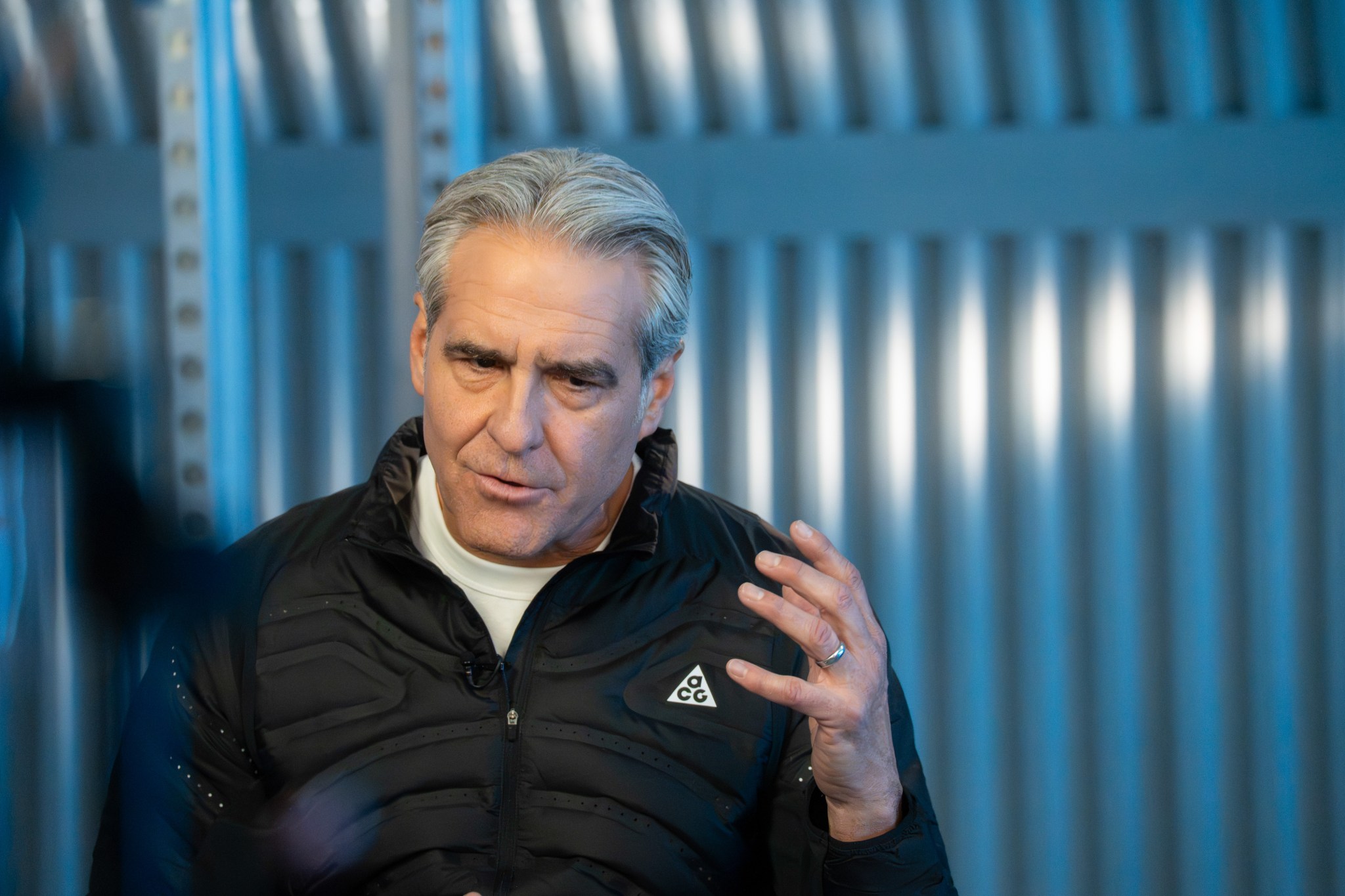
The news traveled quickly across Nike’s sprawling headquarters in Beaverton, Ore. Elliott Hill was coming back.
Employees high-fived. An audible cheer could be heard in parts of Nike’s 400-acre campus. Current and former employees lit up group chats and social media. On Wall Street, investors joined the celebration, sending Nike shares up roughly 8% in after-hours trading following the company’s September 2024 announcement that Hill would come out of retirement to replace John Donahoe as chief executive.
The exuberance reflected more than relief that Donahoe was leaving. Hill’s return carried an almost messianic quality inside a company that had spent several years watching its innovation pipeline sputter, relationships with retailers deteriorate, and its once-untouchable cultural standing erode. Nike was reaching into its own past for someone who seemed uniquely equipped to restore what it had lost.
Hill had spent over 32 years at Nike, rising from an intern in 1988 through sales and leadership positions across North America and Europe before eventually becoming president of consumer and marketplace. By the time he retired in 2020, Nike credited him with helping grow the business to some $39 billion.
The appeal to Nike’s board was obvious. It was buying a turnaround CEO and, just as importantly, buying time. Hill would not have to spend his first year learning the company he had been hired to save. He knew how Nike worked when it was working. He presumably knew where it had gone wrong.
Nearly two years later, the savior narrative has collided with the scale of Nike’s problems.
Hill has repaired relationships with wholesalers, curbed the flood of once-hot sneaker styles Nike let saturate the retail market, and poured resources back into athletic innovation. Wholesale has returned to growth, and performance running is showing signs of renewed strength.
Still, investors remain unconvinced, and the stock market’s initial euphoria has long since disappeared. Nike shares, which jumped when Hill’s appointment was announced, now trade around $40, roughly half their 52-week high and a fraction of their 2021 peak. The decline has reduced Nike to the lowest-priced member of the price-weighted Dow Jones Industrial Average and generated speculation about whether the company could eventually lose its place in the index, an extraordinary symbolic comedown for a brand that once seemed synonymous with American consumer dominance.
“The initial excitement around the appointment has been replaced by a realization that this is a long, hard slog,” says Neil Saunders, managing director at GlobalData Retail. “There are no real quick fixes here.”
The turnaround takes shape
Nike’s latest results show that Hill’s early progress has yet to meaningfully change the company’s overall trajectory. Fourth-quarter revenue fell 1% to $11 billion, but more troubling is how broadly the weakness is distributed. Nike Direct, the business Donahoe had once positioned as the company’s future, fell 7%. Digital sales sank 12%, while revenue at Nike-owned stores declined 7%. Greater China and Europe are also weak.
For Hill, the problem is that improvements in one corner of Nike keep getting swallowed by deterioration somewhere else. A healthier wholesale business cannot offset falling digital sales, struggling stores, and a deeply troubled China business. Running has emerged as one of Nike’s clearest bright spots, delivering five consecutive quarters of double-digit growth and adding roughly $1 billion in revenue over that period. But even gains of that magnitude have not been enough to change the entire trajectory of a company with $46 billion in annual revenue.
And the cost of cleaning up years of mistakes, including discounting old merchandise and reinvesting in the business, continues to weigh on profitability.
If there’s another bright spot, it’s in wholesale. Fourth-quarter wholesale revenue rose 4% to $6.6 billion as Nike rebuilt relationships with retailers it had alienated, including Dick’s Sporting Goods and its Foot Locker business, as well as JD Sports. Getting Nike back onto those shelves matters, but much of that work amounts to recovering business the company surrendered through its own strategic mistakes. It does not yet answer the harder question facing Hill. Where will Nike find significant new growth?
That distinction has become the defining tension of Hill’s tenure. Nike did not bring its celebrated veteran home simply to stabilize a decline. Hill’s first phase has largely consisted of repairs, but Nike must still show that those repairs can translate into growth, consumer excitement, and renewed cultural relevance.
Nike argues that such a judgment is premature. The company says Hill’s immediate priority was to stabilize the business by rebuilding wholesale relationships, clearing excess inventory, and fixing its biggest sneaker franchises. Nike has since moved to the longer-term work of reorganizing around individual sports and developing new products, changes it says could take 24 to 36 months to show up fully in its financial results.
“We have been clear that progress will not be linear and that significant change is required to secure NIKE, Inc.’s long-term leadership,” a Nike spokesperson told Fortune in a statement. “We are not optimizing for short-term outcomes that could compromise the strength of the brand.”
Simeon Siegel, senior managing director at Guggenheim Partners, sees Nike’s uneven results as a reflection of its sheer global scale, with major markets moving on different timetables. “There’s no question the turnaround has been taking longer,” he says.
Still, Siegel sees signs of progress in North America, Nike’s largest geography, where revenue has returned to growth after a prolonged decline. The question is whether North America offers a preview of what could eventually happen elsewhere.
Siegel says Nike’s regional performance invites two readings. A skeptic can see “falling dominoes, house on fire.” A more optimistic investor can see the company “strategically fixing big parts of a business that certainly need some help.”
Reclaiming relevance
Yet the financial deterioration only partially captures Hill’s challenge. Nike’s struggle to generate growth is intertwined with its loss of cultural relevance. For decades, the company’s genius was its ability to collapse the distance between elite athletic performance and ordinary life. Nike could develop a shoe around the needs of a world-class athlete and somehow make millions of people who would never approach that level of competition want to wear it. Performance created aspiration, that aspiration created fashion, and fashion turned the iconic Swoosh into a global status symbol. That machinery no longer works as reliably.
Nike spent years engineering shoes for serious athletes while competitors got better at serving consumers who wanted performance, comfort and style in everyday life. Hoka, On, New Balance and Asics turned running shoes into lifestyle products, capturing demand Nike once dominated. Meanwhile, Alo and Vuori helped redefine athletic apparel around clothes that could move from a workout into the rest of the day.
Of course, Nike still makes technically sophisticated products. What it has struggled to produce consistently is a breakout item that escapes the world of sport and becomes a cultural phenomenon.
Saunders describes Nike as fishing from two increasingly different pools. One is sport, where technical performance, elite athletes, and credibility remain essential. The other is lifestyle, where sneakers and apparel function as expressions of taste and identity. Nike’s problems are much more acute in the second pool.
“Nike has lost its edge,” he says. “It’s very unclear as to what Nike really stands for.”
Siegel sees Nike’s enormous sales as evidence that the brand still commands considerable consumer demand. The company generates more than $45 billion in annual revenue, requiring consumers to make fresh purchasing decisions every year.
“Whether people like Nike, people are certainly buying Nike,” Siegel says. “That’s a fact. That’s not an opinion.”
Sales, however, offer an incomplete measure of Nike’s cultural influence in an increasingly fragmented market.
“How does Nike get people to not only buy the product but also love the product again?” Siegel says.
The competitive landscape has also changed dramatically from the era when Nike’s scale was an almost unqualified advantage. Consumers, especially younger ones, now move through a patchwork of brands, communities, and aesthetics. Smaller brands can generate enormous cultural heat. Take Gymshark, for example, which has built a following among younger consumers through influencers and social media. Twenty years ago, the biggest brands could set the market’s tone. Today, Nike’s mass message has to compete with dozens of brands speaking more precisely to particular consumers.
Winning over a new generation
When Hill spoke to Fortune in 2025, he emphasized a return to sports, namely in key categories like basketball and running. His “sport is back” prescription makes sense as a response to years of drift in product and innovation. Jordan Brand offers an early test of whether that strategy can resonate with a new generation.
It remains one of Nike’s most valuable cultural assets, built around an athlete whose influence once transcended basketball, sneakers, and even sport itself. For millennials, Michael Jordan was a living cultural reference point. Gen Z inherited the iconography without experiencing Jordan’s dominance in real time.
“I don’t think it’s as healthy as it was,” Saunders says of the brand. For younger shoppers, Jordan “is just not cool in a way with the consumer.”
Hill has responded by deliberately restricting the supply of classic retros such as the Jordan 1, sacrificing some near-term sales to restore the scarcity that once fueled the brand’s appeal.
Saunders points to the resale market as one rough barometer of brand heat. Retro Adidas styles have enjoyed renewed attention while many Jordans have struggled to generate the same excitement they previously commanded.
For Nike, the stakes extend past one sneaker franchise. Younger shoppers will eventually become the consumers with greater spending power. Every year Nike fails to build an emotional connection with them gives competitors more time to become their default brands.
Nike’s stubborn gaps
Nike has also struggled to build the same cultural hold among women that rivals such as Lululemon and Alo have achieved, partly because its brand identity still skews heavily male.
Those brands built their identities around female consumers, while Nike has frequently approached women through individual products and categories such as leggings, bras, and footwear.
Women do care about performance, Saunders asserts, but they also want fashion, versatility, and products that feel interesting outside the gym.
Nike’s much-hyped NikeSKIMS partnership appeared designed to close that gap. The collaboration has expanded into new apparel, footwear, and wider distribution, but its initial cultural heat has proved harder to sustain or translate into a meaningful shift in Nike’s standing with women.
“It generated a lot of buzz. But then it fizzled,” Saunders says. He contrasts Nike’s “start-stop” cadence with Levi’s, Coach, and Ralph Lauren, which maintain a steadier stream of consumer-facing initiatives.
That lack of tempo cuts to the heart of Nike’s cultural problem. The company still operates like a giant from an era when scale itself commanded attention. Today’s consumers, however, are less deferential to giants.
China has become a microcosm of how badly Nike’s old playbook has aged. Domestic competitors have grown faster and more sophisticated, consumers more discerning, and Nike has struggled with excess inventory, heavy discounting, and products that have failed to resonate with local shoppers. A market that once heavily powered Nike’s growth is now dragging on Hill’s turnaround, with eight consecutive quarters of declining sales.
Nike says it is resetting its China strategy by overhauling how it sells online and in stores and developing more products specifically for Chinese consumers.
Saunders considers that market one of the clearest tests of whether Hill can move from stabilization into genuine recovery.
“You can’t fix Nike unless you fix China,” he says. “And China is a long way from being fixed.”
Even at major sporting events, where Nike should enjoy a natural advantage, signs of hesitation have emerged. Nike’s presence around the World Cup felt surprisingly muted, several retail analysts told Fortune, given the event’s magnitude and the tournament being on its home turf. In some stores, Nike merchandise was in short supply while Adidas-backed team products were readily available.
“They are the biggest sportswear brand in the world,” Saunders says. “They should be at the absolute forefront of this important sporting event.” The episode captures something larger. Nike should be built to dominate moments like this. Instead, it appeared to leave demand, attention, and potentially sales on the table.
Can Nike still be Nike?
All of this creates a complicated assessment of Hill.
The board’s decision to choose an insider still has a coherent logic. Nike is a sprawling organization, and an outsider would have spent an enormous amount of time simply learning its structure, politics, and operational levers. Hill used decades of institutional knowledge to start fixing readily identifiable problems. But that institutional knowledge needs to be paired with strong outside perspectives, particularly on branding and culture.
Yet expectations around Hill’s return also reflect how much of Nike’s recovery has been tied to one executive.
Siegel is less convinced that any turnaround of this scale comes down to the person in charge.
“The reality is, in the right set of circumstances, many people could turn around Nike,” he says. “In the wrong set of circumstances, no one could.”
With a market cap of about $60 billion, Nike remains the world’s largest sportswear brand by a wide margin. Its size gives it enormous resources, distribution, and visibility, but it also makes it an enormous target for competitors. “Nike has the most surface area to attack,” Saunders says.
Hill and Nike may eventually have to confront the possibility that the company’s future could involve a smaller share of the sportswear market. And it may ultimately have to consider whether relentlessly chasing its former size makes sense, or whether a better outcome is a culturally stronger, more profitable company with less market share than before.
That would be a difficult message to sell to investors accustomed to measuring corporate health through growth. It also underscores why judging Hill after less than two years requires some restraint.
Product cycles and rebuilding wholesale relationships take time. Excess inventory has to work through the system, China cannot be repaired in a quarter, and a brand that lost cultural heat over several years will not regain it through a single campaign or sneaker release.
But time alone cannot solve Nike’s larger problem. The cultural shift underway surfaces an uncomfortable truth the company must confront: Rebuilding the Nike that dominated the last generation may not be enough to dominate this one.
This story was originally featured on Fortune.com