

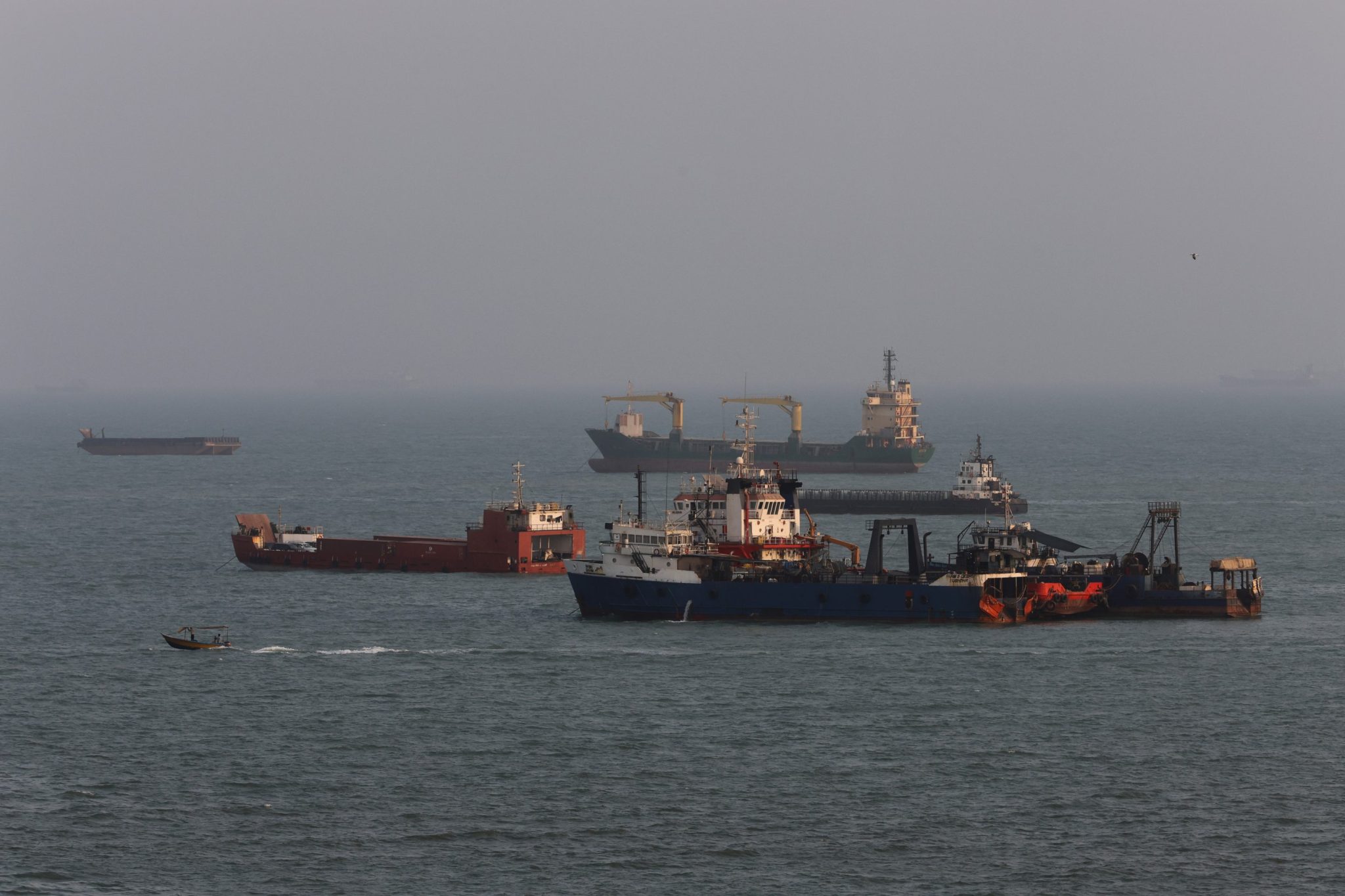
Iran will not allow military vessels to transit through the Strait of Hormuz under an agreement the Islamic Republic is currently negotiating with Oman, Iran’s Deputy Foreign Minister told state TV late on Tuesday night.
The top diplomats of the two countries met to discuss managing commercial shipping traffic in the vital waterway, which remains largely shut down nearly six months after the Iran war began.
Officials in Thailand said the USS Lincoln was scheduled for a brief stopover in the country as the aircraft carrier prepares to reposition after a lengthy deployment, including support for the Iran war.
Meanwhile, Israel’s strikes continued in Gaza, testing the already fragile ceasefire with Hamas.
Here’s a look at the latest developments in the Iran war and the wider Middle East. Full coverage can be found here.
No military vessels will transit through Hormuz, Iran says
Iran and Oman have reached an understanding on a new framework for managing ship traffic in the Strait of Hormuz that would exclude military vessels, Iranian Deputy Foreign Minister Kazem Gharibabadi told state TV late on Tuesday night.
“If the understanding becomes binding, no military vessel will be permitted to pass through the Strait of Hormuz,” he said. “No military vessel at all.”
Gharibabadi didn’t provide further details about military traffic. He described the proposed commercial route through the Strait of Hormuz, the vital shipping waterway.
Traffic into the Persian Gulf from the Gulf of Oman would pass entirely through Iranian waters, while the outbound route would pass partly through Iranian waters and partly through Oman’s territorial waters, he said.
The Trump administration told Oman it opposed parts of the evolving deal, including the joint Iranian and Omani management of the exit route out of the passage that’s critical to global supplies of oil and natural gas.
U.S. President Donald Trump last week threatened to bomb Oman if it “gets in the way.”
Israel launches deadly strike in Gaza, health officials say
An Israeli strike on a tent for displaced people Wednesday in southern Gaza killed one person and wounded at least four others, according to officials at the territory’s Health Ministry. The Israeli military said it struck a “military operative,” without elaborating.
Even as U.S. efforts to advance the fragile ceasefire in the nearly three-year Israel-Hamas war continue, Palestinians in the strip have reported a surge in deadly Israeli strikes.
Israel has said it targets Hamas and other militants who pose a threat, as well as those who participated in the Oct. 7, 2023, attack that triggered the war. About 1,200 people, mostly civilians, were killed that day in Israel and 251 abducted by militants. Israel’s retaliatory military campaign in the enclave killed more than 73,400 people, according to the Gaza Health Ministry.
The health ministry, part of the Hamas-controlled government, is staffed by medical professionals and maintains detailed records viewed as generally reliable by United Nations agencies and independent experts. It does not distinguish between civilians and militants.
Traffic at Dubai’s airport dropped sharply during Iran war
Dubai International Airport, one of the world’s busiest travel hubs, said Wednesday it saw a sharp drop in passengers during the second quarter as the war with Iran disrupted air travel and prompted many travelers to choose routes that avoided the Middle East.
The airport recorded 13 million passengers in the second quarter, down 31.3% in passenger traffic in the first-half of 2026 compared to the same period last year, with 31.5 million passengers
Air traffic in the United Arab Emirates and elsewhere in the Gulf region was disrupted by shutdowns and restrictions since Feb. 28. The airport itself suffered minor damage in attacks from Iran.
CEO Paul Griffiths noted, however, that passenger volume has steadily increased each month in the second quarter, and said the momentum is expected to continue in the second half.
“The trajectory now is universally positive,” he told The Associated Press.
US aircraft carrier will stop in Thailand as its Mideast deployment draws to end
The U.S. aircraft carrier USS Abraham Lincoln will make a stop in Thailand after its grueling deployment in the Middle East, Thai officials said, without specifying a date or port for security reasons.
The Lincoln has been deployed during the Iran war. Its very lengthy deployment, including a record-setting uninterrupted time at sea of more than 250 days, raised concerns about deteriorating mental health among the crew.
A statement from the Royal Thai Navy on Tuesday said a short stopover by U.S. Navy ships was for recuperation and that no military exercises would be carried out during the visit.
Germany draws down its mission in Iraq’s Kurdish region
Germany has ended the military mission of its advisers in Iraq’s semiautonomous northern Kurdish region after years of supporting the U.S.-led coalition’s efforts against Islamic State militants, the Kurdish region’s Ministry of Peshmerga Affairs said Wednesday.
The ministry said it held an official ceremony at Camp Stephan at Irbil International Airport to mark the mission’s end. Germany had already reduced its footprint in Iraq but had maintained a small contingent at the base.
The end of the German mission comes as U.S. forces have also begun withdrawing from northern Iraq ahead of a Sept. 30 deadline to end their military presence in the country.
U.S. bases in the Kurdish region have regularly come under attack since the U.S. and Israel launched the Iran war on Feb. 28.
This story was originally featured on Fortune.com