

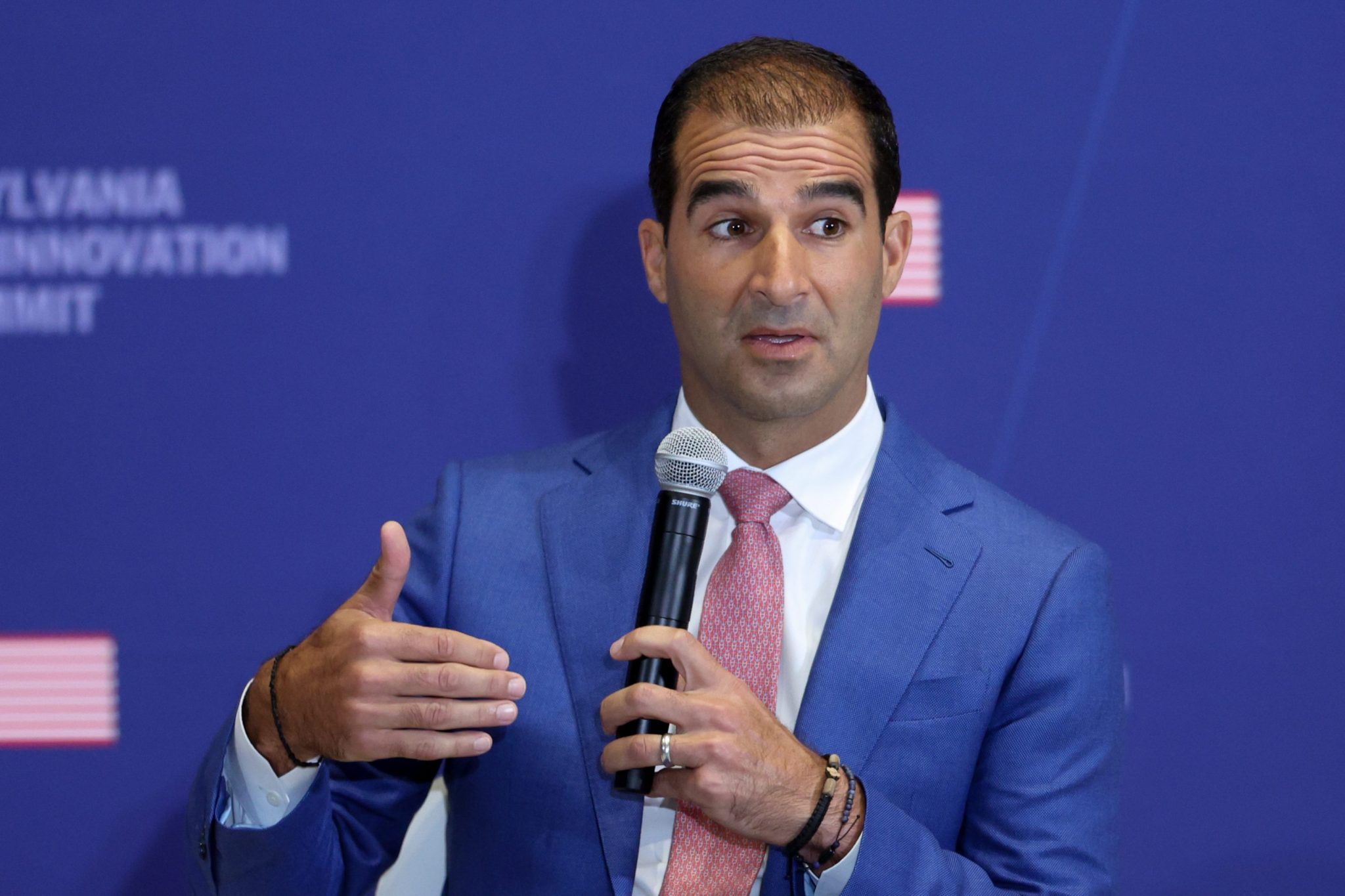
At just 46 years old, Dino Mavrookas’ career already looks more expansive than most, spanning three distinct roles: Navy SEAL, private-equity investor, and now cofounder and CEO of $9.25 defense-tech startup Saronic—proof that your first career doesn’t have to be your last.
His latest career pivot came just four years ago, when Mavrookas was a senior associate at Austin-based private equity firm Vista Equity Partners. However, after half a decade in finance—likely bringing in a six-figure salary—Mavrookas began to question whether he wanted to spend the rest of his career on the same path.
“After five years, I started to look around and say, is this what I want to do for the next 20 or 30 years of my life? Like, I learned a ton about investing. I learned a ton about operating companies, but is this what I wanted my career to be? And the answer was no,” Mavrookas said in a recent interview on the Sourcery podcast.
“I walked into the living room one night and I told my wife that I had to quit my job.”
Mavrookas knew he wanted to start a defense-tech company, but he didn’t yet know what the business would be. What he did know was that he needed to create the time and space to figure it out.
“I just knew that I had to go and focus my energy there, and I wasn’t going to come up with Saronic, or at that point whatever the idea was, if I was working 80 to 100 hours a week at a finance firm,” he said.
That leap has proved to be a lucrative one.
Mavrookas co-founded Saronic in 2022, focusing on the development of autonomous maritime vehicles. The Austin-based firm has become one of the fastest-growing in defense tech, with a $9.25 billion valuation and a workforce of more than 1,000 employees. It is also expanding aggressively: Saronic currently has more than 200 open roles, and earlier this year announced plans for “Port Alpha,” a next-generation shipyard in Brownsville, Texas, that the company says will create 10,000 jobs and generate billions of dollars in investment.
How being a Navy SEAL prepared Mavrookas for entrepreneurship—and the C-suite
For Gen Z workers who feel intensive pressure to map out their entire careers—and pick a trajectory that’s simultaneously AI-proof, lucrative, and also interesting—Mavrookas’ path offers a different lesson: You don’t necessarily need to know exactly where you’re going before making a change.
In his case, each experience built on the one before it, eventually giving him a combination of technical, military, and business expertise that he could bring to the C-suite.
Before his time in finance, Mavrookas graduated in 2003 from Rutgers University with a degree in computer engineering. He then joined the Navy, spending 11 years as a Navy SEAL, including eight deployments and five years on SEAL Team Six.
That high-stakes experience dramatically shaped how he approaches decision-making as a CEO. Mavrookas has said one of the biggest lessons he took from his time as a SEAL was the importance of making decisions with the information available—and then executing quickly.
“A good decision doesn’t always have a good outcome, and a bad decision doesn’t always have a bad outcome,” Mavrookas said in an interview with McKinsey earlier this year.
“You have to focus on the decision-making process. Make good decisions with the information that you have and then execute adeptly. A perfect plan with mediocre execution will lose to a mediocre plan with excellent execution every time. Our goal is to deter a conflict, regardless of when it happens.”
Fortune reached out to Saronic for further comment.
JPMorgan CEO Jamie Dimon says Navy SEAL traits are good for business
Navy SEALs have long been up as a model for speed, execution, and accountability—critical traits that carry into the business world.
In fact, JPMorgan Chase CEO Jamie Dimon has specifically pointed to the SEALs as an example of how he wants small teams inside his 300,000-employee-strong finance giant to operate.
“The teams needed to tackle [specific problems] should be small and authorized with the decision-making ability to move and act like Navy SEALs or the Army’s Delta Force,” Dimon wrote in a letter to shareholders earlier this year. “This is trench warfare; it’s about fighting for every inch, moving quickly, and getting things done.”
Dimon and Mavrookas have another interest in common: shipbuilding. As the U.S. looks to revitalize its domestic construction, Dimon has become increasingly vocal about the need to train a new generation of skilled workers to build the ships.
“We need 300,000 electricians, welders, etc. to build ships in the next five or 10 years,” Dimon told CNBC in July, speaking from the Philadelphia Navy Yard.
“It fits what we call the American dream: getting kids skills or all workers’ skills that they have jobs that could pay 80-, 90-, $100,000 a year after you know a year or two of training. This lifts up America. It helps build the defense industry,” Dimon added.
As Saronic works to expand the shipbuilding industry through its new products and technological advancements, JPMorgan has committed $24 million through loans and philanthropic grants to support a new submarine manufacturing and assembly facility in Philadelphia. The funding is also expected to expand workforce training and apprenticeship programs for “thousands” of prospective welders, electricians, pipefitters, and other skilled trades workers.
This story was originally featured on Fortune.com