


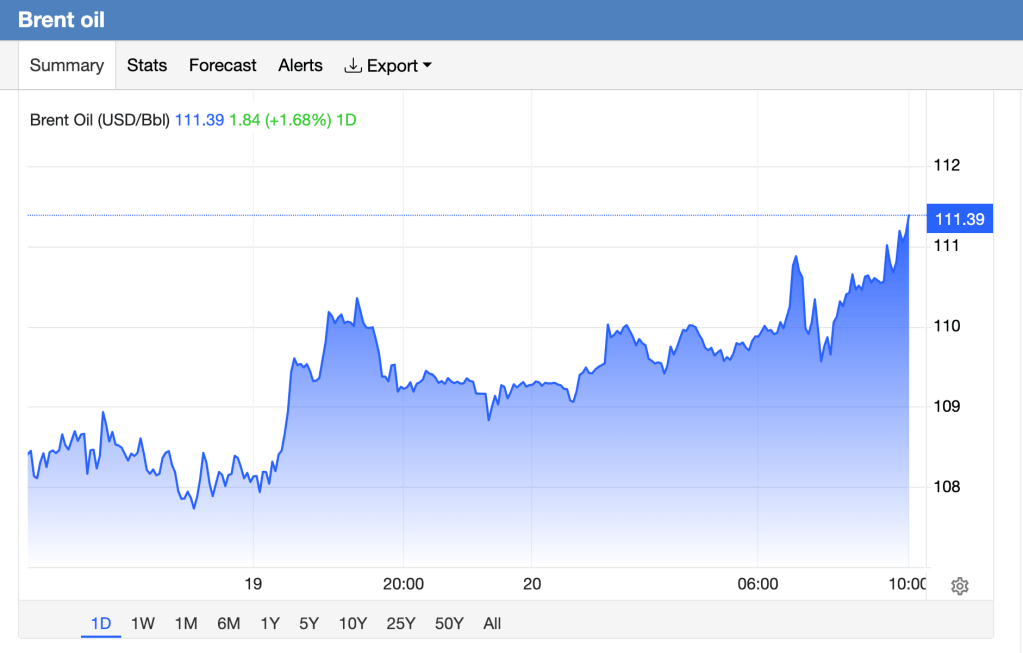
S&P 500 futures were marginally down before the New York open after a tough day for markets in Asia and Europe. Traders sold off after oil hit $111 per barrel this morning, an AI IPO in South Korea lost 30% on its debut, and the yield on the French 10-year bond hit 4.94%, a level it has not seen since 2002.
The bad news began in Asia, with the market debut of AI cloud provider Elice. Its IPO was modest—raising just $150 million—but the fact that its stock tanked upon launch was a reminder that investors have lingering skepticism about AI. Nasdaq futures declined as well.
Although the supply of oil from the Middle East has increased in recent days, its price went up anyway after Saudi Arabia cancelled its Flagship Future Investment Initiative meeting—better known as “Davos in the Desert”—following Houthi attacks on the airport in Riyadh. Alphabet president Ruth Porat, Goldman Sachs CEO David Solomon and BlackRock CEO Laurence Fink had been billed as attendees. The Houthis also struck two tankers in the Strait of Hormuz on Friday.
And then there is France. The government imposed a curfew on major cities last night after nights of rioting and looting on the streets of Paris. Video on social media showed distressed shopkeepers begging young men to stop stealing their inventory—and those young men pushing them aside to grab shoes and food from their shelves. Similar unrest spread to Milan yesterday. “Latest dynamics show signs of global, not just French debt crisis,” Commerzbank’s Christoph Rieger said in a note.
- S&P 500 futures were flat this morning. The index rose 0.41% yesterday.
- In Europe, the Stoxx 600 fell 0.34% in early trading, and the U.K.’s FTSE 100 fell 0.54% before lunch.
- Asia: South Korea’s KOSPI was down 3.73%. Japan’s Nikkei 225 was down 1.30%. India’s Nifty 50 was closed for a national holiday. China’s CSI 300 was down 0.54%.
- Brent crude rose to $111 per barrel, up from $108 yesterday.
- Bitcoin was at $82,769.
Q3 earnings are off to a weak start, Wall Street moans
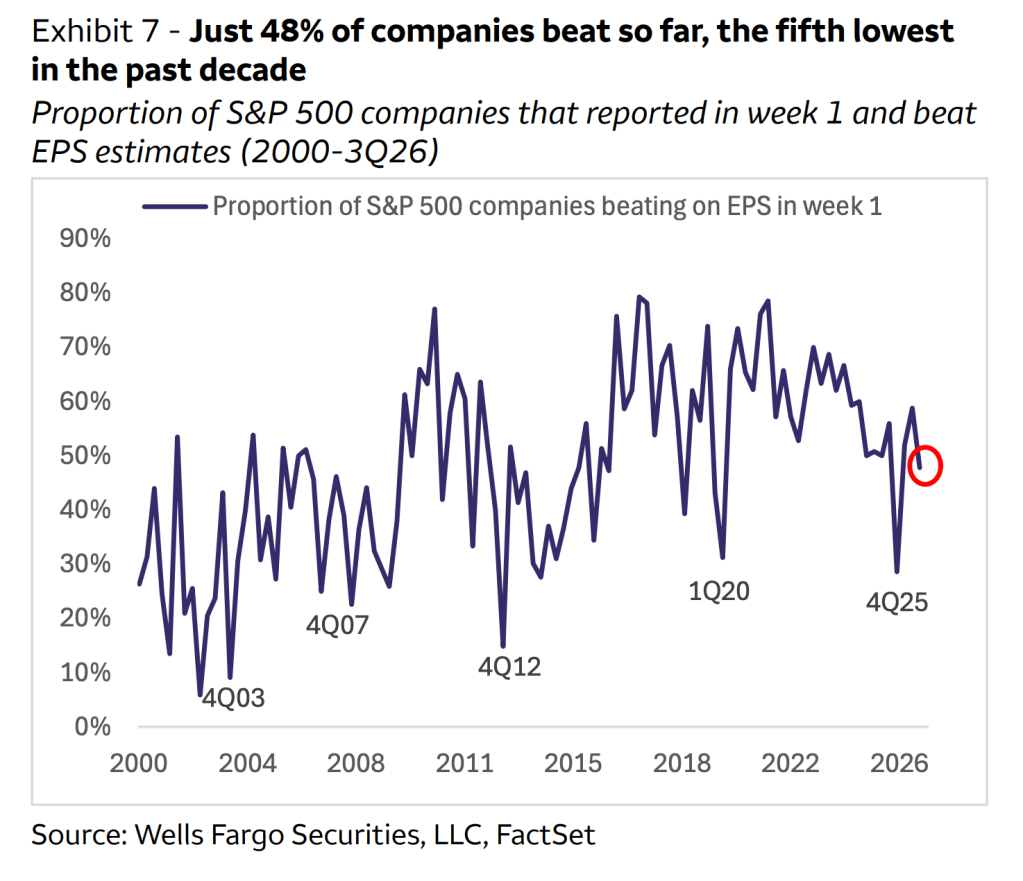
By yesterday, 46 companies in the S&P 500 had reported Q3 earnings. That’s 11% of its market cap. 80% of them beat expectations, according to Savita Subramanian and Victoria Roloff at Bank of America. That’s lower than the 88% beat rate from Q2, they note.
Earnings per share was reported at 0.3% below analysts’ expectations, Ohsung Kwon and his team at Wells Fargo noted, which makes it “one of the weakest starts to EPS season in history.”
How the AI boom might go bust
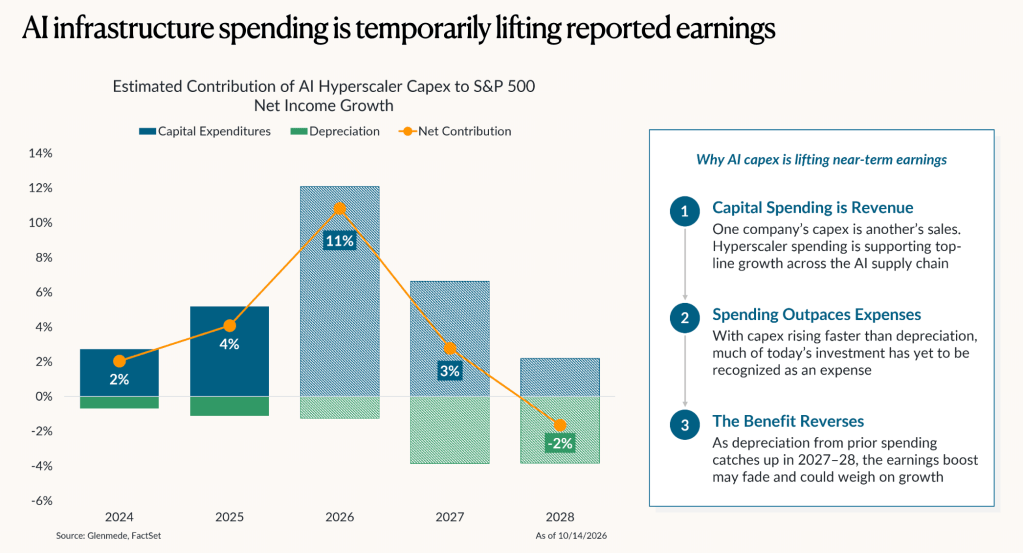
Tech stocks face headwinds that will reduce their earnings per share starting next year, according to Jason Pride and Michael Reynolds at the asset manager Glenmede. As this chart shows, AI capex spending has juiced the net earnings of S&P 500 companies. But that comes with a catch, they say, as capex is recognized immediately as revenue by the companies that receive it but is depreciated over years by the companies that spend it. That delayed bill for the capex depreciators will start to show up as increased expenses on the spending companies’ income statements starting next year, they say.
“In the near-term, that means strong top-line results for AI-spending beneficiaries and a longer tail of costs for the companies undertaking those investments. Glenmede estimates this phenomenon is boosting profits for the S&P 500 by 9% in 2026, though it may start to become an earnings headwind as the depreciation costs build into 2028,” they said in a recent note.
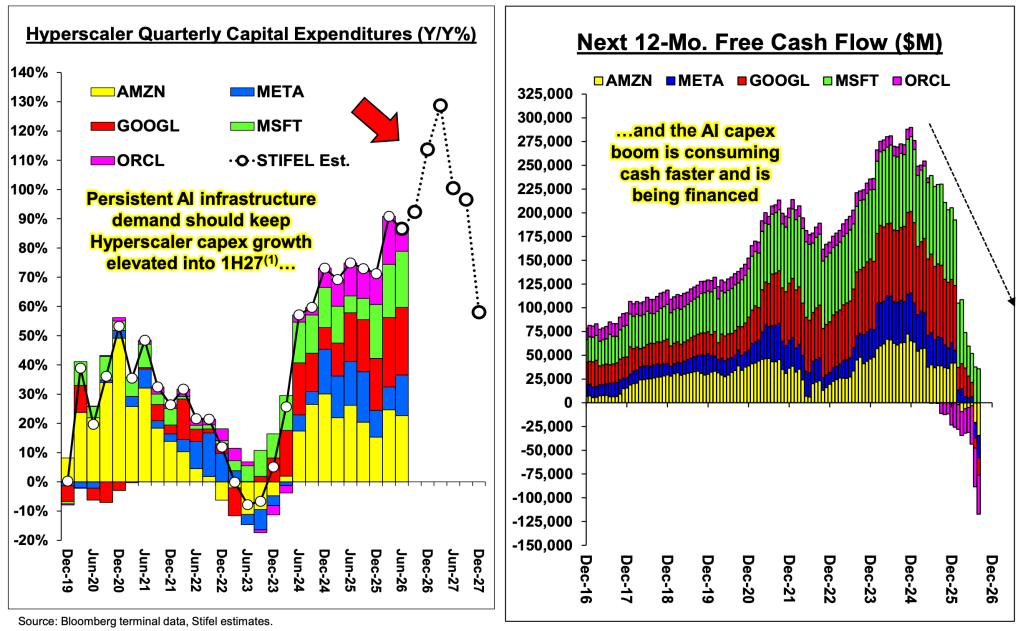
At the same time, the capex boom will inevitably run down. The major hyperscalers are forecast to go cash flow negative, in aggregate, this year (because they are increasingly funding their capex with debt), and capex budgets as a whole are forecast to get smaller next year, according to Stifel:
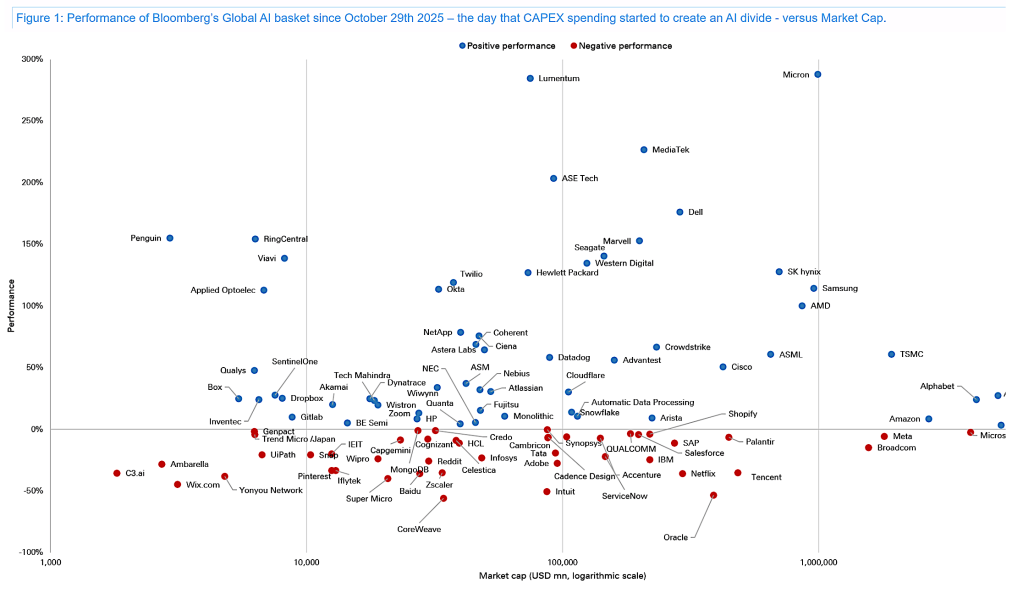
As the AI trade has divided companies into the “spenders and sellers,” the sellers have been the winners, Deutsche Bank’s Jim Reid told clients yesterday. Looking at over 100 different tech stocks since October 2025, “the basket is up around +18% since, but that headline hides a market that has spent the year sorting AI exposure into those who pay and those who get paid,” Reid wrote.
“The companies writing the AI cheques have generally gone nowhere,” he said in a note. For instance, Microsoft is down 2%, Meta down 6%, and Broadcom down 15%. But the companies benefiting from their largesse have done very well indeed: SK hynix and Samsung are up over 100%; TSMC is up 60%.
Read the full digital edition of today’s Fortune 500 Digest here.
This story was originally featured on Fortune.com