

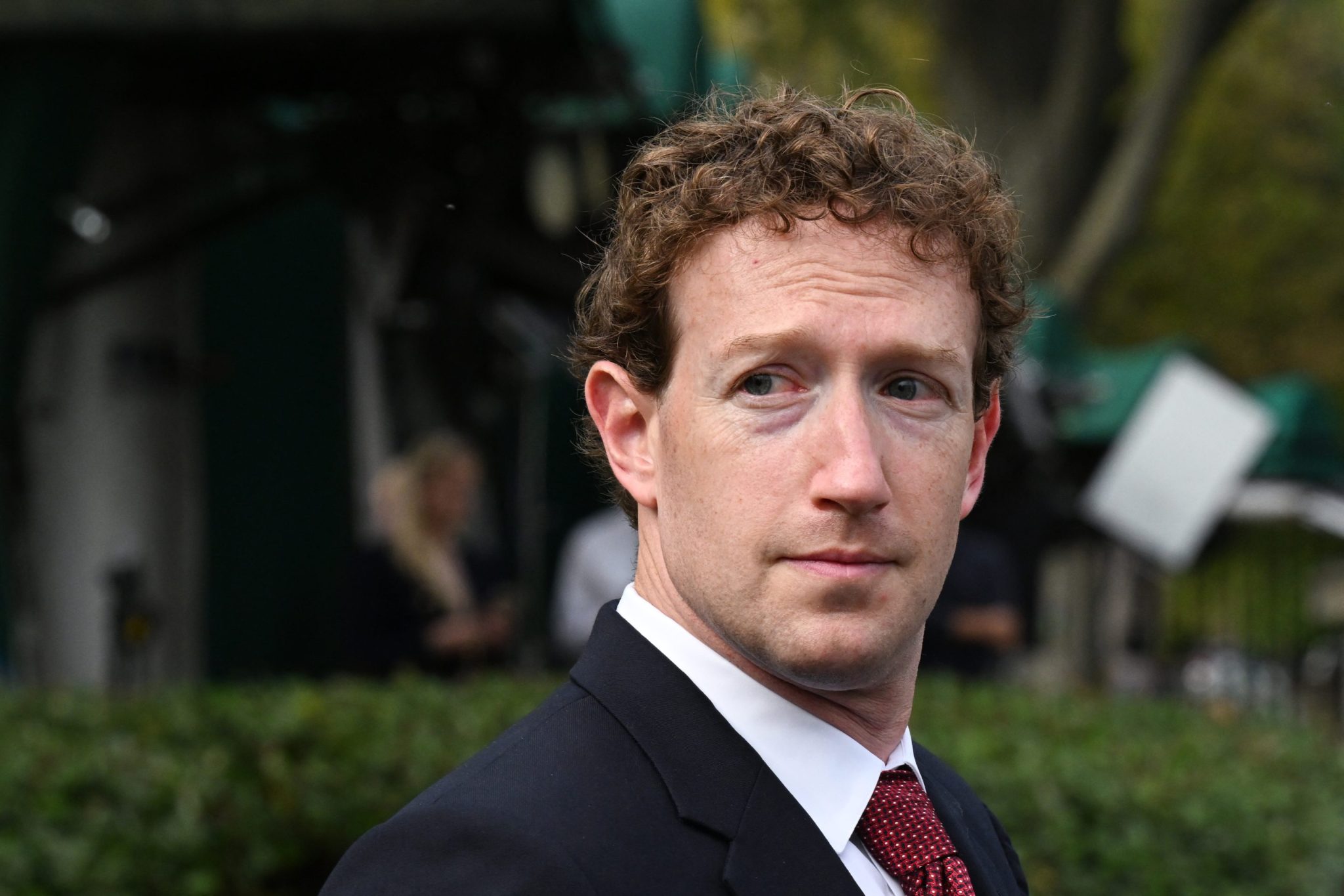
Mark Zuckerberg’s Meta Platforms grew revenues 26% year-over-year in the third quarter, topping analyst targets, but saw its operating margin cut in half due to billions in legal payments to settle litigation over its product’s impact on teen mental health.
Investors focused on the company’s revenue growth and the traction of its new AI tools, sending shares up more than 5% in after hours trading on Wednesday.
“Our investments are paying off, the core business is strong, and we’re seeing velocity across the board,” Zuckerberg said in a prepared statement on Wednesday.
Meta’s third-quarter revenue rose 26% to $64.6 billion, above the $63.3 billion analysts expected, according to Visible Alpha consensus from S&P Global Market Intelligence. And the company forecast revenue for the final quarter of the year to range between $73 billion and $76 billion, compared to the $73.75 billion expected by analysts.
But Meta’s operating income of $13 billion was down 37% from the $20.5 billion it posted in the second quarter of 2025 as a result of a $10 billion settlement Meta struck with a group of attorneys general over youth safety. The terms of the settlement will see Meta pay about $18 billion to the states over the next decade, depending on cooperation from TikTok and Google’s YouTube. Without the charge, operating income would have been $22.9 billion and earnings of $7.40 a share, rather than $13 billion and $3.83.
Net income in Q3 totaled $9.9 billion, or $3.83 a share, versus $2.7 billion, or $1.05 a share in the year-ago period.
Meta is plowing unprecedented amounts of capital into AI infrastructure and services, joining companies like Alphabet, OpenAI, and Microsoft in a race to develop the most advanced AI models. To continue funding the AI effort, Meta said it would re-allocate investments from its money-losing virtual reality business, Reality Labs, and create a new class of stock.
Hours before the results, news broke that a New Mexico judge ordered the company to pay $25 billion in penalties related to the Cambridge Analytica data privacy scandal. A jury previously found more than 43 million violations, which meant Meta’s penalty could have been nearly $220 billion. Meta plans to appeal. The results also come a week after Meta’s Superintelligence Labs launched Muse Wonder to the public, its first frontier model.
Capital expenditures, which have tech investors on tenterhooks, clocked in at $34.9 billion, compared to $31 billion in the second quarter and $19.4 billion a year ago. Meta slightly tweaked its full year capex guidance to $135 billion to $145 billion, from $130 billion to $145 billion.
Melissa Otto, global head of Visible Alpha research at S&P Global, wrote in a note before the results that consensus capex for 2026 had risen more than $14 billion since April to about $140 billion—almost double 2025. She noted that investors continue to want clarity on how that spending will translate into shareholder returns.
Overall in tech infrastructure spending, capex is expected to continue ballooning in 2026 to $790 billion, according to Otto, almost double what it was in 2025 at $404 billion. And it won’t stop there. For 2027, capex is expected to rise to $1.2 trillion, meaning companies will have spent nearly $2 trillion on the AI buildout in two years.
Free cash flow, which has been a sore spot for Meta, was negative $2.1 billion, compared to $784 million in the second quarter and $10.6 billion a year ago.
Hours before the results, news broke that a New Mexico judge ordered the company to pay $25 billion in penalties related to the Cambridge Analytica data privacy scandal. A jury previously found more than 43 million violations, which meant Meta’s penalty could have been nearly $220 billion. Meta plans to appeal. The results also come a week after Meta’s Superintelligence Labs launched Muse Wonder to the public, its first frontier model.
This story was originally featured on Fortune.com