

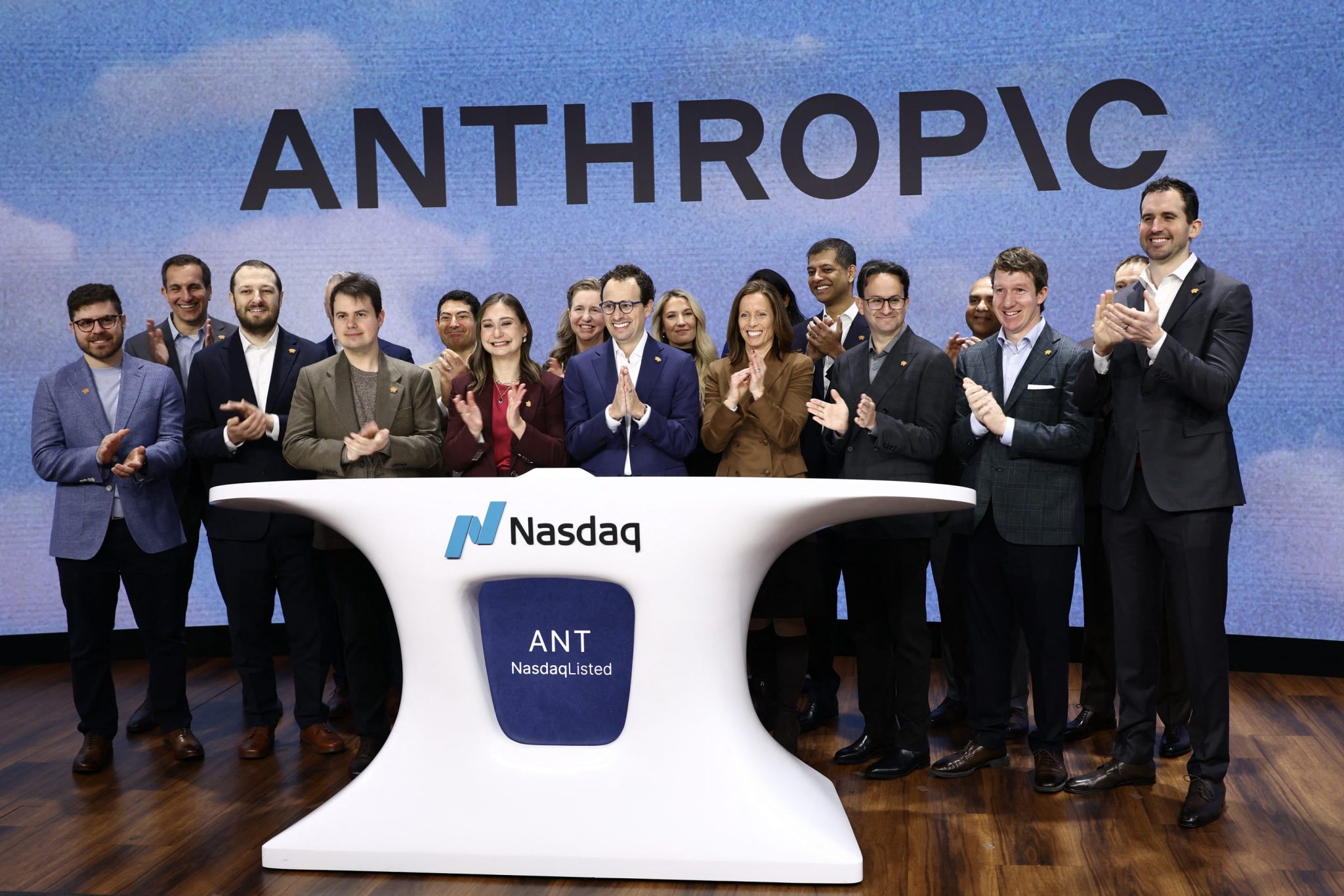
Anthropic’s stock surged more than 30% in first minutes as a public company, a roaring debut that crowned the AI company—at least briefly—with a stunning, $2 trillion market cap.
Shares of Anthropic opened at $111.50 per share on Thursday, up 34% from the $83 IPO price. The stock pop began to moderate somewhat as the trading day continued, with shares trading up 18%, at $97.76 per share.
At the $111.50 opening price, Anthropic’s market cap was roughly $2 trillion—an astounding Wall Street debut that instantly puts the five-year-old AI company in the elite club of trillion-dollar public companies.
Shares of Anthropic, under the ticker symbol “ANT,” began trading a couple of hours after the stock market’s opening bell. The strong demand for Anthropic shares came as the broader market was under pressure, with the Nasdaq down 363 points and the Dow Jones Industrial Average down 1038 points in midday trading.
Anthropic priced the offering Wednesday night at $83 a share, above its marketed range of $70 to $78, giving the company a $1.5 trillion valuation. Demand was strong enough that it raised the deal to 980 million shares from 825 million.
There had been endless speculation about whether Anthropic would top SpaceX as the largest IPO of all time. At a $1.5 trillion IPO valuation, Anthropic would be the second most valuable IPO of all time, behind SpaceX’s $1.77 trillion IPO in June. Measured by capital raised however, Anthropic’s $79 billion ($81.4 billion, if stock sold by insiders is included) topped the $75 billion raised by SpaceX.
Seven strategic partners, including Google and Nvidia, have also agreed to buy $26 billion of non-voting Anthropic stock at the IPO price. The deal’s underwriters also have a “greenshoe” option to purchase an additional 147 million shares of Anthropic stock. If exercised, that would bring the proceeds of Anthropic’s IPO to $118 billion.
The offering will provide Anthropic with a vital infusion of capital as it seeks to stay ahead in the AI race and to invest in the computing infrastructure to train its models. It will also make instant billionaires out of numerous Anthropic employees and early investors, particularly the seven cofounders who created Anthropic.
“This moment is bigger than any one company, or any one country. It will take all of us, working together, to ensure this technology goes well for us and the many generations to come,” Anthropic CEO Dario Amodei said in a statement posted on X on Thursday.
Anticipation for the IPOs of Anthropic and its arch-rival OpenAI has been building ever since OpenAI ignited the generative AI boom in late 2022 with the launch of ChatGPT. With OpenAI holding off on its IPO until at least 2027, Anthropic becomes the first pure-play maker of frontier AI models to go public (SpaceX also does rockets, and Google and Meta both have massive businesses in search and social media).
But the Anthropic IPO also comes at a tenuous time for the AI industry. It’s been barely a week since the AI industry lost one of its most powerful figures. Nvidia co-founder Jensen Huang resigned as CEO last Thursday, following reports that he had engaged in two extramarital affairs: one with a customer suspected by U.S. intelligence of being a Chinese intelligence asset, and one with an Nvidia executive who reported to him. His exit added fresh pressure to a listing that was already seen as a stress test of investors’ appetite for AI.
Analysts and investors told Fortune they didn’t expect the Nvidia shock to derail the offering or touch Anthropic’s core business. The bigger risk, they said, may come later. Seaport Research Partners analyst Jay Goldberg warned that turmoil at Nvidia could bring Anthropic “much tougher questions” once it starts reporting quarterly results as a public company. Georgetown’s Jason Schloetzer predicted closer scrutiny of Anthropic’s ties to Nvidia and to customers associated with the chipmaker.
Anthropic CEO Amodei, once the VP of research at OpenAI, left to cofound Anthropic at the end of 2020, along with sister Daniella and several other OpenAI employees, when they became disillusioned with OpenAI’s approach to AI safety. Still, the company’s IPO prospectus is replete with warnings of the potential dangers posed by artificial intelligence including “catastrophic or existential risks to humanity.”
The IPO also comes amid growing public backlash to AI data centers, underscored by the results of the U.S. midterm elections. High profile incidents of rogue AI agents, by OpenAI as well as Anthropic, have added to the unease over the technology.
The stakes reach well beyond one company. Anthropic has more than 400 backers, and nearly every major venture firm owns a piece of it, so the IPO is effectively a liquidity event for the AI boom itself. A strong debut and a stable stretch of trading afterward would suggest the boom has more runway. A stumble would be read as a sign the bubble is near its peak. At least one investor argued that Huang’s departure could even help Anthropic: CEO Dario Amodei had clashed with Huang over chip exports to China and over AI regulation.
There was tremendous demand for Anthropic’s shares, according to news reports. Bloomberg News cited Anthropic’s underwriters as saying the shares were as much as seven times oversubscribed and that only about half of the institutional orders for shares were filled. The company had reserved about 20% of its shares for retail investors and those investors had reported that they had begun to receive their allocations through brokerage platforms such as E*Trade, Charles Schwab, SoFi, and Fidelity.
Several Wall Street research firms, including Wolfe Research, Citizens, and Melius Research initiated coverage of Anthropic with buy ratings.
This story was originally featured on Fortune.com