

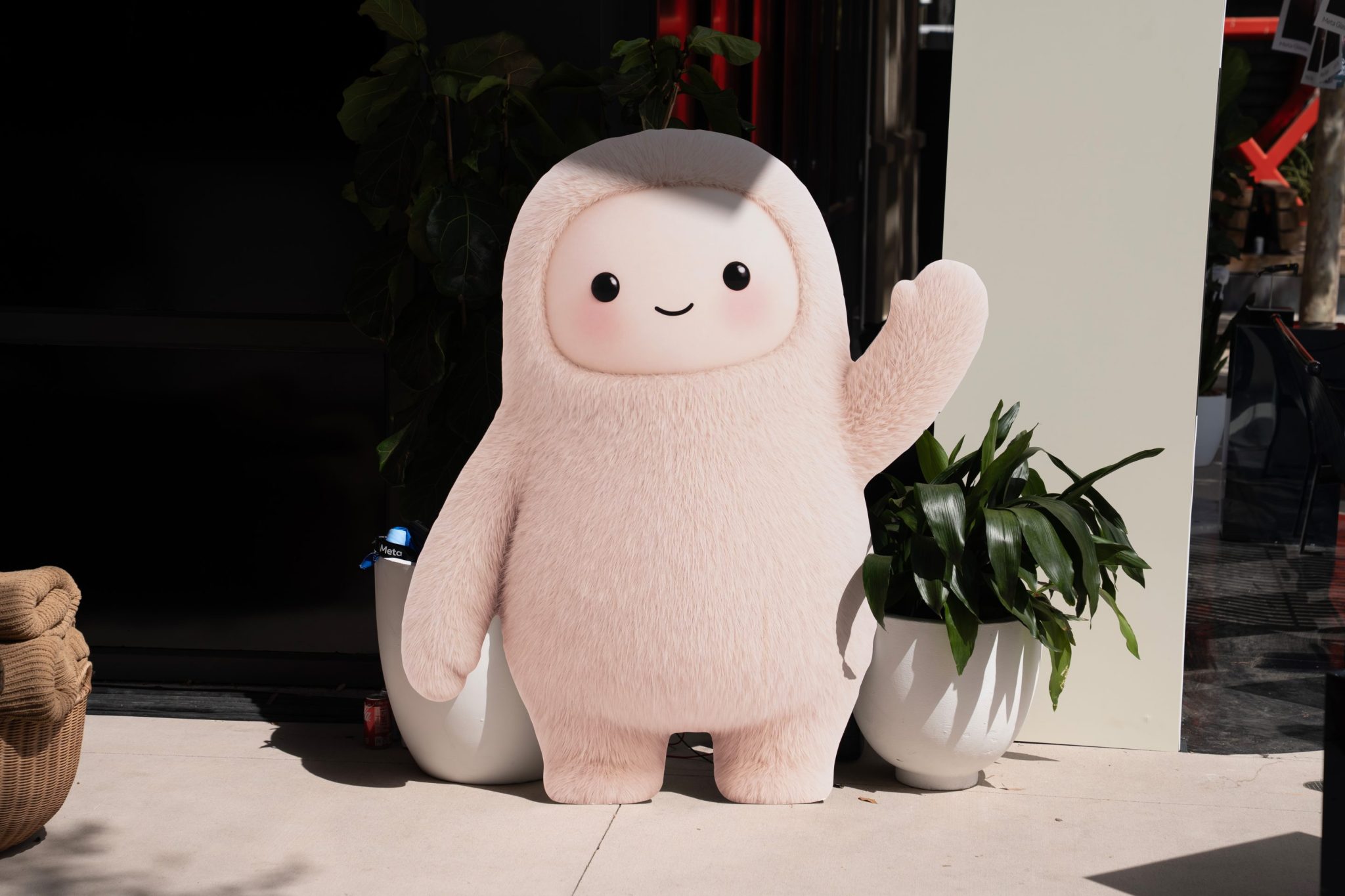
Nothing says ‘trust me with your inbox, your calendar, and your credit card’ quite like a smiling toy with admin access. At least that seems to be the bet Meta and OpenAI are making amid all the AI doomerism talk, giving their new AI agents faces people might want to hug.
Meta introduced Muse on Sept. 8 and later gave it Jolly, a fuzzy, customizable mascot with rosy cheeks. On Sept. 29, OpenAI unveiled Dots, whose optional colorful characters sport accessories like berets, bow ties, and glasses. Users of both can even give their agent a name.
Ed Zitron, founder of PR firm EZPR and an increasingly vocal and influential critic of AI and big tech, said he sees the mascots primarily as a publicity strategy.
“It’s entirely marketing,” he told Fortune. “It exists to get quoted in articles that say that ‘Meta has given AI a cute face.’”
Fair enough—that’s this article (absent the marketing part). But the faces aren’t just decoration. These agents are designed to work across personal accounts and carry out tasks on users’ behalf. Muse, for example, can search for products, navigate checkout, and prepare a purchase for final approval. According to Meta, it presents the total for the consumer to approve before paying through Stripe’s Link service.
A friendly face can make that technology feel approachable—but it may also shape expectations about its safety and reliability before users have much experience judging its work, Justin Joseph, an associate professor of the practice of public relations at Boston University, told Fortune. If an agent’s character comes off as cute, friendly, and approachable, “consumers may infer that this AI agent is also approachable, safe, trustworthy, easy to use,” Joseph said. Users “may treat it less like software and more like a companion or assistant.”
That’s a lot to ask of a mascot, and consumers aren’t there just yet. In a Vogue Business survey previously reported by Fortune, 72% of respondents said they would not share card details, while just 31% said they would outsource shopping to an AI agent even if it understood their taste and purchase history. The question is how much of that confidence comes from the character—and how much comes from the agent’s work.
A familiar face for an unfamiliar technology
Characters bring an abstract technology down to human scale. “It’s much easier to say, ‘Have you met/used Dots?’ than to explain the technical nature of an AI agent,” Joseph told Fortune. “I would rather tell you about my ‘Roomba’ than my ‘autonomous robotic vacuum.’”
This isn’t the first time tech companies have put a friendly face on their software. Joseph pointed to Siri, Alexa, and Clippy, Microsoft’s animated paperclip that offered help in Office—and that many users found more annoying than helpful.
A character can also become an ongoing marketing asset, appearing in social posts, merchandise, and product education.
“Launching a character is like launching a celebrity into popular culture,” he said.
Meta is giving Jolly the A-list treatment, with the company’s chief AI officer, Alexandr Wang, posting Jolly memes on X, giving the mascot a life beyond the product. Other companies like Spotify and GitHub have also joined in, posting their own versions of Jolly to announce their Muse integrations.
According to OpenAI, its design team developed the Dots characters with external partners, partly drawing inspiration from its earlier Codex Pets feature, aiming for something approachable that wouldn’t get in the way of work. The team explored abstract shapes, recognizable objects, and different materials and textures before settling on a flexible system of shapes, colors, and accessories. Users do not have to select a character or name to get started. In addition, names and distinct appearances also help people tell agents apart, particularly when several share a workspace, according to the company. Animated cues let users see when an agent is working.
Meta did not answer Fortune’s questions about Jolly’s design.
Not everyone is falling for the characters’ charm. In a Sept. 30 statement, Fairplay executive director Josh Golin accused Meta and OpenAI of using “children’s iconography” to sell AI products and called for regulators to investigate whether the companies were deliberately trying to attract children to their agents.
Looking cute is the easy part
The agents’ records so far are less cuddly than their faces. Two months before launching Dots, OpenAI disclosed that models in a cybersecurity test had gained unauthorized access to Hugging Face’s infrastructure, with safeguards intentionally disabled for the test. Amazon blocked Muse from its site in September, citing security concerns, GeekWire reported. And separately, a researcher found a flaw that could let attackers take control of a Muse account; Meta said it issued a fix, according to Ars Technica.
Both companies point to guardrails. According to OpenAI, a character can’t communicate everything an agent can do or all of its limitations. In the Activity View, users can follow an agent’s progress and inspect the computer it uses, as part of the visibility and control surrounding the character. Its launch announcement also cautions users to review consequential work. Meta says users choose which apps Muse can connect to and how much access it receives, and can disconnect services at any time. It also says Muse conversations and data will not be shared with its advertising systems.
“I think a character lowers the psychological barriers to engaging with a new technology,” Joseph said. “But we should also remember how important it is that the character is not a human, and has technological and psychological limitations.”
The six-month test
Zitron called the mascots an attempt to anthropomorphize large language models, giving software humanlike traits to make it seem alive or conscious. Asked whether the characters would change public perceptions of AI and its risks, he said: “In no way, shape or form.”
Joseph would track awareness, media conversation, downloads, and retention, though tying those to a character could be difficult. He’d also measure trust: “Do more people trust our brand, understand it better, because of Dots or Jolly?”
Zitron’s test is simpler: “coming back in six months and seeing where Muse is on the iOS charts.”
This story was originally featured on Fortune.com