

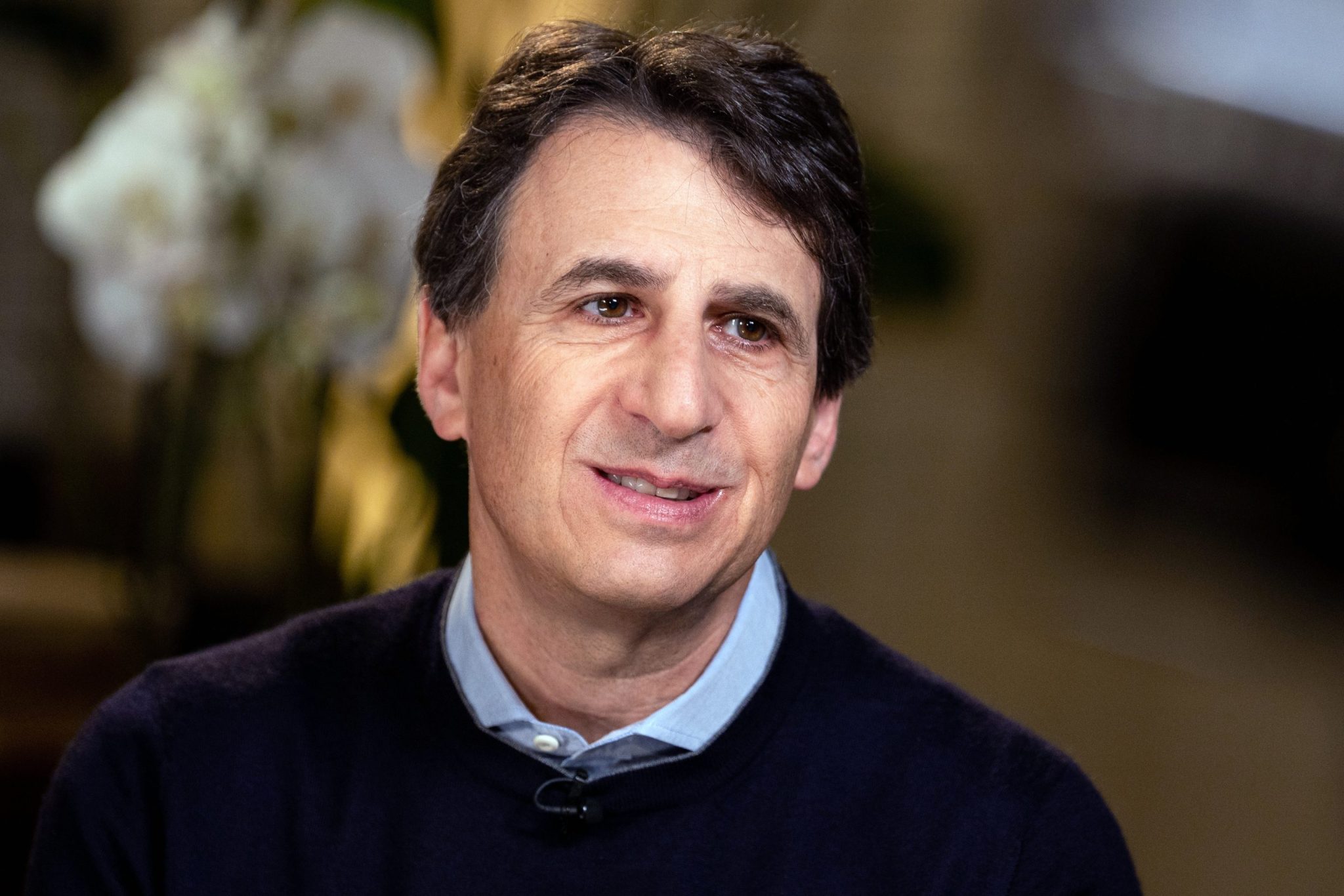
Long before they were running multibillion-dollar companies and joining the ranks of the ultrawealthy, some of the business world’s top players were flipping burgers and working the front desk. Marc Rowan, the cofounder and CEO of Apollo Global Management, juggled a slew of hospitality and retail gigs before leading the $79 billion investment giant.
“I’ve had a lot of different jobs,” Rowan recently told iCapital CEO Lawrence Calcano during a podcast. “I was a valet parker at the Diplomat Hotel—now, the Shell Bay Golf Club. I would drive cars between New York and Florida for snowbirds, transporting their cars for the winter.”
Rowan grew up bouncing back and forth between Florida and New York, attending high school in the sunshine state’s coastal town of Hollywood. Alongside driving cars up and down the eastern coast, he also spent his early working years manning a party goods store and “the best kosher caterer” in South Florida.
By the time he graduated high school in 1980, the federal minimum wage stood at just $3.10 per hour—a standard often applied to service-sector jobs. It’s a far cry from the $11.1 billion fortune he’s built for himself since, but Rowan says he’s carried those early-career experiences with him throughout his four-decade financial come-up.
“Every one of those jobs, you have to take something away from,” the Apollo CEO said.
Fortune reached out to Apollo for comment.
Rowan’s financial career—from a NYSE runner to CEO of a $79 billion firm
After those early jobs, Rowan dove head-first into finance.
Although he was raised by a family of lawyers, he decided to take a different path after seeing the “terrible” coursework for his pre-law program. So he called up the University of Pennsylvania’s Wharton School of Business and asked if he could still go. Rowan attended the Ivy League college, where it all “just made sense.” He had finally found his calling, and it was only a matter of time before he became one of the most influential figures on Wall Street.
“When I started getting a little bit of education, I worked at Booz Allen for a summer in financial consulting,” Rowan continued in the podcast. “I worked on the floor of the New York Stock Exchange—it was then the Blue Room—as a runner.”
Rowan’s “first real job” after receiving his bachelor’s and MBA was at Wall Street investment bank Drexel Burnham Lambert. He joined the mergers and acquisitions department at the end of 1984, but in just a few short years, his employer went belly-up. The firm collapsed in 1990 following the junk bond crisis, and in the aftermath, Rowan was set on the course for billion-dollar success.
He and two former Drexel colleagues, Leon Black and Josh Harris, joined forces and founded Apollo the same year they lost their jobs.
In the decades since, they’ve grown Apollo into one of the world’s largest alternative asset management firms following the 2008 financial crisis. Rowan ascended to the CEO role in 2021, and its assets have swelled to over $1 trillion earlier this year. The 62-year-old has also served as the chair of the board of advisors of the Wharton School of Business and also funded the launch of the Penn Wharton Budget Model, a nonpartisan research venture analyzing the fiscal impact of public policy.
The world’s most powerful leaders once worked average jobs
The rise to the top of the C-suite isn’t always defined by family connections and elite credentials. Some of the world’s most successful business leaders once worked ordinary hourly jobs before taking on corner offices.
Marvin Ellison, the chief executive of $122 billion home-improvement giant Lowe’s, got his start making just $4.35 per hour working part-time at Target while studying at the University of Memphis. Now, he’s president, CEO, and chairman of the home-improvement giant—just one of only 11 Black Fortune 500 leaders. He credits his success to taking on jobs and assignments that “nobody else wanted” throughout his decades-long career.
“I didn’t have great pedigree, I didn’t have an Ivy League education. I didn’t have any stellar international opportunities or stints on my résumé,” Ellison said in a 2022 interview. “I’m competing against all of these exceptionally talented people on paper; I had to find a way to differentiate myself.”
While studying at Yale University, former PepsiCo CEO Indra Nooyi worked night shifts to cover the costs of her college degree. Instead of spending evenings socializing like her peers, Nooyi worked as a dormitory receptionist from midnight until 5 a.m.—an experience that she says contributed to people’s respect for her determination and work ethic.
“When we got consulting jobs or investment banking jobs, people looked at us and said, ‘Hey, these are brainiacs,’” Nooyi said in an interview with former U.S. Secretary of State Condoleezza Rice earlier this year. “Respect just went up—purely because of the hard work and all the efforts we put in…People realized that this was a grueling experience for us, and they respected us for that.”
Even Tim Cook, the CEO of one of the most valuable companies in the world, worked normal jobs before heading up the $4.49 trillion firm Apple. As a kid, Cook was a delivery boy tossing newspapers onto front lawns in his small hometown of Robertsdale, Alabama. By 14, Cook says he “graduated to flipping burgers” at a local joint, and served ice cream at Tastee Freeze. The executive recalled that his classmates would drop by and “make fun of him” in his little hat and apron, making $1.10 an hour. And while getting his MBA at Duke University, Cook worked during the day and went to school at night to cover his tuition costs. Thanks to the work ethic his parents instilled in him, he would later go on to lead one of the world’s biggest tech companies, his net worth ballooning to $3 billion.
“My upbringing was centered on work and the belief that hard work was essential for everybody, regardless of your age,” Cook shared on the Table Manners podcast last year.
This story was originally featured on Fortune.com