

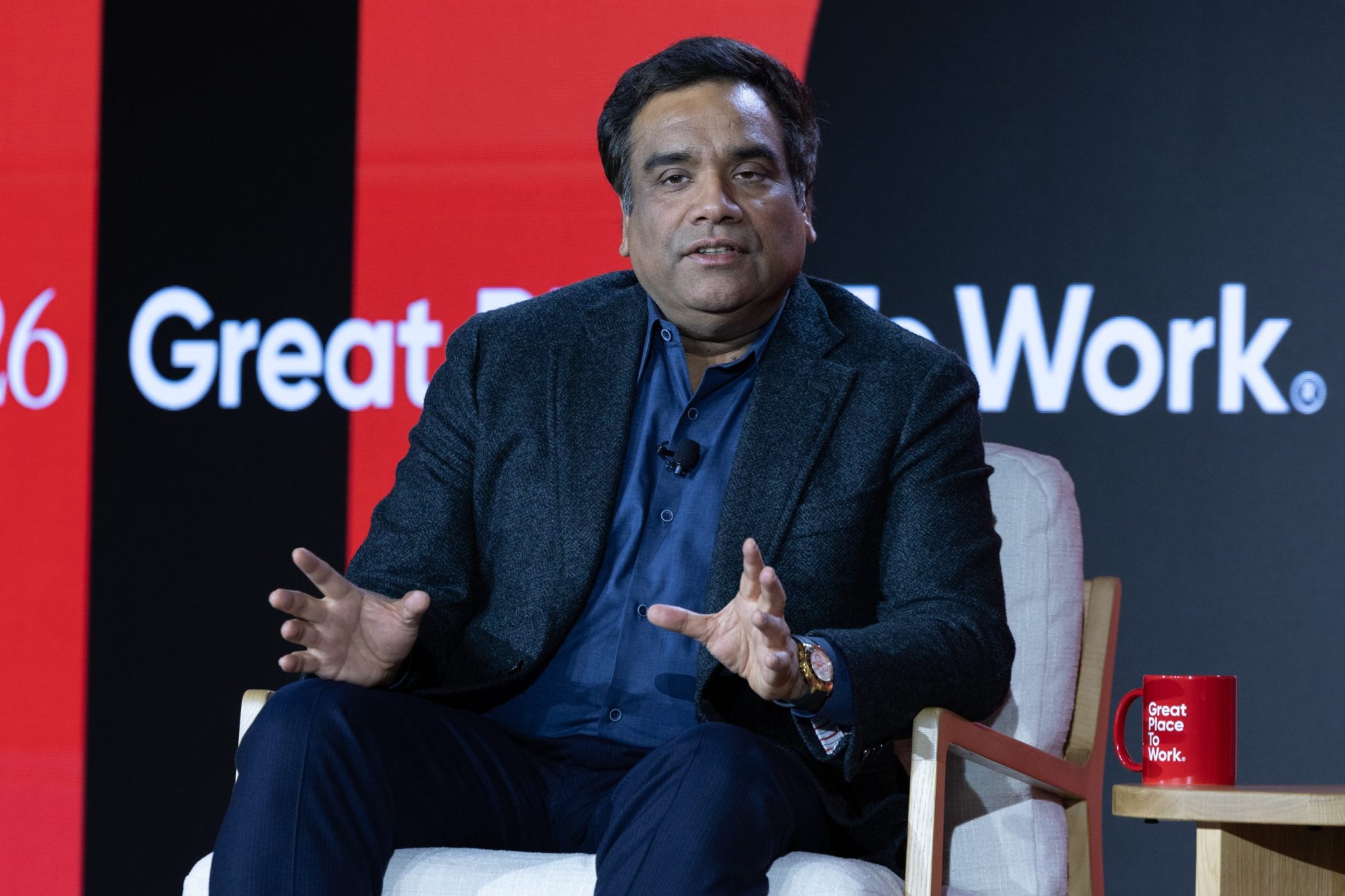
Anirudh Devgan has a theory about why smart people keep making the same mistakes.
Every generation faces a new wave of technological disruption and responds with the same blend of overconfidence, short-termism, and reluctance to let go of what’s working. The internet did it. The mainframe era did it. AI is doing it now.
“The technology always evolves faster,” he told Fortune backstage at Great Place to Work’s For All Summit in Las Vegas, when asked about the pace of change.
“I’ve had this debate so many times,” Devgan said, sighing in a slightly professorial manner, fittingly attired in a tweed blazer. He allowed that technology has given humans more options, but argued they are still the same human beings underneath.
“There are more tools, but the human part is not different,” he said.
What makes Devgan’s perspective unusual is that he’s not a philosopher: He’s an engineer at the center of the AI build-out. As president and CEO of Cadence, the $90 billion-plus electronic design automation company whose software underpins the chips in everything from iPhones to AI data centers, he has a front-row seat to the most consequential technology boom in history. And he keeps seeing the same human tendencies play out—in corporate boardrooms, in Washington, and in the broader culture of AI panic and AI hype.
AI vs. humanity
Onstage, in conversation with Great Place to Work CEO Michael C. Bush, Devgan sounded a similar tune about why he believes AI is a bit overhyped.
“There is some AI washing going on,” he said, referring to the practice of attributing mass layoffs to AI efficiencies that may or may not exist or ever materialize. “It is a real thing. It is a big, big thing,” he told Bush, referring to projections that the semiconductor market where his customers operate was supposed to hit $1 trillion by 2030, but Devgan said it’s set to hit $1.2 trillion this year—impressive when you consider that in 2025, global semiconductor sales were roughly $793 billion, according to the Semiconductor Industry Association.
“Because of AI, the whole industry is going much faster,” he continued. Devgan’s levity may be a big part of why Cadence ranked No. 11 on the 100 Best Companies to Work For list in 2026.
Backstage with Fortune, Devgan dismissed the idea that AI is unlike anything we’ve ever seen, even as he hailed its breakthroughs. He kept coming back to a constant refrain: Humans will be human, no matter what technological changes society undergoes.
“I’ve had this debate so many times,” he said. “And people are like, ‘It’s totally different this time.’ It’s like every generation is disgusted by government.” When he was young, he recalled, he wondered, “Why do all these old people keep talking about government?” But every generation has to discover the same things anew, seemingly.
Data centers aren’t the real crisis
That framing helps explain why Devgan is relatively unbothered by one of the loudest anxieties in tech right now: the idea that AI data centers will strain electric grids, spike utility bills, and ultimately prove energetically unsustainable.
He sees it as a classic first-derivative mistake—projecting a straight line from current conditions and ignoring the human ingenuity that always bends the curve. Calling it a “first-derivative projection,” he said people extrapolate from the data-center boom onto a spike in utility bills, “but human innovation always saturates.” He predicted software efficiencies alone—not quantum computing, not new energy sources, just better algorithms—will deliver the 10x improvements in AI computation that make today’s projections obsolete.
“It always happens in software,” the Silicon Valley veteran told Fortune. “One software change can give you 10x improvement.”
Balance sheet philosophy
Cadence is careful with its balance sheet and debt. The company posted more than 14% revenue growth and roughly 45% non-GAAP operating margins in fiscal year 2025, making it one of the most profitable companies in tech. And yet even from that position, Devgan said he deliberately sets aside 20% of investment for what comes next—recent bets including a $3 billion acquisition of Hexagon’s design and engineering business.
“The best time to do this is when you’re doing really well,” he said, “because the typical mistake is when you’re doing really well, you will just try to milk what you have.”
What’s next for tech
On the question of what comes next, Devgan gets expansive. He called Waymo “the biggest breakthrough in AI in the last five years”—a window into a $3 trillion to $4 trillion global transportation industry on the verge of total transformation. He estimated 25% of downtown Los Angeles currently consists of parking lots—real estate that should become available the moment self-driving goes mainstream. On defense, he said he sees the industry being “completely redesigned for autonomous”—noting the absurdity of a $1 million missile being fired in Iran to knock down a $30,000 drone. Robotics and drug discovery are the next frontiers, for him: “We can’t even imagine how different the world is going to look.”
And yet, in the same breath, he returns to his anchor: Human nature doesn’t change. Kids today have the same worries about careers and friendships that his generation did. The nostalgia for previous eras is always misplaced. The warnings about disruption are always slightly overblown, the timelines always slightly wrong—self-driving cars were supposed to arrive in 2012, he noted, and they’re only arriving now.
Onstage with Bush, Devgan framed this not as pessimism, but as a kind of operating principle. His biggest worry about AI adoption, he said, isn’t the technology—it’s the disconnect between executives who are enthusiastic and employees who are skeptical.
“The enthusiasm is very high at the leadership level,” he said, “but there’s more skepticism at the employee level—and that’s the real thing.” His advice to leaders: Stop positioning AI purely in terms of margins and efficiency.
“We need to bring everybody along and do it in a truthful manner, right, in a transparent manner,” he said. Not everything has to be positioned as a question of financial gains or increased margins, he added, but “also how it affects the whole organization.” (In other words, the human part.)
The technology changes the landscape. It doesn’t change the people walking through it. That, for Devgan, is both a comfort—human beings are resilient and adaptive—and a warning. The same patterns that toppled tech titans of yore are visible in the U.S. government today: an institution generating enormous value, refusing to invest in the future, and protecting yesterday’s programs as though the world isn’t about to look unrecognizable.
“You can’t have a country that is not making money with all the strengths that we have,” he said.
This story was originally featured on Fortune.com