

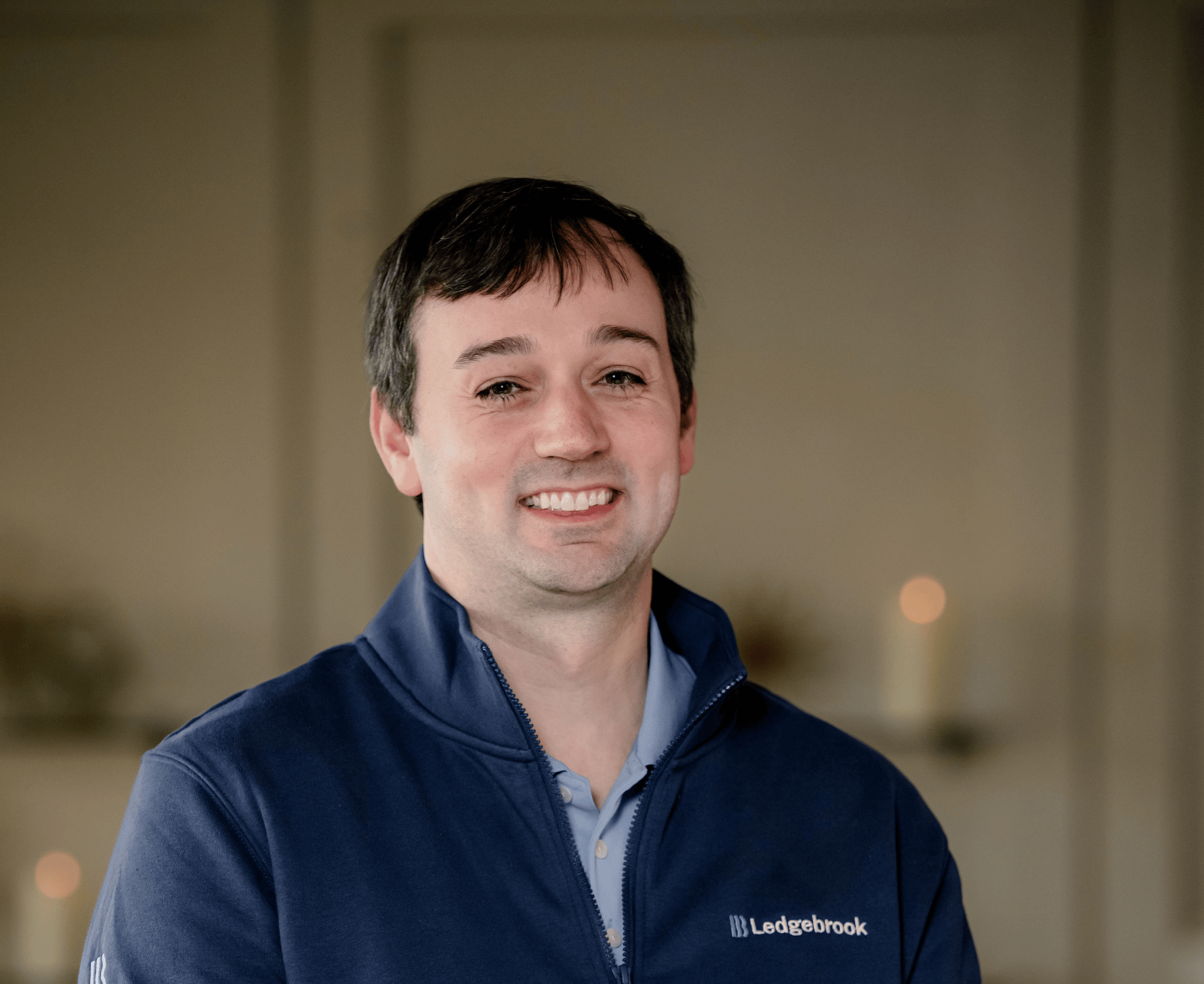
Gage Caligaris said he decided to marry his wife on their first date, during his last month at Harvard. A few years later, he made another consequential decision: leaving Wall Street and starting over as an insurance intern to get closer to her family in Boston.
The math graduate had been trading exotic derivatives in New York, a career he describes as fast-paced and fun. (His LinkedIn profile shows three trader roles, including one at Barclays Capital in New York.) Originally from Yardley, Pa., Caligaris recalled spending a year in a long-distance relationship, riding Chinatown buses between New York and Boston before his future wife moved south to join him.
“I took so many Chinatown buses,” he told Fortune. And he still supports the Philadelphia Eagles.
But her parents lived in Boston, and after about three years on Wall Street, he wanted a route north. He had been considering business school when his younger sister, who had interned in Travelers’ actuarial program, suggested a profession he said he had never heard of.
“She told me it’s a bunch of math tests. You can become an insurance executive if it pans out,” said Caligaris, who studied applied mathematics in undergrad. “And so, armed with those two sentences, I did some Googling.”
That search led him to Liberty Mutual, where he joined as an intern in 2014. Today, the 38-year-old runs Ledgebrook, a Boston-based, AI-native specialty insurance platform, and he has just raised a $200 million financing round co-led by Allianz X and Rockefeller Capital Management. The deal values the company at $2.6 billion after the investment, according to a source close to the company, taking it into unicorn territory for the first time.
The family calculation worked out, too.
“My in-laws still watch the kids every weekend,” said Caligaris, now a father of three. “So that part worked out.”
Inside the cafeteria
Founded in 2022, Ledgebrook provides insurance for midsized businesses with complex or hard-to-place risks. It sells exclusively through wholesale brokers, offering coverage including general liability and professional liability. Its technology helps underwriters assess those risks and decide what to charge, with the company saying it can often provide quotes in hours rather than weeks.
It operates in what the industry calls the excess and surplus, or E&S, market—the home for risks standard insurers won’t take. Caligaris puts the market at $143 billion in premiums last year, growing about 10%. Average policy size at Ledgebrook is “well over” $100,000, he said, and some run into the millions.
Plenty of startups pitch AI-powered insurance. Caligaris argues that in his corner of the market—big policies placed through wholesale brokers—”there’s really not a tech competitor.” The reason, he said, is that reinsurers are careful about whom they hand the pen.
In his telling, the industry’s social dynamics come down to trust. He describes the decision a reinsurer makes as effectively saying: “Hey, Gage, go write $250 million on my behalf and I’ll live with the results.” Even extensive scrutiny cannot remove the need to trust the people making those decisions.
“Reputation matters a lot,” he said. “And that cuts both ways, in good and bad ways.”
Winning that trust also means navigating the industry’s social order.
“Insurance is like kind of like a high school cafeteria,” Caligaris said. If established players think an upstart is taking their business, he explained, they may start telling others not to work with it or suggesting that it is cutting corners. Ledgebrook has been happy to stay away from the fray, until now.
“We’ve tried to like kiss the ring, keep our heads down, just block and tackle,” he said. The new round is Ledgebrook’s Series D, but it did not publicize its earlier raises, even as it wrote close to $1 billion in premiums.
“That’s a lot of premium to write without people catching on that you’re kind of coming up in the world,” he said.
The caution also reflected Ledgebrook’s early dependence on other companies. It initially operated as a managing general agent, a structure Caligaris describes as walking, talking and acting like an insurer while relying on someone else’s licenses and outside reinsurance to write policies.
“We do 95% of the work, but the money sits elsewhere,” he said.
Ledgebrook now has its own insurance carrier, which received an A− financial strength rating from AM Best in August 2026. Caligaris said that gives the company greater operational independence. He said he expects Ledgebrook to surpass $1 billion in cumulative written premiums within four to six weeks.
Allianz’s American bet
Caligaris said Allianz spent three months examining the business before investing. Allianz X contributed to the $200 million equity round, he said, while Allianz Re separately agreed to a multi-year commitment providing reinsurance capacity.
Allianz X describes the investment as filling a gap in its U.S. property-and-casualty platform, adding exposure to midsized general-liability risks in the E&S market. Its CEO, Nazim Cetin, framed it as a bet against where most of the industry is pointing its AI.
“The industry is applying AI to its simplest risks first, because that is where automation comes easily,” Cetin said in a statement. “We think the larger prize sits at the other end, in complex, hard to place business, where underwriting judgment is scarce and slow decisions cost the most.”
Allianz isn’t the only kind of backer circling. Caligaris said Ledgebrook is getting outreach from private equity firms and hedge funds interested in providing reinsurance on a collateralized basis, drawn by returns that don’t move with markets.
“Whether the wind blows, it’s not correlated with the stock market,” he said. “I think you’re gonna see larger sums of money put behind forward-thinking players like us.”
The partnership has already taken Caligaris to Munich, where Allianz hosted him for Oktoberfest the previous week.
“There’s some pretty embarrassing photos of me in Lederhosen that are floating around out there now,” he said.
Less paperwork, more hockey
Ledgebrook’s pitch is that software should do the preparation, leaving experienced insurance people free to exercise judgment and spend time with the brokers who bring them business.
Its proprietary platform, Blackbird, reads the documents submitted with an insurance application, classifies the risk and calculates a technical price. Experienced underwriters make the final decision. Instead of spending their days assembling information and producing paperwork, Caligaris said, they can get on the phone, negotiate terms or meet a broker in person.
“Our guys are spending their time at the hockey game with the broker,” he said. “Going to a steak dinner.”
Those relationships still matter when a broker asks whether a price can come down in exchange for a higher deductible or a change in coverage. The technology is meant to make it easier for an underwriter to respond, without eliminating that conversation.
“If you ask our brokers what we do, we pick up the phone,” Caligaris said.
In some cases, the company is putting its tools directly in partners’ hands. Caligaris describes one user who runs a real estate investment firm buying and selling commercial properties. Property coverage came quickly, but liability coverage was taking weeks, and deals were falling apart while he waited. Ledgebrook gave him a bot that quotes live against its systems at prices about 25% higher than the company would normally charge. He knows that, Caligaris said, and uses it anyway, because a quote now beats a cheaper one three weeks later, after someone else has won the property.
Some of the improvements he describes are less futuristic than the AI label might suggest. When interviewing underwriters as he was starting the company, he recalls candidates asking how many years it would take before they could produce a policy PDF with the click of a button.
“Guys, it already does that,” he remembers responding. Candidates told him they had heard similar promises before, only to find themselves still handwriting policies years later.
He also recalled waking up one Saturday last summer to an email from the head of RT Specialty’s distribution operation. Around 4:30 the previous afternoon, a big producer in San Diego had lost an umbrella layer of coverage on a policy and called Ledgebrook for help. Caligaris said his team turned around a replacement quote and had the coverage bound with the retail broker by 4:45.
“Everybody makes their dinner reservation,” he said. The appreciative email arrived the next morning.
The company reports roughly 300 employees, including about 80 underwriters and 50 engineers. Caligaris said its underwriting results have been strong, although he did not supply loss-ratio figures during the interview.
A slide deck and a smile
Insurance was an unexpected destination, but starting a company was always part of Caligaris’ plan. At Liberty Mutual, he managed pricing teams and said he built a $500 million mobility business involving insurance for companies including Uber, Lyft, Turo and Waymo. That gave him experience bringing products to market and building partnerships before founding Ledgebrook.
Reading Zero to One helped him recognize what his career could be. He remembered thinking: “Oh my goodness, I’m a tech founder.” When he set out on his own, he said his first task was creating 30 slides about the culture of a company he would want to work for for the rest of his life.
One result is an unusual compensation model: base salary and Ledgebrook equity, but no bonuses, premium targets or performance reviews, according to Caligaris. He argues that annual targets push underwriters to take on or discount business near year-end simply to hit a number. In the last weeks of December, he said, “everybody starts squinting at all the policies.”
“If you [write] 4.9 million, you’re a villain, 5.1, you’re a hero,” he said. “Does it really matter?”
The financing marks a milestone for a founder who jokes that he started with “a slide deck and a smile,” but he said he wants to avoid “success theater” and concentrate on building a company that will last through insurance market cycles.
For the founder who changed careers to get closer to family, the plan now is to stay put.
“I’m gonna die in the chair,” he said. “I’m gonna do family stuff, I’m gonna do Ledgebrook, and I’m gonna build the insurance company I would’ve wanted to work at and come up in the world in.”
Generative AI was used for research assistance and/or transcription of this article. The reporter independently reported and verified the factual claims in this article, and a human editor reviewed it before publication. The report has been updated to clarify the scope of Allianz’s investment.
This story was originally featured on Fortune.com