

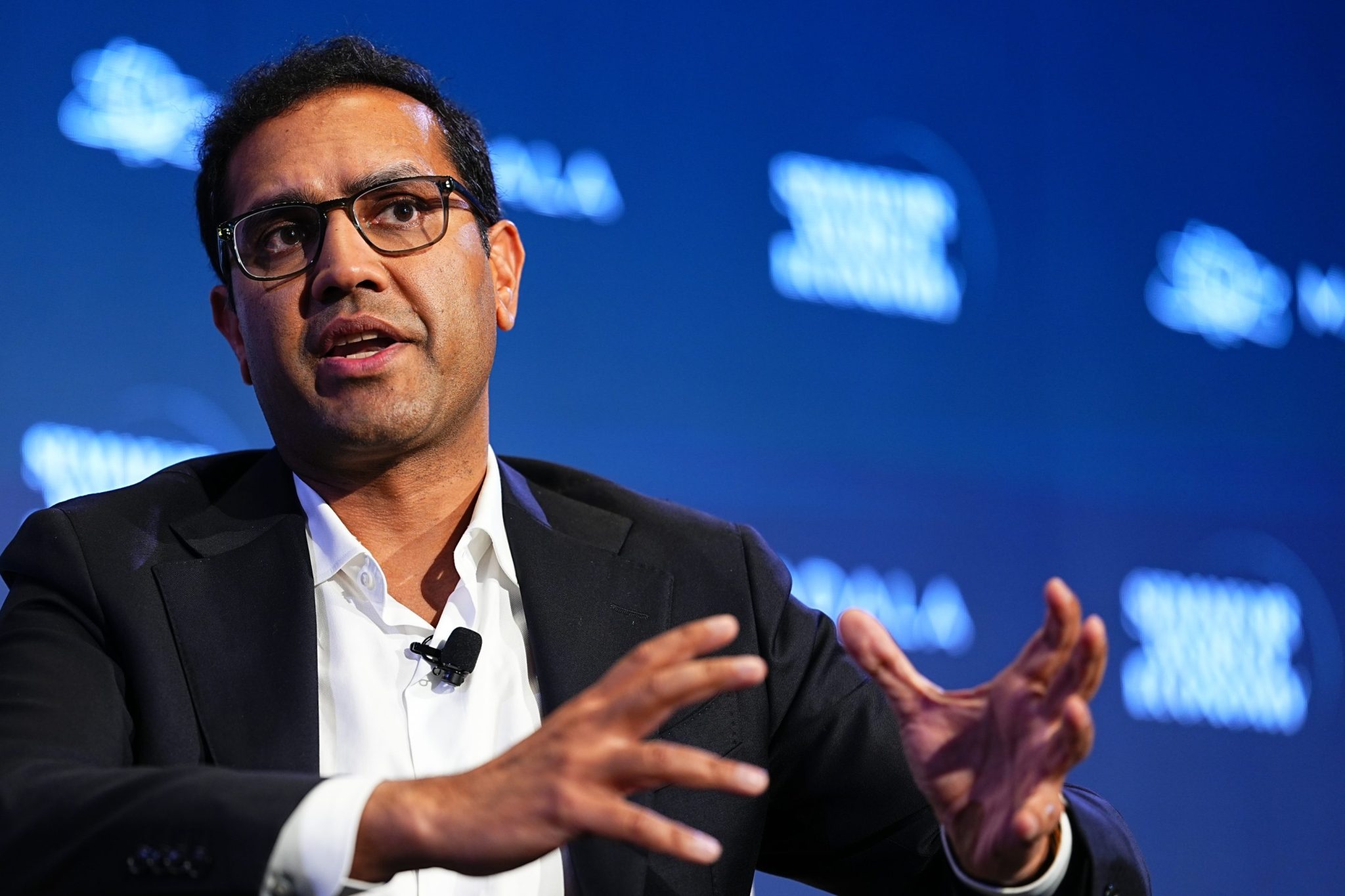
Hours after Better.com founder Vishal Garg was ousted as CEO this summer, the board member picked to replace him texted Garg after midnight.
“You are the last person I am texting tonight—you are on my mind,” interim CEO Daniel Lewis wrote, according to a log of texts between the two reviewed by Fortune. “You are in my heart, whether you believe it or not.”
The two men had a history of mutual affection, even if circumstances were now testing it. In April, Garg texted Lewis about becoming “BFFs” as the pair collaborated. At one point, it seemed like the engaged investor was just the boost Garg needed to help turn around the business he founded in 2014 to make getting a mortgage faster and cheaper online, and grow the flagship “Tinman” AI product for approving and closing home loans.
Within weeks of the CEO change, however, the budding bromance was officially dead. Garg took Lewis to task in a group chat on X with Better.com investors, blasting the new CEO for working remotely in the South of France instead of the New York City office. Lewis hit back with a seven-part thread on X questioning his predecessor’s credibility and calling Garg a “bully.” Better’s board claims the company “accumulated more than $2 billion in net losses and lost more than 90% of its value as a public enterprise” under Garg’s tenure.
Lewis ended the X thread with a line summing up his perspective on the relationship.
“The love died when the diligence began,” Lewis wrote.
Garg remains on the board for now, and he and his backers are fighting Lewis and the rest of the board for control over the $230 million company. The decision will come down to shareholders including Activant Capital, Framework Ventures, and SoftBank Capital Partners. Rarely does such a feud spill out into the open. But with control of the publicly traded company set to be decided by a shareholder vote—the contest deadline is Oct. 20—both men have taken their cases public, through dueling SEC filings, competing threads on X, and press releases. Fortune reviewed thousands of text messages exchanged between Garg and Lewis over 13 months that show how quickly the kinship between a founder and an investor who wanted to coach him pivoted into open hostility.
For any founder who has taken outside money, or any investor who has gotten close to one, the Garg-Lewis rupture is a cautionary tale about how fast a partnership built on shared ambition can curdle—and how little a boardroom, or a friendship, can do to contain it once it does.
Behind the curtain
If the name Better sounds familiar, it’s probably thanks to the PR nightmare that followed when Garg, in December 2021 during the height of the COVID pandemic, laid off 900 employees on a Zoom call. Garg was accused of being insensitive and tone deaf about the job losses, which he blamed on a lack of productivity and a collapse in demand for refinancing. “I got some negative press for that,” said Garg, referring to the Zoom call. “But it also saved the company because the company was burning $100 million a month, right? We had too many people.”
The losses didn’t stop after the 2021 layoffs but in recent years they have begun to recede. Better’s annual reports show net losses of $301 million that year, then $877.1 million in 2022, $536.4 million in 2023, $206.3 million in 2024, and $165.9 million in 2025. Revenue has also been on the rise, from $72.3 million in 2023 to $108.5 million in 2024, and $164.9 million in 2025.
In its annual reports for 2023 and 2024, Better disclosed a weakness in internal controls after an outside law firm’s review of the company’s culture found that “certain actions taken by our CEO failed to set a tone at the top that supported a strong culture of internal controls.” The 2024 report states Garg completed executive coaching “to address behavioral aspects of his management style to the satisfaction of the board of directors.” The tone-at-the-top weakness and others were remediated as of Dec. 31, 2025 and Garg noted that the SEC and Consumer Financial Protection Bureau investigated and “found nothing” against him or the company.
Lewis, who founded investment firm Orange Capital 20 years ago, decided to invest in Better in 2025, becoming one of the largest outside shareholders (Lewis currently holds a stake between 2% and 3% in the company). From July 2025 to August 2026, Lewis and Garg exchanged at least 2,000 text messages, according to a log Garg shared with Fortune. The two compared notes about how to strengthen Better’s operations, and Lewis offered up investor relations advice to Garg. Eventually, their texts spilled over to their personal lives and families. Lewis invited Garg out to Nashville and got him to meet up with Lewis and his wife at the swanky sushi spot Nobu in downtown Manhattan.
The two bonded over their shared passion for the minutiae of corporate finance and AI, humblebragging about ducking out of date nights and parties in favor of trying to “3x” in distressed debt trades.
“Birds of a feather,” Garg wrote to Lewis when he discovered they both made similar trades during the Great Financial Crisis.
The two men came from different worlds but shared a love for finance. Garg, 48, grew up in Queens and went to public school, taking his first job at 14 making $6.50 an hour on a Wall Street trading desk, he said. He dropped out of traditional finance in 1998 to strike out on his own, starting an online student loan company, MyRichUncle.com, before he founded Better.
Lewis, 51, is a die-hard Buffalo Bills fan who finished Cornell at 20 before moving to Tokyo to work for Citibank. He started on the Salomon Brothers trading floor in the 1990s, investing globally in special situations (unusual, one-time events that might be fatal for a business). He ran a hedge fund and later a family office, and spent five years running a Toronto software company.
Both thrive on the grind. Last year during the holidays, Garg told Lewis to “have a tequila shot and just let it all go” while on vacation in Mexico. “My ability to relax is the same as yours,” wrote Lewis. “Doing my best.”
In an October 2025 text to Lewis, Garg wrote “this time around” he is focusing on humility and gratitude, and that he printed the two words out “in big type and put up on my wall so I don’t forget.” Garg also texted Lewis about his CEO role, writing that he needed to run leadership for the direct-to-consumer division’s sales culture “in the kindest way, a boiler room sweat shop.”
“My flaw was hiring and promoting same type of people. So the managers and workers were friends,” wrote Garg to Lewis. “I need the opposite. I should be friends with the workers. But they should hate their managers.”
Lewis also shared some of his personal victories with Garg, sending him an article about Orange Capital’s investment in a real estate investment trust that was sold to Hong Kong interests in 2016. His feats as an investor, Lewis told Garg, made him “a good wingman.”
“I own the record for fastest control proxy fight ever—8 days,” wrote Lewis. “It took me 8 days from announcement to take over the board of the largest hotel reit in Canada.”
Lewis repeatedly offered IR advice to Garg to share with Better’s executive team. He sent Garg feedback on draft 8-K filings and press releases and tried to keep Garg from responding to short sellers on X. In multiple messages, Lewis advised Garg to “stay above the fray” when it came to his critics.
“Please be the elevated CEO we want,” Lewis wrote to Garg in April. “I love you man,” Garg wrote on March 26, thanking Lewis for talking to other potential investors. “You don’t need to be doing this and you are.”
Lewis replied, “True friendships take years. We are early in ours. I would like you in my life—ups and downs.” Two weeks later on April 8, Garg wrote that he was “Hoping to be BFFs!”
The unraveling
By spring of 2026, Lewis had signed an NDA and was more deeply enmeshed with the company than ever, helping Better with strategy. Garg said Lewis was helping him further downsize, and the two cut about $1 million a month in expenses. A draft memorandum of understanding crafted by Lewis and reviewed by Fortune dated May 2026 describes a plan to explore a board overhaul—with Lewis added as a director—and a revamp of Better’s executive compensation plan with terms tied to stock price, revenue, and GAAP-based profits. The MOU also calls for cancellation of millions in performance-share unit grants awarded to Better’s board members, canceling the board’s consulting agreements, and reducing the cash retainers paid to directors to “zero or nominal amount.”
The implied targets of the MOU included Harit Talwar, who has been Better’s board chairman since August 2023. He got a stock award valued at $4.1 million, the 2026 proxy statement shows. Another is Prabhu Narasimhan, who has also served as a director since August 2023. He got an award valued at $3.8 million. Neither are independent directors and both have consulting arrangements with Better. The PSU grants to Talwar and Narasimhan are out of step with governance norms and their total pay is millions richer than board members are paid at similarly sized companies.
Garg claims Lewis falsely told the board that Garg supported the plan to rescind their equity grants and remove half the board.
“I think that is how he eventually turned the board and these four members of the board against me,” said Garg in an interview. “And then engineered the coup that he did where he joined the board and… days later ousted me as the CEO and became the interim CEO himself.”
But in an interview with Fortune, Lewis disputed that he made false claims to the board and called the allegation that he duped Garg and the board “spin.” Lewis said Garg had previously told him the reason the company was failing was in part because the board wouldn’t let him take action. So Lewis worked on a plan to remove directors.
But as Lewis began working more closely with Better executives, he had a chance to see “with my own eyes” how various employees were treated in the company and how information and strategy were articulated. Lewis says he soon came to a realization: Garg was the problem.
“I have never in my career—which is 30 years, involved special situations, distressed operations, trading floors, hedge funds, and as I said, running a software business—seen a culture promoted by the CEO that was more the antithesis of my personal values,” said Lewis.
In addition, Lewis said Garg was making promises he didn’t ultimately deliver, and built a culture that was misaligned with the innovative tech being developed by employees at the company.
“Late-night texts, swearing campaigns, saying that he was going to disembowel people publicly because that was the way to show people that that’s how you need to work, threatening if they’re not on the phone for more than four hours a day that he’s going to fire them,” said Lewis. “Just an endless amount of abhorrent behavior.”
Garg denies threatening employees the way Lewis described, but acknowledged to Fortune that, in the age of AI, he believes, loan officers spending fewer than four hours a day talking to consumers needed to be “coached up or coached out.”
“Daniel has made a habit of twisting my words,” wrote Garg. “The bigger question is – what has he ever achieved himself and how does that help in what he can do for better as its CEO.”
By August, tensions had reached a boiling point. The two men differ in their accounts of what precisely went down, but the facts are that on July 27 Lewis officially joined the board. On August 3, Garg stepped down as CEO, effective immediately, and the board appointed Lewis to serve as CEO on an interim basis. Says Lewis: I “believed that without a significant change in leadership, we would never be able to realize our potential and that was unanimously approved by the board,” said Lewis. “Not my agenda, but what they all agreed needed to happen.”
‘My phone starts blowing up’
When Garg got word he was out, he was advised to remain “calm and collected.”
“They thought I was going to go bananas,” said Garg. His ouster happened on a Monday and on Tuesday, Garg said he “was free.” He went to brunch on the Lower East Side at 10 in the morning and then to drinks in Soho in the afternoon, followed by a stroll through the West Village.
“It’s been 30 years since I had a Tuesday afternoon in the middle [of the week] for free,” said Garg. “And then, my phone starts blowing up.”
The news of Garg’s departure had been announced after Monday’s stock market close, and in the ensuing hours Better’s stock price cratered 37%. Agitated investors were messaging Garg.
Garg said he left Better quietly because he didn’t want to risk his ability to raise capital in the future. But with the stock tanking, and Garg still on the board, he says he couldn’t help but get involved.
On a Zoom call that Wednesday, Garg said he got an offer to remain with the company through a transition period, and met up for lunch on Friday with two board members who said his ouster was a mistake. Garg claims it was the board members who gave him the idea to get majority support to make changes to Better’s board if he could muster the votes. Garg said he now feels he was coerced into leaving his chief executive post at Better.
Documents reviewed by Fortune show an email sent from Better’s corporate secretary to Garg on August 6, cc’ed to the board’s compensation and nominating committee, plus Talwar. The message, sent to Garg’s Gmail account, included an attachment with proposed transition terms for Garg to receive $450,000 in pay, $300,000 of equity in lieu of salary during the transition period, vesting on 575,000 outstanding performance share units (PSUs), and a new grant of 200,000 PSUs for service as vice chair, plus the board would consider another 100,000 PSUs. The agreement was never approved and Garg says he turned it down.
After Garg’s ouster, the tone of his texts to Lewis grew ice cold. “My family is asking me about my health insurance. Would you please advise me on that. Thank you.” wrote Garg, according to texts seen by Fortune. “It’s embarrassing.”
Lewis asked Garg to “kindly” stop emailing him multiple times a day and asked that Garg stop contacting Better employees, customers, and investors. Lewis encouraged Garg to “seek guidance” from his executive coach on the difference between a board role and an executive role.
“Vishal. Remember, every move you make—I have planned for it in advance,” wrote Lewis on Aug. 11. “#boyscout.”
When Better published a press release on Aug. 14 calling Garg’s leadership destructive and stating the company had GAAP net losses exceeding $1.5 billion since 2022, Garg fired back on X: “#Bubkis. Yeah that’s Boy Scout for FAKE NEWS. Sacre bleu Daniel, I think the French air is getting to you.”
The fight for control
As the two duke it out, clamor about the Better board and its ability to oversee the company is increasing among investors. Better’s stock has yet to regain the lost value that followed Garg’s departure. The board is also being scrutinized because it signaled to shareholders an amicable, orderly handover from Garg to Lewis, only to sow chaos by taking it back a few weeks later and claiming Garg was “unfit” to lead Better due to his conduct.
Garg is asking shareholders to remove five of Better’s eight directors, including Lewis and board chairman Talwar. If he succeeds, Garg and two other board members would be the only ones left, although it’s not clear that would be an obvious win for Garg. One of the board members who would remain is Hugh Frater, former CEO of Fannie Mae and a founding partner at BlackRock. Frater has said he will step down if Garg returns in any sort of executive capacity. The other remaining director, Michael Farello, is considering stepping down from the board in 2027, which would leave Garg largely in control, the company has said. Garg says a new board could hire a CEO with stronger qualifications than Lewis, and he would take a product and innovation role for himself.
If the current board prevails, Lewis will stay on as interim CEO while a search committee he doesn’t have a role on will work to find a permanent CEO successor. Lewis says Better will narrow its focus to wholesale lending, home equity lines of credit, and partnerships with consumer platforms.
In an interview, Lewis said he is also focused on cultural change at Better, and plans to champion its technology and employees. “It is naturally the time for us to go from a founder-led company based on bold promises, into the future of execution, which is a very different set of skills,” said Lewis. The plan is “to coalesce this team around a vision where we can generate sustainable profitability versus just being a dreaming fintech that someday will be profitable.”
As for the proxy advisory firms who advise shareholders on such matters, ISS and Glass Lewis recommend investors support the current Better board. ISS stated in its report that the company has lost the “majority of its value under [Garg’s] leadership” and Glass Lewis pointed to “prolonged value erosion” during Garg’s tenure. Conversely Egan-Jones recommended that shareholders vote for Garg’s group. Its report states that cumulative total shareholder return was negative 53% since Better’s August 2023 public debut, while the past two years show positive 14% total shareholder return, which is evidence that the tech-led strategy, including Tinman AI, has begun gaining traction.
The contest deadline is October 20. On Friday, Garg announced a slate of three directors to work alongside him on a newly refreshed board: Kleiner Perkins partner Bing Gordon, L Catterton senior advisor David Heidecorn, and Activant Capital’s Steve Sarracino. As shareholders contemplate which side to back in the ongoing vote, the only thing clear at this point is that the friendship between Garg and Lewis is officially lost, according to both parties.
“I thought Daniel was my friend,” said Garg in an email. “And then he proceeded to earn my trust and backstabbed me in the worst possible way.”
This story was originally featured on Fortune.com