

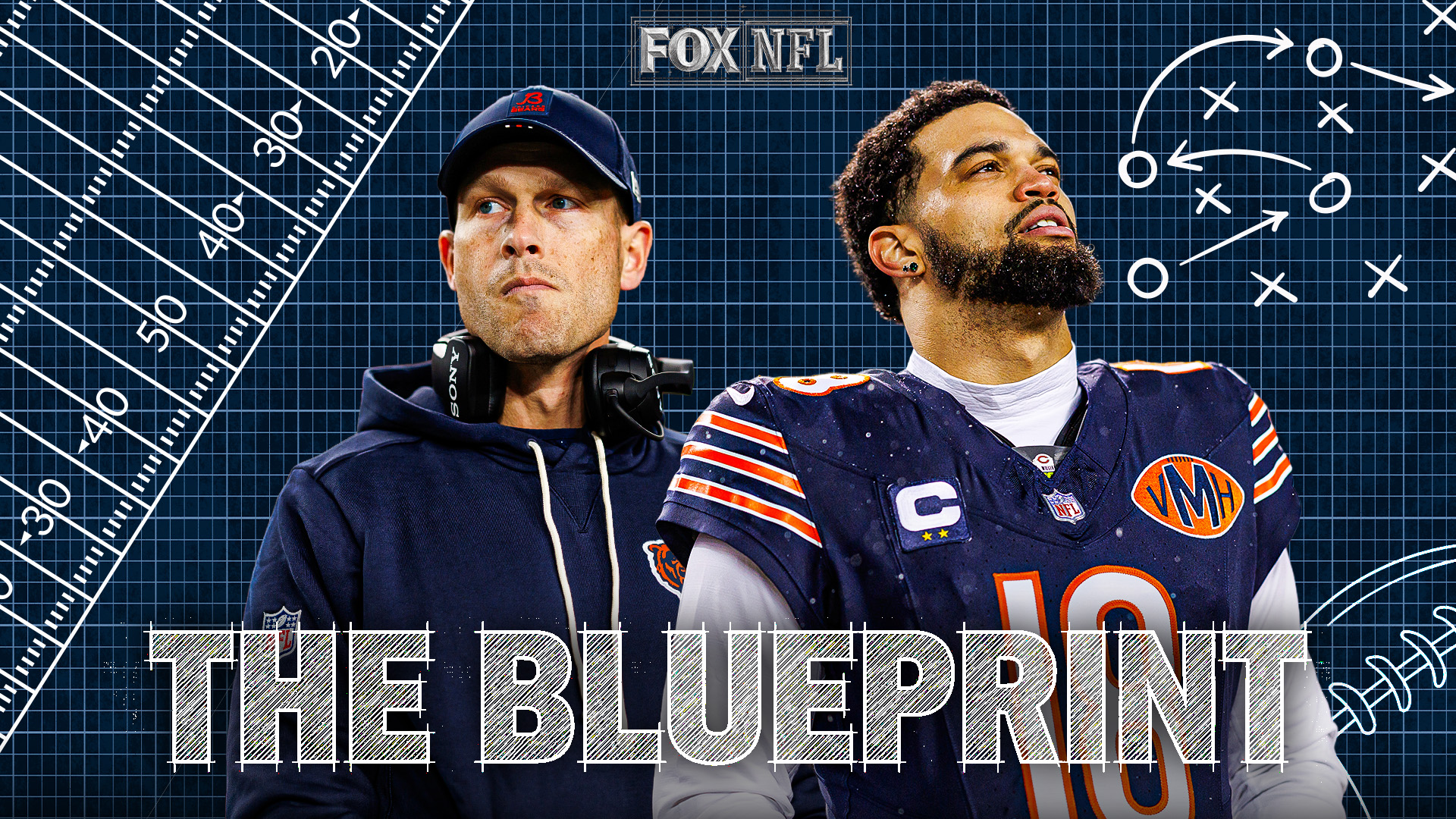
Ben Johnson and Caleb Williams established many routines in their first season together. One of Johnson’s favorites was their post-practice meeting. All season long, they’d finish their work on the field and, once Williams got out of pads and into street clothes, the Chicago Bears’ rookie coach and second-year quarterback would log anywhere from 60 and 90 minutes together in Johnson’s office. Much has been made of how Williams once called his early-season relationship with his coach “fragile.” But in those post-practice meetings, they seem to have built something solid. And when I asked Johnson about the moments with Williams that were most fun last season, the coach pointed to those one-on-one sessions, where he would lay out the nuances of opposing defenses in relation to the Bears’ game plan. “It’s just this complete clarity of how we want to attack that opponent this week,” Johnson told me in March at the NFL Annual League Meeting in Phoenix. “I think the coolest thing was seeing [Williams’] growth from early in the season.” It’s not rare for an NFL head coach to spend time with his starting quarterback every day of the season. But it is rare to see a coach have as much of an impact on his quarterback as Johnson seemed to have on Williams in 2025. After all, at this time last year, there were concerns that the previous Bears regime left the QB in a state of developmental regression. Chicago won just five games in 2024 and fired its head coach in midseason for the first time in franchise history. Williams took 68 sacks, tied for the third-most all time. It was a tough rookie year for the No. 1 overall pick, who’d been touted as a generational prospect. But these coach-QB meetings helped catalyze the Bears’ breakout success in 2025. Williams engineered six fourth-quarter comebacks to lead all NFL quarterbacks last season, earning the nicknames “Iceman” and “Cardiac Caleb” — and just recently, the cover of “Madden NFL 27.” The Bears went 11-6 and made the playoffs for the first time since 2020. As Johnson tells it, those meetings had a cascading effect on the relationship between coach and QB. Everything improved: communication, repetition, execution. “We’d meet the night before the game to go over his favorite calls, and to see how that went from early in the season to what it looked like at the end of the season, [it was] much more fluid,” Johnson told me. “We just saw the game so much more through the same lens as the year went on. I think all those quarterbacks saw that and witnessed that firsthand. So I think that was the coolest thing, just to see where it started to where it finished.” At the end of Chicago’s season, which concluded in an overtime loss to the Los Angeles Rams in the divisional round, Johnson said he wanted Williams to get away from football for a little while. But just before he let Williams go, Johnson had a message for his QB about the 2026 season. “It’s going to be more difficult. I’m going to push you more,” Johnson told Williams, per the QB. “Yessir, let’s do it,” Williams remembered telling Johnson. While the players took their time off after the season, Johnson and his staff spent their time self-scouting, a process that spanned roughly a month and a half. They dove into every phase and every element of the game. “As you watch clip in and clip out, I think it would have been easy to get a little bit upset or disappointed that it didn’t look quite the way we want,” Johnson told me. “And yet I see it as, ‘Man, we got so much room for improvement. This is great. This is gonna be good to get these guys back in, and they’re gonna be able to see this. And hey, we can be so much better as an entire team if we just make these few small changes going forward.’” Of course, I was most curious about the Bears’ findings on the QB. Johnson told me he would boil the self-scout into three takeaways and goals for Williams, whose work is well underway, with minicamp in session this week. Johnson wouldn’t disclose all three points of emphasis, but he discussed one item after Williams finished the 2025 season with a 58.1 completion percentage, second-worst in the league. “We need to get the completion percentage up,” Johnson told me. “And so we’ll look at that as we go through the cut-ups of where we can best do that. There were probably 80 or 90 throws on tape that we felt like could have been completions. “You’re always going to have some drops by the route-runners. … We need to find a way to complete some of those other ones, though. That’s really the challenge for Caleb. If we do that, then we’ll be 65%, 70% completion, which is closer to where we want to be.” That’s the challenge for Williams — or at least one of them. The QB is already facing that challenge head-on. “It starts with reps,” Williams told the media in May at OTAs when asked about reaching the coach’s goal of a 70% completion rate. “And then the next part, it comes down to comfort in the offense. And I think that toward the end of the year, it started to grow for me. … The last part is the details, whether it’s the receiver’s steps and where his landmark is to break or settle. And then from there, it’s being able to deliver a catchable ball, whether it’s velocity or ball placement.” Meanwhile, Johnson is putting plenty of challenges on his own plate. That includes making sense of all the Bears’ narrow victories and come-from-behind games. As impressive as that quality was for Chicago, it can also lead to regression. Look at the Kansas City Chiefs as a cautionary tale. They made the Super Bowl in 2024 with a run of 17 consecutive wins in one-possession games (a streak that started in 2023). But the Chiefs lost nine one-possession games in 2025 and finished 6-11. As I tried to spit out a question about whether the Bears were worried about that same fate, Johnson, smiling wide, interrupted me. “You think it was fluky? Is that what you’re getting at?” he asked me. That’s not it. Anyone who listened to the Bears explain how they beat the Green Bay Packers on a bomb to receiver DJ Moore in Week 16 knows that Chicago’s comebacks were not fluky. They were a product of hard work and careful planning. That 46-yard walk-off play exemplified how Johnson’s steady hand and sharp mind can literally change the game, which was why Williams called him “the best coach in the world” after the game. Johnson had that play ready for that moment. That’s how the Bears won. “That’s a play that Coach and I — we were sitting in his office, one of those meetings — and we discussed that play,” Williams said after the game on the FOX broadcast. But history has a way of repeating itself, and dramatic wins are often not sustainable. Johnson admitted he’s thought about that. “It goes back to a term that I learned early as a coordinator called ‘unstable success,’” he told me. As the Detroit Lions’ offensive coordinator before coming to Chicago, Johnson knew that success in the screen game and the red zone did not automatically carry over from year to year. It was on the coaching staff and players to create and sustain success, rather than expect the same results, even with the same ingredients. So Johnson made that an emphasis every offseason. Detroit was a top-five team in the red zone for three years in a row, from 2022 to 2024. “I view that as a challenge,” Johnson told me. “So to your point, do you want all these games to come down to the very end like that? No, hopefully our growth as a team means that we score more early and more often and our defense plays a little bit better in terms of limiting the points, and we’re not in those spots. “But at the same time, I don’t want to lose that. I don’t want to lose that ability to score 14 points in less than two minutes. That’s something that you’re going to want to lean on at some point. And I think that’s part of who our guys are. That’s part of who Caleb is. … I view it as a challenge. And I think when you frame it that way, I think our guys will see it the same way.” That actually loops back to the discussion of completion percentage. Because if Williams becomes more efficient, Johnson said he could envision scenarios where the team might not need late comebacks to win games. But that changes the equation in more ways than one. Efficiency often means taking what’s available. And in today’s NFL, with two-high-safety defenses growing increasingly popular, efficiency requires quarterbacks to check the ball down and/or make good use of the short (and quick) passing game. How will the Bears balance that with Williams, who, considering his impressively low sack (27) and interception (7) numbers last season, was just the right amount of aggressive in 2025? “He knew when he could take chances and not. And certainly when you’re in that, ‘Hey, we’re in fourth downs from here on out’ mode, I think that kind of helps his mentality,” Johnson told me. “It’s so curious with him. He’s just always been such a great protector of the ball. For a guy that can be a little bit aggressive at times with some of these throws he makes, he rarely puts it in harm’s way. “And so I think that’s a little bit unique to him. And so maybe it’s one of those things we just need to encourage him to open it up a little bit more earlier in games, when he might be just a little bit more conservative in some of the decision-making early in games.” If you need any further proof that the Bears built something enviable last year, just look at their coaching staff moves this offseason. After just one year in Chicago, Johnson’s staff produced two offensive coordinators for other teams, with Declan Doyle taking over the Baltimore Ravens’ offense and Eric Bieniemy returning to his old gig as Kansas City’s OC. It’s clear that teams want the recipe for Chicago’s secret sauce. One thing that has been a common refrain from Johnson this offseason is that the Bears are starting over. They’re tearing everything down to ground zero, and they’re piecing together a brand-new version of the team for 2026. “The number one enemy that we would have right now is entitlement or complacency based on what we did a year ago,” Johnson told me. There’s no doubt the Bears are young and talented. There’s no doubt they showed tremendous progress in 2025. There’s no doubt their quarterback has the potential to be great. And how many times have we seen that go wrong in Chicago? But this particular team seems different, and that’s because of Ben Johnson, who is hell-bent on bridging the gap between goals and results. Just ask Caleb Williams.