


The days when a rich family could buy a team as a passion project are over, according to a senior Goldman Sachs wealth executive.
“Gone are the days when a single family might have a passion project and buy a team for a few hundred million,” Nicole Pullen Ross, who heads Goldman Sachs’ Private Wealth Management Sports & Entertainment Solutions, told Fortune. Only “a very short list” of the world’s wealthiest people could afford to invest in or purchase a team outright, she added.
Pullen Ross is a contributor to Playing for Scale, the second edition of a report on sports investing from Pullen Ross’ team and the first since Getting in the Game in 2024. The report is written for the bank’s private wealth clients. Its argument is that the way into team ownership has changed. Institutions are now a major force pushing valuations up, and wealthy individuals get in through smaller stakes, loans and structures the bank can help arrange.
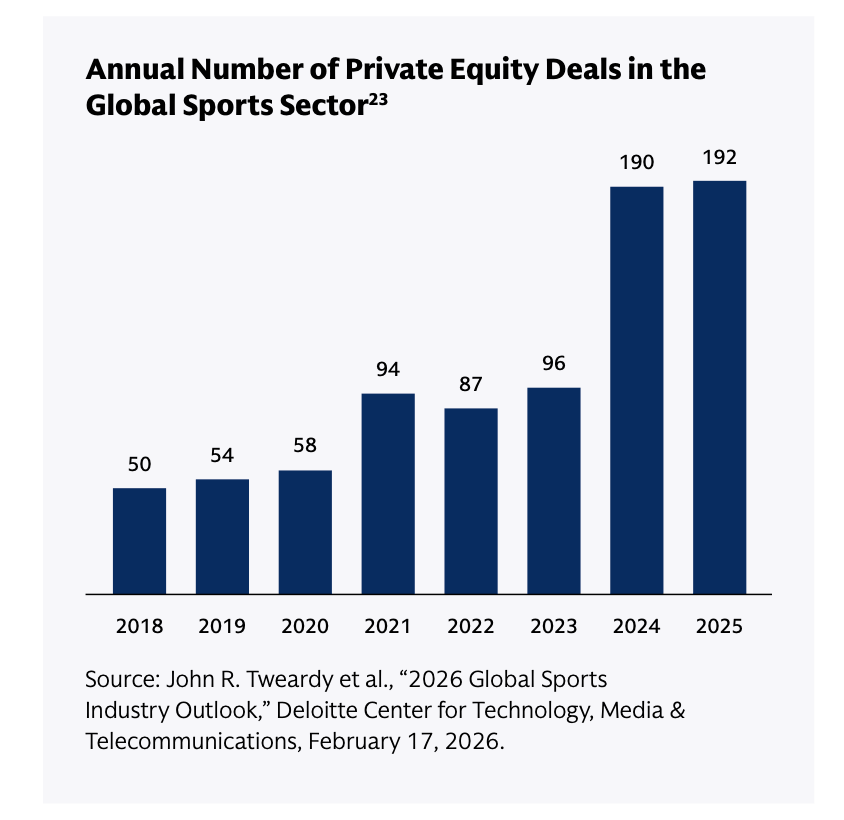
Institutional money drove much of that change. Private equity deals in sports rose from 50 in 2018 to 192 in 2025, according to the report, which says institutional capital “began pricing out high-net-worth individuals from control ownership.” The NFL, the last major U.S. league to allow such funds, opened to them in 2024. Pullen Ross said 74 North American teams now have private equity or institutional capital in their ownership ranks, and valuations are at “pretty extraordinary levels,” with institutional capital “stepping into that gap in a meaningful way.”
The fine print
Funds are buying in under strict terms. The NFL requires them to buy at least 3% of a team, hold it for six years and have $2 billion in capital, with no more than 20% of that capital in any one team. Arctos Partners bought 8% of the Los Angeles Chargers, and the team’s valuation rose from $5.8 billion to $8.6 billion the following year, the report said. Pullen Ross said institutional money “gives some investors a better sense that the growth will be professionally managed,” and that it makes an eventual exit more likely.
Wealthy individuals are not shut out. Controlling NFL owners are selling minority stakes to funds and to “traditional high-net-worth individuals,” the report said. The Philadelphia Eagles recently sold 8% at an $8.3 billion valuation. The report says such sales could narrow the historical discount on secondhand limited partner stakes, which it puts at 10% to 40%.
Most investors, Pullen Ross said, will need “a variety of approaches to exposure,” including institutional capital and “creative financing” from Goldman’s private bank. The report describes two loans the bank structured for team owners, and labels both as illustrative examples. One was secured by liquid assets and by equity in entities that own real estate, with indirect reliance on the value of the team. The other was secured partly by a stake in a private equity management company, with a negative pledge on the owner’s team stake, meaning the owner agreed not to pledge it to anyone else.
Those are loans the bank makes, in a report written for clients who could take them out. Goldman also advises on sports deals and sells wealth services to the same clients. The report says its advisors will not introduce clients to lenders not affiliated with Goldman. The same disclosures say advisors may receive internal recognition for lending referrals, which may factor into their compensation.
Access is tight, even for institutions. One institutional investor the report interviewed said NFL demand is “considerably higher than available supply,” and the report says the league will likely expand existing approved investors before admitting new firms.
The question under all this valuation growth is whether younger fans will keep paying for sports. The report cites a “fragmented media landscape” and an “increasingly short attention span,” and says short-form social content is now the primary way to reach younger audiences. Owners are answering with athlete-centered documentaries, 365-day content calendars, low-cost standing-room tickets, and subscription virtual reality access to live games. Asked whether younger fans might drift, Pullen Ross pointed to those tactics and offered no engagement data. Asked directly whether young people like sports less, she described the same tactics. “Baseball’s been trying to figure this out for quite some time,” she said.
Sports Disney
Pullen Ross argued live events are hard to replace, because advertisers can reach audiences in real time and fans “find common ground” in a crowd. The interview also turned to Boston Consulting Group’s recent research on media consumption, which Fortune described to Pullen Ross as highlighting the importance of live entertainment such as theme parks, concerts and sports events.
Pullen Ross said she loved the idea and extended it to Disney, where “part of it is the experience, the individual experience.” Teams are trying to recreate that operational excellence, she said, so that fans feel “special and seen and engaged.” She called that parallel “an aspirational objective.”
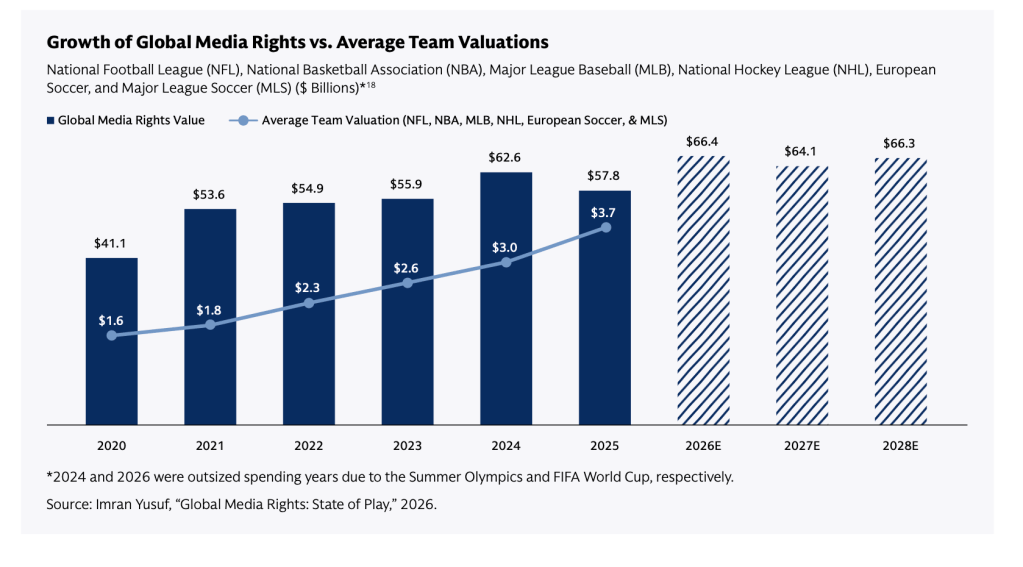
The valuation case rests partly on media rights, which the report projects at $66.4 billion in 2026, a figure it ties to the World Cup as an outsized spending year. Media rights are then projected to fall to $64.1 billion in 2027. Pullen Ross called that decline “contractually baked in in some ways,” and described 2028 as effectively flat. Media rights rose 41% from 2020 to 2025, and the report says streaming platforms now hold about 20% of the market, up from 8% in 2021. The projections therefore depend on contract timing as much as on fan demand.
Women’s sports: the same squeeze, earlier
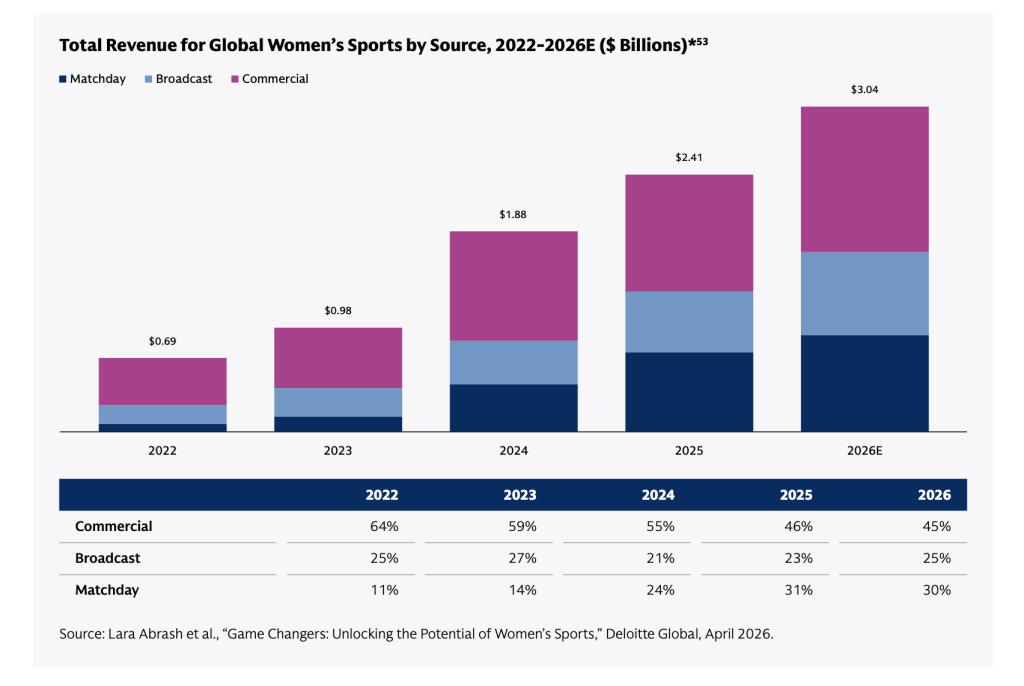
Women’s sports is following the same path. The global women’s sports market is projected to reach $3.04 billion in 2026, up from $0.69 billion in 2022, with the WNBA and NWSL generating nearly two-thirds of it. The average WNBA team is valued at $414 million, up 52% in a year, and the average NWSL team at $200 million, up 49%. The WNBA’s new media deal averages $200 million a year, four times the last one. The Golden State Valkyries generated more than $78 million in revenue in their 2025 inaugural season, surpassing the revenue of more than half of MLS franchises.
Pullen Ross said institutional money is bringing a discipline women’s teams had lacked. Those businesses had not had “the same level of professionalism” as the men’s side, she said, and many started as family passion projects. The report says active investors have “routinely passed on opportunities” where operating plans were not adequately structured. One WNBA owner described a shift to “disciplined capital allocation.” Commercial sponsorship fell from 64% of women’s sports revenue in 2022 to 45% in 2026, while matchday revenue rose from 11% to 30%.
Real estate is the next barrier. No WNBA team owns its gameday arena, and the report says building one is a decade-or-longer project likely to depend on public-private partnerships. In the interview, the Atlanta Dream’s planned move from a 3,500-seat venue to the Hawks’ arena, which holds about 17,000, was raised as an example.
The audience gap is wide. Pullen Ross said more than 50 WNBA games have drawn a million viewers, while some of the highest men’s games reach about 20 million. “It’s a pretty big gap to try to fill over time,” she said. Women’s sports is “more early innings” than the mature markets, she added.
The next frontier, Pullen Ross said, is college sports, which investors are watching closely. The NCAA agreed in a 2025 settlement to pay $2.8 billion in back damages to athletes. Athletic departments are now using outside capital: Otro Capital put $500 million into Crimson Brand Partners, a new commercial entity at the University of Utah. The report says such structures are expected to proliferate and could create opportunities for high-net-worth individuals to participate as limited partners.
Generative AI was used for research assistance and/or transcription of this article. The reporter independently reported and verified the factual claims in this article, and a human editor reviewed it before publication.
This story was originally featured on Fortune.com