

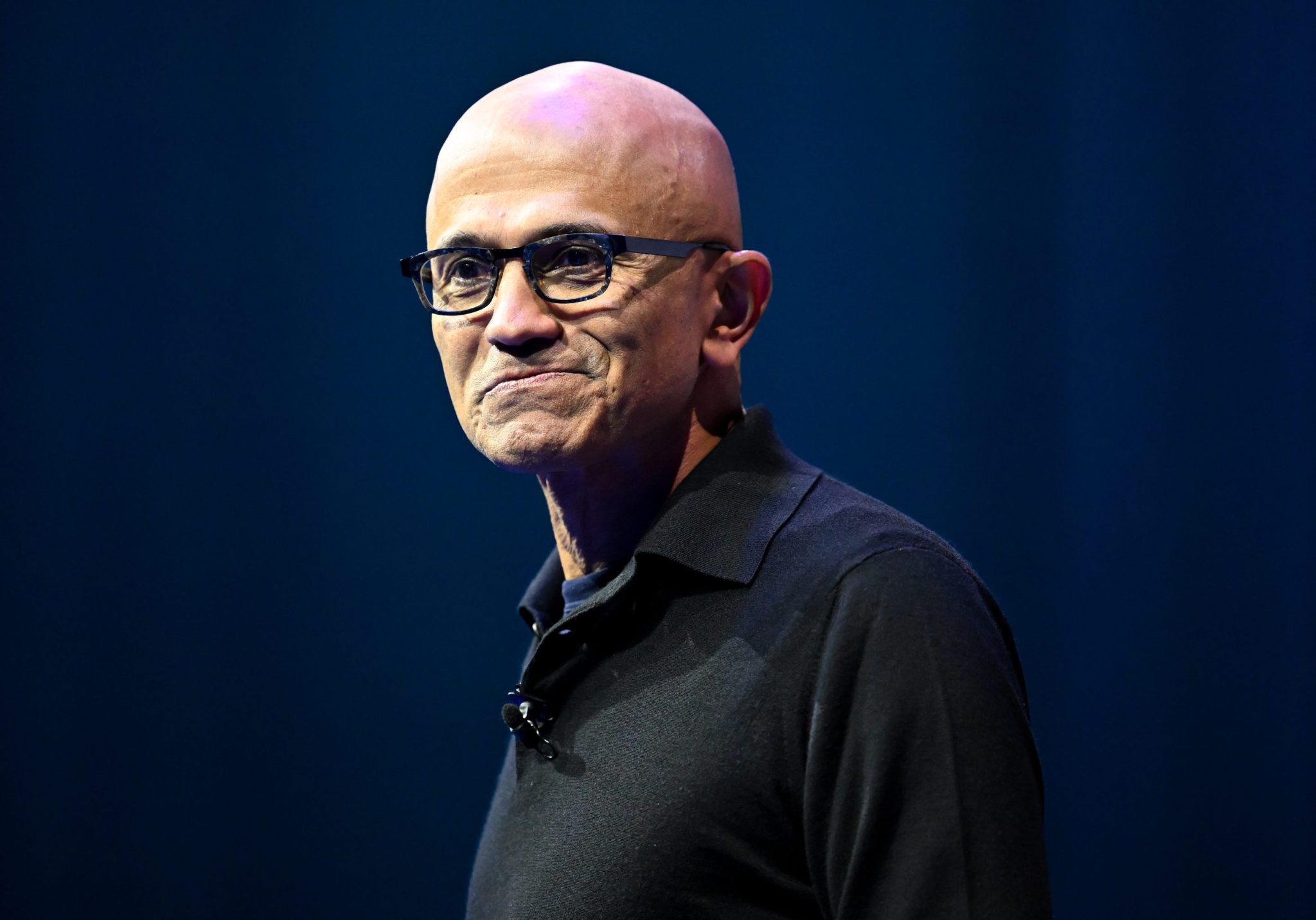
Microsoft stock prices surged as much as 17% on Thursday to above $455, the largest single-day gain in nearly 20 years.
The resurgence followed the tech giant’s 2026 fiscal year fourth-quarter results on Wednesday, which appeared to finally convince investors that CEO Satya Nadella and chief financial officer Amy Hood’s strategy for converting an estimated $190 billion AI spending this year into rising revenue growth is bearing fruit.
Microsoft went into earnings this week with its stock down nearly 30% from an October 2025 high of $555, depressed by months of investor funk about ephemeral returns in the AI sector following a massive investment in a buildout now expected to exceed $850 billion across the hyperscalers and cloud providers. The stock closed at $390.54 on Wednesday, and then briefly hit $456 in afternoon trading Thursday, adding about $483 billion in market value during the day.
The stock’s Thursday rally represents the single biggest one-day gain since 2008, when Microsoft’s stock increased 19%, according to Jefferies.
The gloom lifted following Microsoft’s fourth quarter and fiscal year end results that saw nearly every metric exceed analyst expectations, along with forward guidance that was even stronger—delivered by Hood who sounded almost cheerful during the earnings call. Quarterly revenue hit $90 billion, about $2.4 billion over analysts’ $87.6 billion consensus and up $13.6 billion (17.7%) from a year ago. Earnings per share came in at $4.74, above the consensus estimate of $4.24, amid total quarterly net income of $35.8 billion.
By design, Azure took center stage after Nadella unveiled Microsoft’s once-a-year look at the cloud platform’s revenue. (Microsoft does not break out revenue figures for its cloud computing platform and instead tucks the figure inside its broader intelligent cloud segment.) Nadella announced during Microsoft’s earnings call yesterday that Azure crossed $100 billion in revenue for the first time during the 2026 fiscal year.
William Blair analyst Jason Ader, who rates the stock outperform, estimated Azure revenue at $29.9 billion for the fourth quarter, up from $20.9 billion a year ago. The 43% growth sailed by the company’s guidance of 39% to 40% growth. Hood guided 45% Azure growth for the next quarter, which ends in September, above the 41% analysts had expected, according to analysts at BNP Paribas.
OpenAI’s $24.1 billion contribution
For the full 2026 fiscal year, Ader estimated Azure’s revenues at $104 billion, up from $75 billion last year. And even more notable, Microsoft’s annual report disclosed that OpenAI accounted for $24.1 billion in fiscal 2026 revenue, and that the AI company still owes Microsoft $6 billion in accounts receivable. OpenAI has been a source of concentration risk—and consternation over the lack of clarity—for analysts and investors for both its revenue-sharing deal with Microsoft, and how much of Azure’s growth was dependent on OpenAI.
Analyst research estimated OpenAI was responsible for roughly half of Azure’s $30 billion in year-over-year growth, and investment bank Stifel’s Brad Reback flagged in his investment thesis that the relationship is becoming less competitively additive as Google follows hard on Azure’s heels. Not to mention, Azure has long chased Amazon Web Services for customers and market share. Yet, BNP Paribas senior equity research analyst Stefan Slowinski estimated the $24.1 billion as less than a quarter (23%) of Azure’s revenue, and noted that Microsoft has a path to keeping Azure’s growth above 40% as it phases in consumption-based pricing across its Copilot product offerings.
Slowinski, who has a $549 price target on the stock, wrote in a note on Thursday that the quarter showed a point of progress in the will-they-won’t-they narrative of Microsoft’s revenue trajectory versus its capital expenditures. According to Slowinski, the company has taken an onramp to revenue growth outpacing capex growth, “an equilibrium state” that investors had longed to see.
Ader of William Blair described the quarter as one where AI-driven momentum showed up across Microsoft’s application and infrastructure business lines. Reback of Stifel reported that Microsoft 365 Copilot seats surged to 30 million, which was a single-quarter increase of 10 million seats, above investor expectations of about 6 million. William Blair also highlighted commercial remaining performance obligations as a green flag, pointing out the rise to $678 billion from $368 billion a year ago, offering what Ader described as “ tremendous demand visibility across enterprise and AI workloads.”
Reback carries a hold rating on Microsoft, but raised his price target from $400 to $450. Microsoft reported $55.4 billion in operating cash flow during the quarter, $6.7 billion above consensus, according to Stifel. Even with $41 billion in quarterly capital expenditures, the convergence of commercial cloud revenue growth and further capex growth in July 2027 could mean a higher price-to-earnings ratio—investors willing to pay more for the stock.
Looking forward, Microsoft announced a capex change this quarter that will make its headline numbers appear more palatable, and will offer a further glow up to its free cash flow. Hood guided to more than $50 billion in capex for next quarter, but in tandem announced an accounting change that will extend the “useful life” of the buildings housing its data centers to 25 years, up from the 15-year standard the company had been using. The move will shift some future finance leases into operating leases, which will help reduce Microsoft’s overall capex figures. For instance, even while maintaining 2026 spending plans of $190 billion, the new classification allows for reporting a $175 billion figure.
This story was originally featured on Fortune.com