


By Morgan Stanley’s count, 91.7% of Nvidia’s 2027 revenue is exposed to one thing: AI infrastructure demand. No company on the bank’s list scores higher. Not Vertiv, at 90%. Not Broadcom, at 81%.
The same report, published Oct. 15, calls Nvidia the best risk/reward in the sector.
The bull case for the world’s most valuable company and the bull case for the build-out are now essentially the same case, and Morgan Stanley’s North America Insight, led by Nicholas Lentini, makes both. The note, titled Following AI’s $1.6 Trillion Money Trail: Mapping the Revenue Generated by the Capex Boom, includes a section that runs under the heading “We Are Bullish This Spend.” The 65-page note also spends a good part of its length explaining how the spending could break.
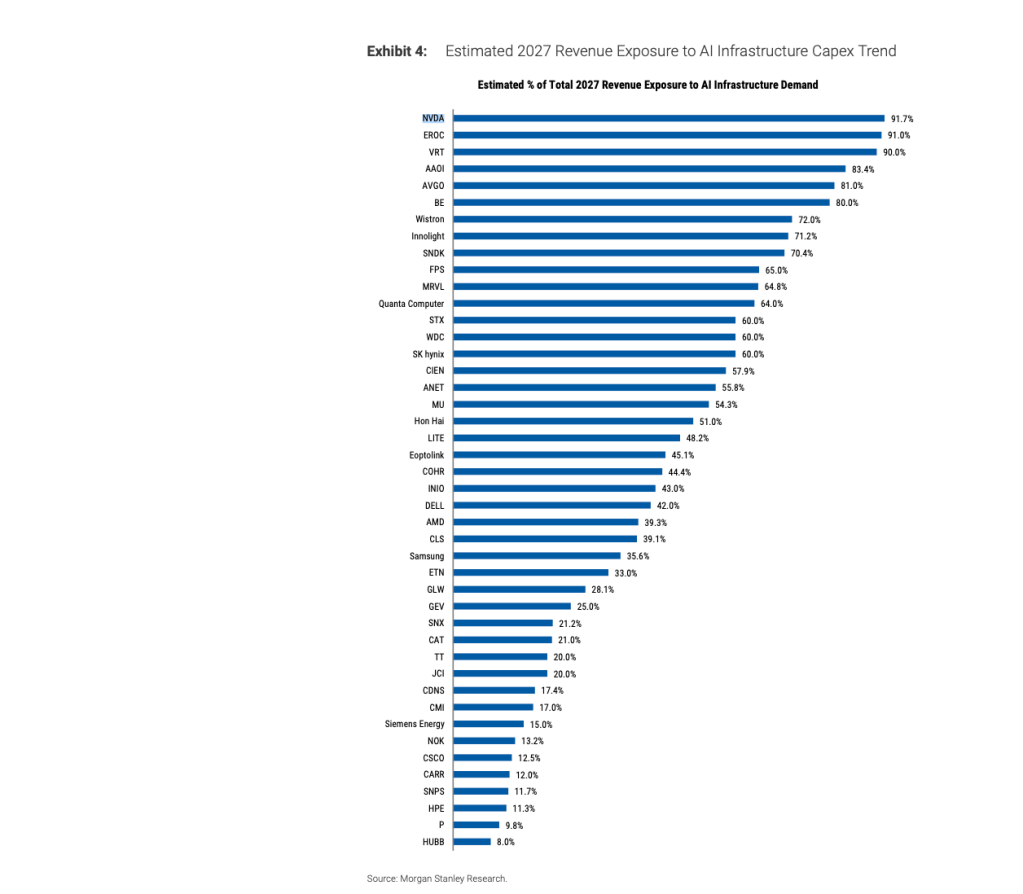
Nvidia’s defenders would say that exposure describes the company. Its data center business has supplied the large majority of its revenue for years, but the report adds a closer look on how few buyers that exposure runs through.
The $1.6 trillion
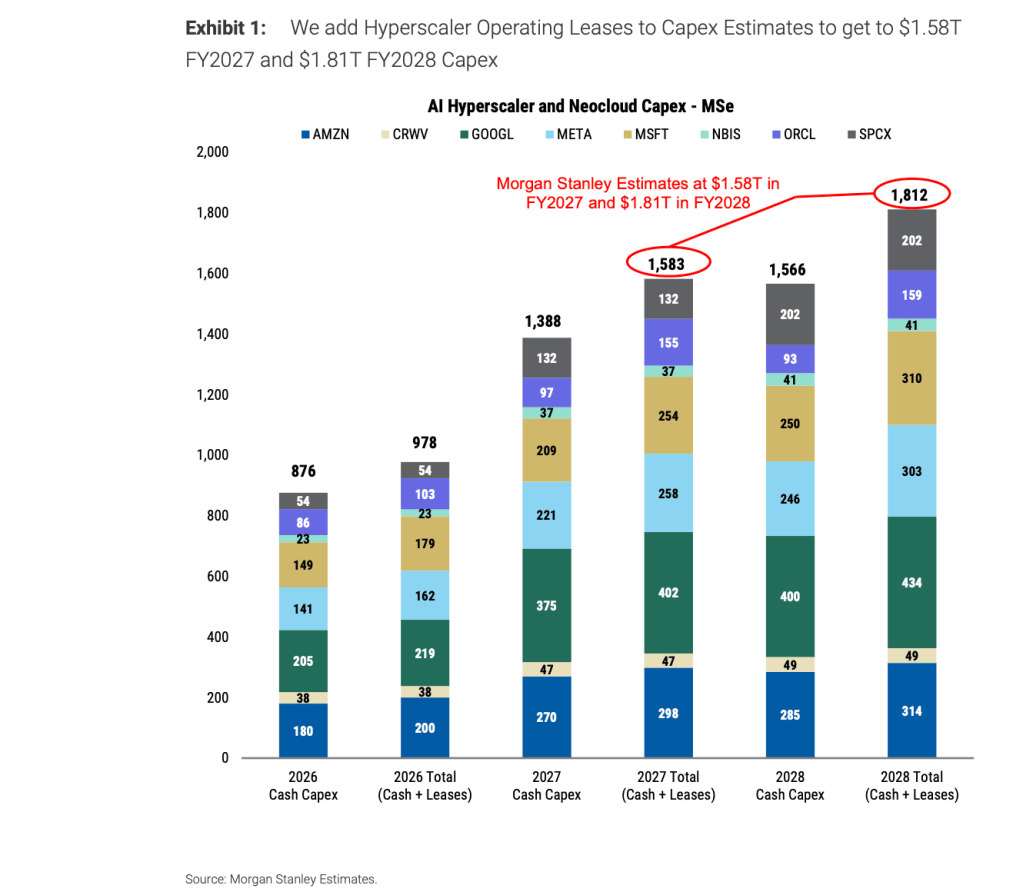
The firm estimates hyperscalers and AI cloud providers will spend $1.58 trillion in 2027, up roughly 60% from about $980 billion this year, and will spend $1.8 trillion in 2028. About $195 billion of the 2027 figure is data center leases, which never show up as capital spending on a cash flow statement. The report calls leases “synthetic capex.” Hyperscalers have disclosed more than $1.1 trillion in lease commitments that haven’t started yet.
About $1 trillion of the 2027 spending lands as S&P 500 revenue, by Morgan Stanley’s estimate. Nearly $700 billion of it goes to Nvidia. Revenue from hyperscaler and neocloud customers makes up 5% of total S&P 500 revenue in 2027 but drives about 25% of the index’s revenue growth.
Nvidia’s own customer list is even narrower. In the bank’s model, SpaceX and Amazon Web Services together account for about 54% of Nvidia’s hyperscaler revenue in 2027 and 72% of its growth.
Morgan Stanley’s argument is that Nvidia is cheap for what it is. The stock trades at 15 times fiscal 2028 earnings, and the bank says multiple expansion “is also not required for the stock to work as numbers continue to go higher.” It expects the spending to earn 25% to 50% on invested capital. It also argues Wall Street has underestimated compute cycles by 38%, on average, based on four past cycles: PCs, the internet, mobile, and cloud.
The bank even says its own Nvidia numbers may be low. It calls its SpaceX and Amazon estimates conservative, creating “a low bar for remaining hyperscalers.” Its model has Nvidia’s share of the other hyperscalers’ spending slipping from 18% in 2026 to 16% in 2027. Nvidia expects to gain share.
Other parts of the company have sounded less certain. In March, Morgan Stanley’s global investment committee said the bull market “rests, more than anything, on the durability of AI capital expenditures.”
What could break
The report’s risk section reads like a list of everything the 91.7% depends on.
Money comes first. Morgan Stanley expects 2027 to bring the largest cash flow deficit of its forecast period, and with it more debt. Hyperscalers have already sold about $255 billion of unsecured bonds this year, roughly 30% of estimated 2026 spending. In what the bank calls a theoretical exercise, it models the cost of borrowing more. Amazon, Alphabet, Meta, and Microsoft, rated AA or higher, see combined interest coverage fall from about 31x to 12x. Oracle and SpaceX fall from 4x to 1.8x.
Some of the spending growth is inflation. A meaningful part of recent capex increases reflects higher component prices, according to the report. It cites Amazon’s finance chief attributing most of an increase in Amazon’s spending plan, from $200 billion to about $220 billion, to rising memory costs, with no change to the build plan.
Then there’s power. The $1.6 trillion assumes every chip ordered gets switched on. Morgan Stanley’s own power model projects a 32-gigawatt U.S. shortfall for data centers through 2028, about one-third of the 97 gigawatts needed. The report notes that hyperscalers can keep buying scarce GPUs ahead of power, which would hold up chip revenue for a while and “could produce hoarding and stranded inventory.”
“But buying power-dependent equipment that cannot be turned on is hard to sustain,” it says.
Politics is last. The firm calls data center restrictions a wedge issue in the midterms. It doesn’t expect a federal pause, but it sees tax breaks as “the consensus target regardless of who wins.”
The supplier problem
Morgan Stanley’s downside case is a timing problem. If spending plateaus, it argues, volumes can hold up while prices fall, and suppliers’ margins disappear first. The bank points to the late-2022 memory downturn, when NAND shipments fell only about 5% while prices fell 20% to 30%.
The bank argues Nvidia would be spared the worst. In a pause, it writes, “we’re likely to see the most disruption at the tail of the bullwhip,” in memory, optics, and other small-dollar parts most likely to be over-ordered.
By the report’s own map, Nvidia sits at the other end of the whip as the single largest supplier in the chain.
The same report that says Wall Street underestimates compute cycles by 38% also says Wall Street “is underprepared for the depth of cuts to the downside.” The risk of volume and price falling together, it says, is underappreciated.
“It’s the standard capital-cycle playbook,” the report says, “just compressed by how concentrated the hyperscaler customer base is.”
Generative AI was used for research assistance and/or transcription of this article. The reporter independently reported and verified the factual claims in this article, and a human editor reviewed it before publication.
This story was originally featured on Fortune.com