

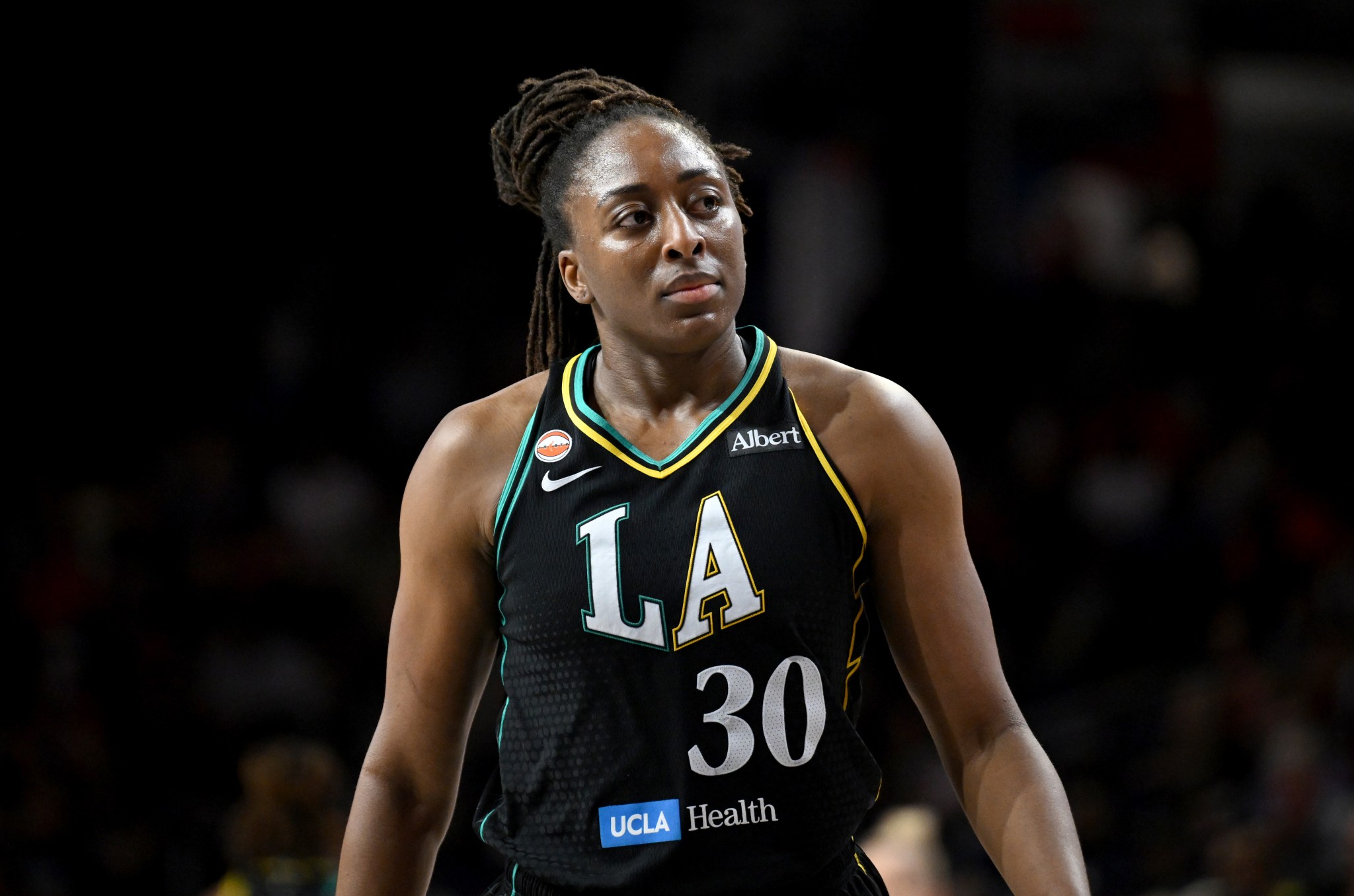
Nneka Ogwumike is on Zoom from her hotel room in Boston, getting ready for one of the biggest moments of her career: in two days, she’ll announce her retirement from the WNBA.
“I feel good,” she says. “I don’t know if excited is the right word, but I feel good.”
Ogwumike, 36, was the league’s No. 1 draft pick in 2012 and is currently playing her 15th season. While she may not be a household name outside basketball circles like some of the league’s younger stars are, she’s been a top player over the past decade-and-a-half: an 11-time all-star (the second-most in league history) and 2016 MVP and league champion with the Los Angeles Sparks. She’s part of a pro basketball family; her sister Chiney Ogwumike also played for the Sparks and has become a successful ESPN broadcaster, and sisters Erica and Olivia played in college and went on to play for Nigeria internationally.
Her legacy, though, will be as much about what she accomplished off the court as on it. In 2016, Ogwumike became president of the players’ union, known as the WNBPA. She steered the union through securing a major collective-bargaining agreement in 2020 that included historic protections like parental leave. This year, she had to do it again.
The WNBA experienced historic growth after the 2024 arrival of a generational rookie class including Caitlin Clark and Angel Reese, but player compensation did not keep up. Constant record-setting ticket sales and TV viewership were undermined by growing resentment among everyone from athletes to fans over the players’ salaries; Clark’s rookie pay was just $76,000.
It was Ogwumike who was tasked with turning that discontent into action. As union president, she had to corral a membership that included everyone from veterans who spent years earning salaries in the five figures to 22-year-old NIL millionaires into a cohesive unit able to take on the WNBA (and NBA, which owns much of the WNBA). At times, that united front threatened to fracture, like when stars Breanna Stewart and Kelsey Plum sent a letter outlining concerns with the union’s handling of negotiations. But the end result was a labor agreement that was historic for more than women’s basketball.
With allies in their corner like Nobel-winning economist Claudia Goldin, WNBA players negotiated a 364% raise, the biggest jump in the history of U.S. pro sports. The average player this season is earning $564,000, and WNBA players are now the highest-paid athletes in women’s team sports.
“It took a lot,” Ogwumike reflects. She had to show up as a competitor even while acting as a leader. “I had to manage people not seeing me as president while I’m on the court.” Then there were the toughest moments—like when the union didn’t hear back from the league for six weeks, or when they negotiated until the “wee hours of the morning” in New York and then had to show up to train the next morning.
During this year’s training camp—her first back with the Sparks after a two-year stint with the Seattle Storm—Ogwumike realized it was time for her to step back. “I was just thinking about how much this league has grown and the demand on players as it continues to grow,” she recalls. She played through some of the league’s lowest lows, when games were rarely broadcast on TV and when it came close to collapse during the pandemic. “Even though I know I’m up for the challenge, I wasn’t sure I needed to do it for longer than another year.”
Players respect Ogwumike and, amid dissatisfaction with league leadership, have sometimes called her their own “commish.” Ogwumike herself has in the past expressed interest in working in the league office, and believes that head office should include more ex-players.
Now that the reality of such a transition is closer, Ogwumike is less certain. In the near term, she plans to continue to split her time between Houston and L.A. and enjoy control over her own schedule for the first time in 15 years. She’s signed on to play for Project B, a soon-to-launch international league that proposes extending the playing careers of star players (men and women) with exhibition games around the world. Of a job in the league office, she says, “I don’t close doors.”
But Ogwumike is humble about what it might take to start a career as an exec during such a demanding growth period for women’s sports. “I’m not assuming that it’s just going to be a role that is made available or that is given,” she says. “I don’t feel as though today I am completely qualified for any type of executive role.”
But anyone who watched the WNBA’s tense negotiations can see the skills its union president must have gained: complex stakeholder management, knowledge of the details of the WNBA’s business, communication, high-stakes negotiation.
Ogwumike says she learned that leading can be “a little less tumultuous” when you “provide an environment for everyone to share their thoughts.” As president, she tried to be accessible and communicative. She tried to understand where players were coming from: “Everyone just has different lived experiences,” she says.
The unpredictable nature of negotiating made her slightly less Type A. “Being adaptable is incredibly important,” she learned.
She’s announcing her retirement during a rocky moment for the WNBA. The league has continued to sell out games and draw TV viewers this year, but its season threatens to be overshadowed by a culture war. After Indiana Fever player Sophie Cunningham said she opposes the inclusion of trans women and girls in women’s and girls’ sports, the wedge issue took over the WNBA news cycle (even without any actual eligibility questions in the league’s near future) and drew rightwing commentary. Fans are showing up to games wearing t-shirts supporting trans women, and shirts from the XX-XY brand built around excluding trans girls from girls’ sports. “I think ultimately there’s too much good and too much excitement happening in the league for it to be swallowed up by the noise,” Ogwumike says.
Ogwumike spent tense days sitting across the negotiating table from league execs including WNBA commissioner Cathy Engelbert. And Engelbert acknowledges her achievements too: “Nneka will retire at the end of this season,” she said, “leaving the WNBA much better than she found it.”
This story was originally featured on Fortune.com