

This is today’s edition of The Download, our weekday newsletter that provides a daily dose of what’s going on in the world of technology.
Nancy Pelosi’s replacement is ready to regulate AI
—Grace Huckins
As a California state senator, Scott Wiener authored legislation aimed at curbing the risks of advanced AI. Now, after winning a tight congressional race for Nancy Pelosi’s open San Francisco seat, he could play a key role in setting federal AI policy.
I spoke with Wiener only a few hours after he had been declared the victor. But he was already thinking about AI risk: during our 20-minute conversation, he used the phrase “recursive self-improvement” half a dozen times.
“We need to slow this down,” he told me. “Because it’s moving very quickly, and we could sleepwalk into a disaster.” Still, he describes himself as only “cautiously optimistic” about Congress’s ability to rein in AI. Here’s what he plans to do about it.
The backlash about data centers might really just be about electricity
—James O’Donnell
As voters went to the polls across the US last week, I was in Ashburn, Virginia, part of what’s known as Data Center Alley—the world’s largest data center hub. It’s also where the backlash sweeping the country arguably first began to take shape.
Big Tech has framed the data center uproar as a culture war over progress. But a few days in Ashburn convinced me the real fault line may be electricity: drawing it from the grid or generating it onsite provokes different forms of blowback.
The industry can improve its image, but it can’t escape the consequences of its enormous appetite for electricity. Find out why.
This story is from The Algorithm, our weekly AI newsletter. Sign up to receive it in your inbox every Monday.
The must-reads
I’ve combed the internet to find you today’s most fun/important/scary/fascinating stories about technology.
1 The FBI is investigating Nvidia CEO Jensen Huang’s affair
But Trump says he doesn’t think Huang needs to worry. (AP News)
+ Huang hired a PR firm known for handling sex scandals last year. (Wired $)
+ The allegations will likely spur new chip export restrictions. (Reuters $)
+ They also raise questions about Huang’s lobbying on China. (Verge)
+ And threaten the fate of the economy. (WP $)
2 France has accused Iran of hacking its supermarket fridges
Prosecutors are investigating the leaders of an Iranian cyber unit. (NPR)
+ Hackers are shifting to manipulating physical equipment. (Axios)
+ Is your smart kitchen next? (Wired $)
3 The Iran war has triggered a drop in global emissions
The main driver is energy supply constraints. (New Scientist $)
+ But the decline will likely prove temporary. (Gizmodo)
+ Our climate models have a big blind spot. (MIT Technology Review)
4 The FDA has ordered GLP-1s to carry warnings about blindness
It says the drugs may increase the risk of vision loss. (NBC News)
+ GLP-1s could also exacerbate eating disorders. (MIT Technology Review)
5 Australia is mulling criminal penalties for rogue AI
The proposals follow an AI agent hacking government systems. (BBC)
6 The Pentagon is planning to patrol the Moon
The project’s first five satellites could launch in 2029. (Ars Technica)
7 Two US cities have voted to ditch Flock surveillance cameras
York, Maine, and League City, Texas, have voted to ban them. (Vox)
+ What Flock’s defenders are missing. (MIT Technology Review)
8 Constant surveillance is changing how children grow up
Tracking apps can fuel anxiety and undermine resilience. (Atlantic $)
9 A tiny RNA molecule could explain how life began
Some researchers believe life emerged from self-copying molecules. (Quanta)
10 A sci-fi novel has won the Booker Prize for the first time
The End of Everything was awarded the prestigious honor. (Gizmodo)
Quote of the day
“Nvidia is not an ordinary company and Jensen is not an ordinary CEO; he is Nvidia, clearly sets the long-term strategy and direction, and pulls most of the company’s strings himself.”
—Stacy Rasgon, an analyst at Bernstein, tells Reuters why it will be so difficult to replace Jensen Huang as Nvidia CEO.
One More Thing

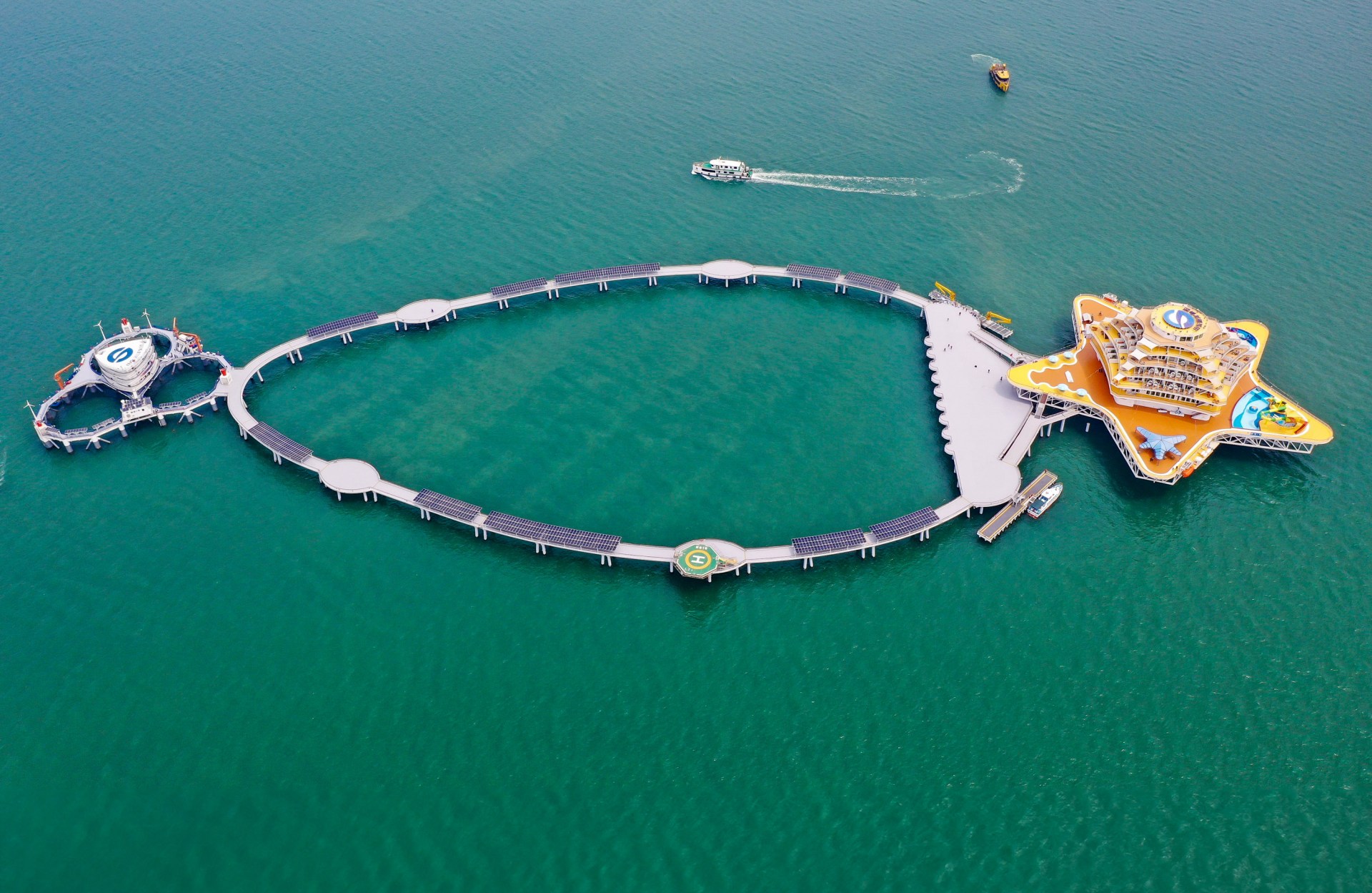
China wants to restore the sea with high-tech marine ranches
Just a short ferry ride from the Chinese port city of Yantai sits Genghai No. 1, a strange offshore complex that combines a tourist attraction with an industrial fish farm. It even has a seven-story visitor center shaped like a cartoon starfish. But its main purpose is to breed fish and release them into the ocean.
Genghai is part of China’s ambitious marine ranching program. Since 2015, the country has built 169 demonstration ranches and released at least 167 billion juvenile fish and shellfish. But the approach has also proved controversial.
Dive into China’s divisive plans to restore the seas with marine ranches.
—Matthew Ponsford
We can still have nice things
A place for comfort, fun, and distraction to brighten up your day. (Got any ideas? Drop me a line.)
+ “Earth artist” David Popa has created a new land-art portrait in the mountains of Norway.
+ The winners of Wildlife Photographer of the Year capture both the power and fragility of nature.
+ A Minnesota man who stopped a runaway school bus got surprised with a $1,000 cheque from Superman.
+ After more than two decades without regular star shows, Frank Lloyd Wright’s only planetarium has been restored.