

President Trump has tried three sequential ways to inflict tariffs on U.S. consumers under the guise of punishing trading partners with misuses of retaliatory ratios, alleged unfair trade practices, and emergency economic powers — but as with saber rattling and swords of Greenland, Venezuela, and Iran — the question is not just why, but why now?
As we write about in our instant New York Times bestseller, Trump’s Ten Commandments, Donald Trump only has so many tricks up his sleeve; and his latest trade and tariff tantrums reflect yet another diversionary maneuver as part of his “Wall of Sound” — his perpetual noise machine of constant, overwhelming distractions to divert attention away from bad news.
For Trump, good news has been hard to come by of late amidst a seeming cascade of bad headlines.
Trump was humiliated by raucous boos showering down upon him at the World Cup as he was pushed off stage while jockeying for a central photo position with the Spanish team he publicly disparaged while cheering for their rival Argentina.
Earlier this month, he was upstaged over Independence Day weekend by Taylor Swift’s glamorous, mellifluous, joyous, unifying wedding bash, which he mocked, in contrast to his angry divisive egomaniacal bellicose growls as he tried to coopt the 250th celebration by rebranding it around himself. Since last November, he has implausibly claimed that affordability is a hoax amidst persistently high prices, even as 3 million files are still unreleased related to convicted pedophile Jeffrey Epstein.
His plunging approval ratings stand at 37% while he is mired in quicksand in the Middle East as the Iran conflict flares back up amidst a flummoxing stalemate that has led to soaring energy prices and a $40 billion military price tag, even as the U.S. death toll rises to 17 with almost 500 injured. Even his determination to acquire Greenland has backfired thanks to the unified voice of the EU, the UK, and Canada. To top it off, he was booed at the World Cup on Sunday before beoing shooed offstage by a celebrating Spanish side.
As a result, Trump has retreated to a collection of what he sees as his greatest hits, old chestnuts such as attacks on law firms and universities, but especially a combative swagger, swinging the distracting cudgel of tariffs.
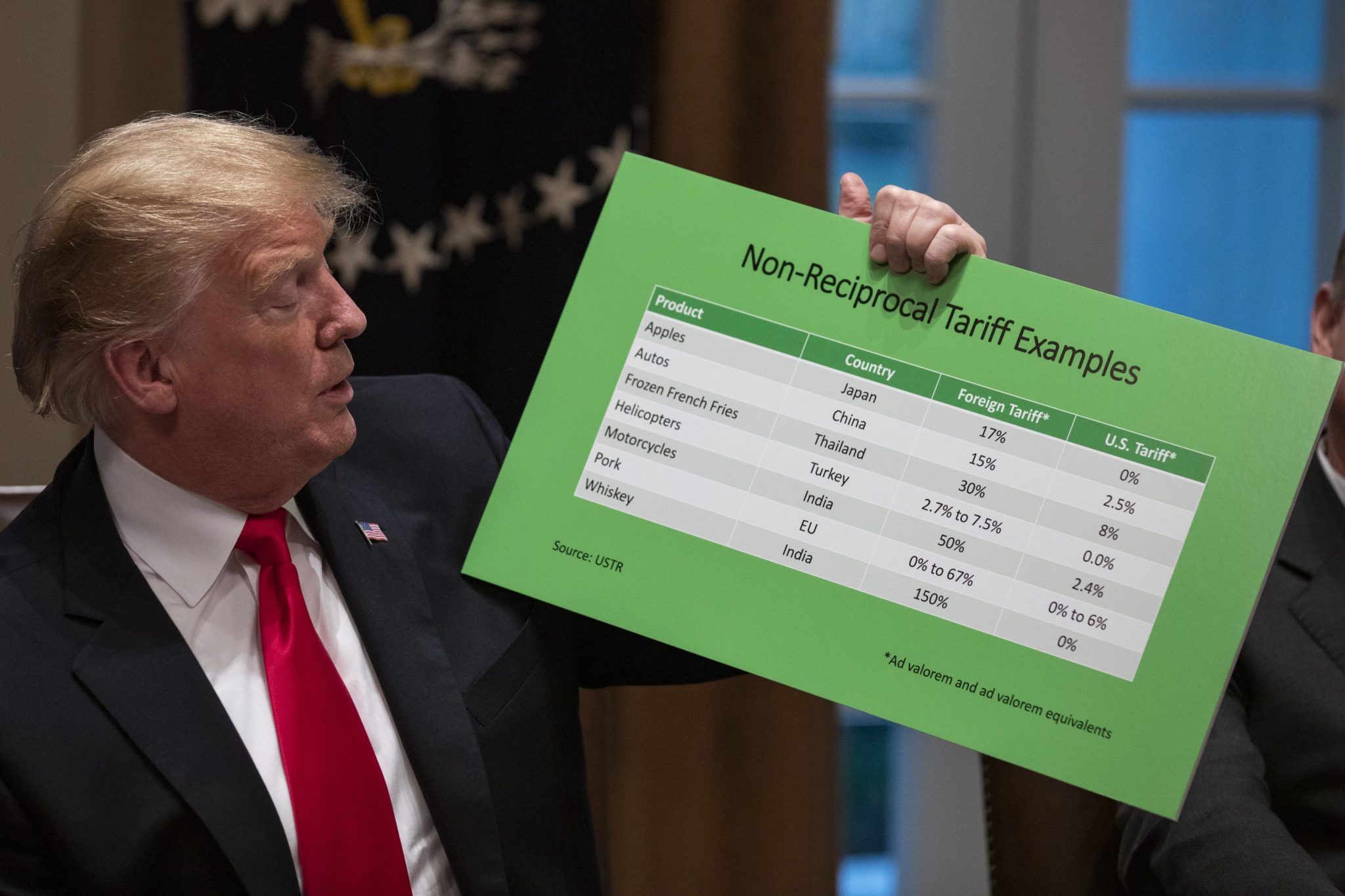
Trump has now tried at least three distinct, primary pathways to impose tariffs. First, on last year’s Liberation Day, he imposed so-called reciprocal tariffs around the world, wielding a bewildering and widely panned formula, under the auspices of his International Emergency Economic Powers Act (IEEPA) authorities. When the Supreme Court invalidated IEEPA as a basis to impose tariffs, Trump pivoted to impose a 10% universal baseline tariff under the authority provided to him by Section 122 of the Trade Act of 1974, which gives presidents temporary powers to balance of payments crises. However, those temporary Section 122 powers expire this Friday, July 24th, which means Trump is now pivoting to a third pathway to rebuild his tariff regime, proposing tariffs on up to 60 countries covering about 99% of US trade under Section 301, in response to alleged forced labor.
These three sequential pathways may sound confusing, but the slapdash way Trump has enacted tariffs under these three pathways have led to no shortage of head-spinning confusion. If they sound confusing, that is exactly the purpose: to create a haze of hostility. Consider Trump’s new tariff threats over the last week alone: Trump slapped a 25% tariff on Brazilian imports, hit $20 billion in Canadian goods—from autos to dairy—with a punitive 50% tariff that contradicted the erstwhile USMCA trade deal with Canada, announced 100% tariffs on generic pharmaceuticals, teased 12.5% tariffs on 60 countries, with much, much, much more teased to be coming in the days ahead.
It didn’t have to be this way with mounting tariff confusion flaring back up. After the Supreme Court decision, we previously wrote in Fortune that “In Greek theater, a deus ex machina arrives when a protagonist is hopelessly trapped — and a golden chariot descends from the heavens to rescue them from a conflict they cannot escape on their own. That is precisely what the Supreme Court has delivered to Donald Trump on trade. With his IEEPA tariff authority struck down as an illegal tax on American businesses and consumers, Trump has been handed an exit ramp from a trade war that was failing on nearly every front: alienating allies, stoking inflation, revolting bond markets, and uniting the American business community against him in rare collective opposition. The question now is whether Trump will climb into the chariot — or stand in the street and argue with the driver.”
But Trump has chosen not to take the easy way out, not only standing in the street arguing with the driver but running over the driver entirely while reverting back to reckless driving of his own. Trump loves tariffs for at least three reasons, as we wrote in Trump’s Ten Commandments. First, consistent with his rule of centralizing all power in himself, he can impose tariffs unilaterally without needing approval from anyone else, Congress included. Second, threatening the imposition of dauntingly high tariff rates is consistent with Trump’s favored approach to negotiations, which is to maximize leverage by starting with a punch in the face instead of building trust incrementally. And third, tariffs allow for Trump to divide and conquer, pitting foreign countries against each other in a bid for his favor and for preferential trade deals.
Trump might love all tariffs all the time, but CEOs distinctly do not. At our previous Yale CEO Caucus, over two-thirds of CEOs surveyed told us that Trump’s tariffs had been harmful to their own businesses, and 80% said that tariff costs had been passed on in part to consumers. 62% told us that they were not planning to invest more in manufacturing despite Trump’s tariffs.
At the same time, CEOs are not against all tariffs. In fact, that same survey found that a majority of CEOs actually support the use of targeted tariffs — key word targeted — when they rectify genuine, targeted trade imbalances rather than as an indiscriminate bludgeon.
Some of Trump’s advisors understand this distinction. For example, we frequently hear many CEOs offering praise for U.S. Trade Representative Jamieson Greer, whose consistent targeted approach to tariffs reflect reasonable seeming, fact and data-based arguments regarding unfair barriers to U.S. dairy, automobile, and liquors imports.
But while these challenges may be genuine, the slapdash execution of tariffs have only hindered American businesses. Canadian leaders such as former finance minister Chrystia Freeland point to growing backlash of Canadian consumers regarding US products as the real challenge, with resentful Canadians voluntarily boycotting U.S. goods and US tourism.
Freeland resembles Dorothy from the Wizard of Oz, drawing back the curtain that hides the smoke machine when the Wizard of Oz is not a wizard at all, but a carnival illusionist distracting the population. As psychologist Erich Fromm warned 70 years ago, “an illusion shared by everyone becomes a reality,” implying it is incumbent on critics to blow away the smoke and explain what is going on.
The opinions expressed in Fortune.com commentary pieces are solely the views of their authors and do not necessarily reflect the opinions and beliefs of Fortune.
This story was originally featured on Fortune.com