

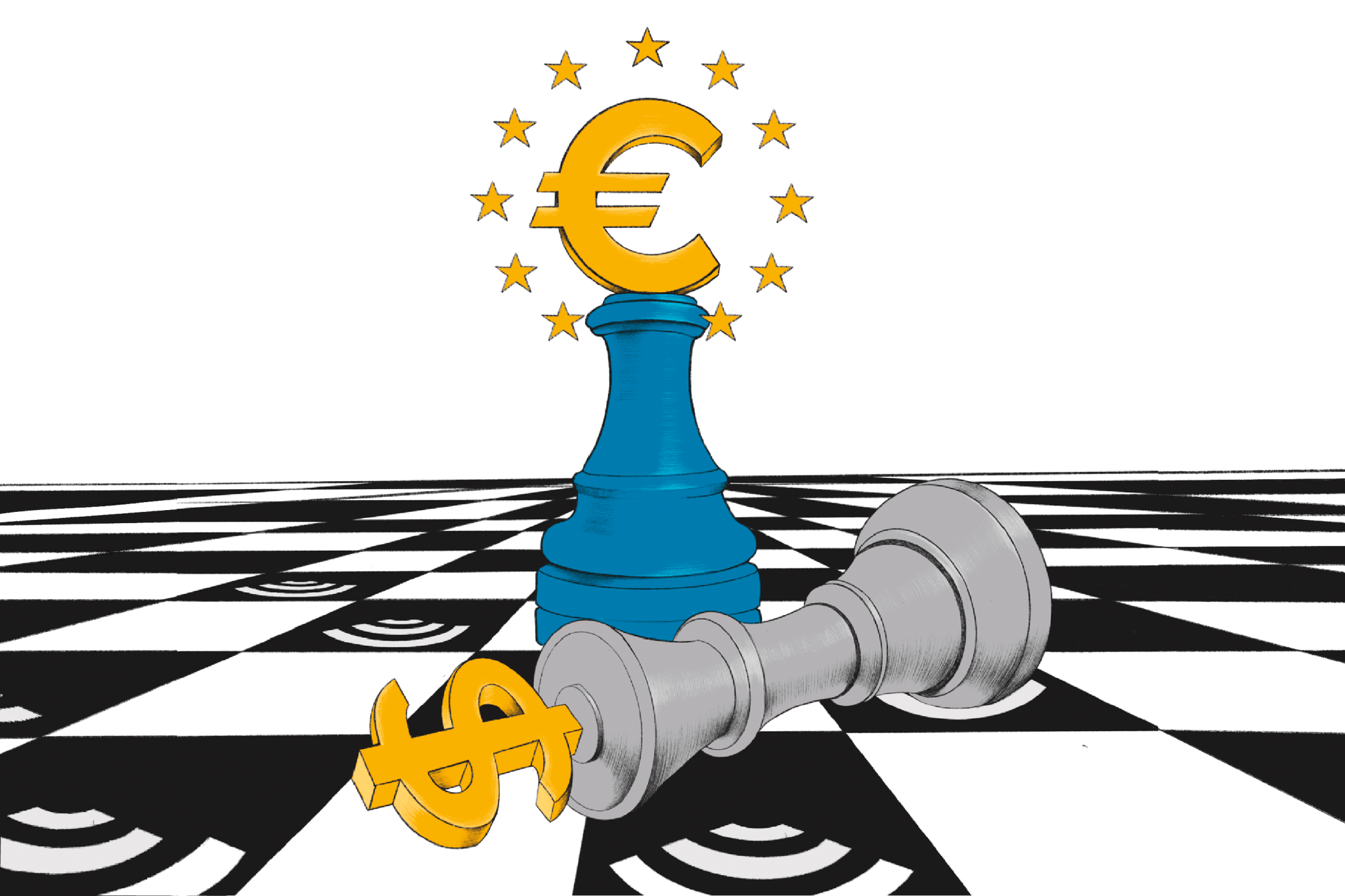
“Payment systems are not neutral; they are instruments of power,” Gilles Boyer, a French member of the European Parliament, said in June. “We Europeans have had many wake-up calls about our dependence on the U.S. We are fully awake now.” That same day, the European Parliament’s economic affairs committee voted 43 to 14 to back the digital euro.
The new form of digital central bank currency, proposed by the European Central Bank (ECB), will act as an electronic alternative to the physical money issued by the bank, offering people and businesses in the euro area a free and universally accepted option for making payments.
A 12-month pilot is scheduled to start in the second half of 2027, and 36 finance firms, including Deutsche Bank, Revolut, Adyen, and UniCredit, are signed up to participate. Businesses will need to accept digital euros, in-store and online, by 2029.
Finance is one of several fronts where EU officials fear the bloc has become dependent on U.S. companies. Almost half (47%) of the eurozone’s card payments value was processed by Visa and Mastercard in 2025, according to GlobalData. In the U.K., the concentration is even higher, with 95% of card transactions relying on payment systems owned by the two U.S. companies. Fifteen of the euro area’s 21 countries still lack a domestic digital payment solution, according to the ECB, and no current European payment scheme works seamlessly across the entire bloc.
European policymakers are wary of the disruption that could occur if access to the two U.S. payment networks were cut off. Under U.S. President Donald Trump, whose administration has leaned harder on financial sanctions as a foreign-policy tool, that urgency has grown.
“It won’t be easy to replace any of the existing payment methods overnight if one of the big networks decides to shut down in Europe,” says Radi El Haj, chief executive of RS2, a payments technology firm involved in the pilot. “The ECB wants Europe to have its own foothold rather than depend entirely on foreign-built infrastructure.”
Physical cash, the one form of money the ECB still fully controls, is fading from daily use. The share of companies in the eurozone not accepting cash has tripled to 12% over the past three years, according to the ECB, and it has already stopped issuing €500 notes.
By the numbers
47%
Percentage of eurozone card payments value processed by Visa and Mastercard in 2025
€1.3 billion
Estimated ECB development costs for the digital euro scheme
€233.8 trillion
Total value of noncash payments made in the euro area in 2025
Sources: GlobalData, European Central Bank
If central banks fail to create a digital alternative, they risk losing domestic monetary sovereignty. Stablecoins—digital tokens that are pegged to fiat currencies—are already gaining ground as an alternative form of digital money.
“A successful digital euro could boost the international role of the euro, helping Europe remain competitive as global payment systems become increasingly digital,” says Pierre-Antoine Vacheron, CEO of French payment company Worldline, another pilot participant. “It’s not a revolutionary improvement, it’s a genuine gap-filler,” he adds.
Kelly Devine, president of Mastercard Europe, says Mastercard has been “part of Europe’s economic fabric for decades.” The company plans to continue investing in Europe, which Devine says will strengthen “competitiveness and create more economic opportunity.”
What’s in it for business?
Businesses have previously voiced concern about the concentration of power in the two main payment providers. In May 2025, trade groups representing Amazon, Carrefour, H&M, Ikea, and other major retailers wrote to the European Commission urging it to curb the allegedly high card-scheme fees of Visa and Mastercard, citing research that showed a 33.9% increase between 2018 and 2022.
A digital euro would allow merchants to sidestep interchange fees altogether and settle instantly. That combination, says Martin Dowdall, a financial services regulatory lawyer at Winston Taylor, could make Europe “a cheaper, more attractive place” to do business.
A standardized payment method offers other benefits. Europe’s patchwork of national payment schemes—iDEAL in the Netherlands, Bizum in Spain, Blik in Poland—has resulted in different checkout experiences in each market. “Managing a wide mix of regional payment methods across different markets brings real complexity for businesses,” says Carlo Bravin, head of payments partnerships EMEA at Adyen. “While it’s still too early to see strong merchant demand for the digital euro specifically, there is consistent demand for choice and flexibility,” Bravin adds.
Rebecca Christie, a senior fellow at Bruegel, the Brussels-based economic-policy think tank, says the digital euro is unlikely to have an immediate impact on business, except in cash-heavy economies that have been slow to digitize. “Merchants will want to know, and reduce where possible, the costs of processing the new system before they embrace it,” she says.
The digital euro carries two structural advantages: mandatory merchant acceptance and mandatory distribution through banks. In 2029, once it launches, retailers across the EU will be expected to accept it, and every bank will have to offer it to customers. However, Vacheron adds: “The real test will be whether it achieves broad everyday adoption.”
Researchers who have tracked the project closely admit the case for it isn’t obvious. “It’s difficult to understand the need for a digital euro,” says Apostolos Thomadakis, a senior research fellow at the Centre for European Policy Studies. Part of the problem, he argues, is messaging. “Officials talk about financial stability, strategic autonomy, or a monetary anchor—abstractions that mean little to ordinary people.”
The track record elsewhere isn’t encouraging. Similar efforts have been, in Dowdall’s words, “complete and utter flops.” The Eastern Caribbean’s DCash pilot was suspended in 2024, and Nigeria’s eNaira, launched in 2021, remains operational but has seen limited adoption.
Integrating the digital euro into existing payment systems is its own challenge. Businesses will need new tools for handling refunds, reconciling payments, and guarding against outages. The system will also require ongoing maintenance, says El Haj. “Card networks already push updates twice a year, and the digital euro will likely demand the same ongoing adjustment.”
Banks face two risks: customers shifting deposits into digital-euro wallets instead of interest-bearing accounts, and the cost of running a second payment system alongside their existing one. The ECB estimates the digital euro could collectively cost European banks €4 billion to €6 billion ($4.7 billion to $7 billion) over four years. Its own setup costs are estimated to be €1.3 billion ($1.5 billion), with ongoing operating costs of roughly €300 million ($350 million) a year.
Banks may recoup some of the cost by charging merchants their own digital-euro transaction fee, although critics argue this is effectively re-creating the interchange model the digital euro was meant to disrupt. It has led to concerns that banks may be left footing a bill for infrastructure nobody uses.
A slow entry to a crowded field
For a project that depends on broad adoption, the digital euro is starting with noticeably uneven support from some of Europe’s largest banks. BNP Paribas, Commerzbank, and Rabobank have all backed Wero, a bank-funded digital wallet that has 50 million users.
“By the time a digital euro is issued, Wero could already be established as a significant European omnichannel payment scheme,” says Jacob Rider, senior program director at Projective Group, a financial services firm. “That raises difficult questions about whether Europe is effectively developing two solutions to the same strategic problem.”
However, Christie sees no conflict between the two efforts. “It’s important to have a clear public anchor,” she argues. “No one wants a situation where the private sector develops something that assumes the role of a public service and then becomes unavailable.”
The ECB maintains that the digital euro is meant to complement existing options, not replace them. “It’s about enhancing people’s freedom of choice,” says Josephine Nachtsheim, the ECB’s digital-euro spokesperson. “It is designed to fulfill its public policy objectives, such as preserving access to central bank money in the digital age and strengthening the resilience and strategic autonomy of European payments.”
The digital euro is a test case for a bigger question hanging over Europe: Can it build the critical infrastructure it needs fast enough to keep pace with the U.S. and China? “As a direct challenger to U.S. payment dominance, the digital euro is undoubtedly arriving late,” Rider says. “It will launch into a market where consumer payment habits are already deeply established and private European alternatives are scaling.”
The digital euro has taken six years to reach the pilot stage. During that time, Washington rejected its own digital dollar and passed the GENIUS Act to support private, dollar-backed stablecoins, which handled roughly $33 trillion in transactions in 2025. “Today, European dependence on U.S. card networks is a central concern, but by 2029, the main issue will be the influence of dollar-denominated private digital money,” Rider says.
In that sense, the digital euro may be solving yesterday’s problem.
This article appears in the October/November 2026: Europe issue of Fortune with the headline “Can Europe break America’s grip on payments?”
This story was originally featured on Fortune.com