

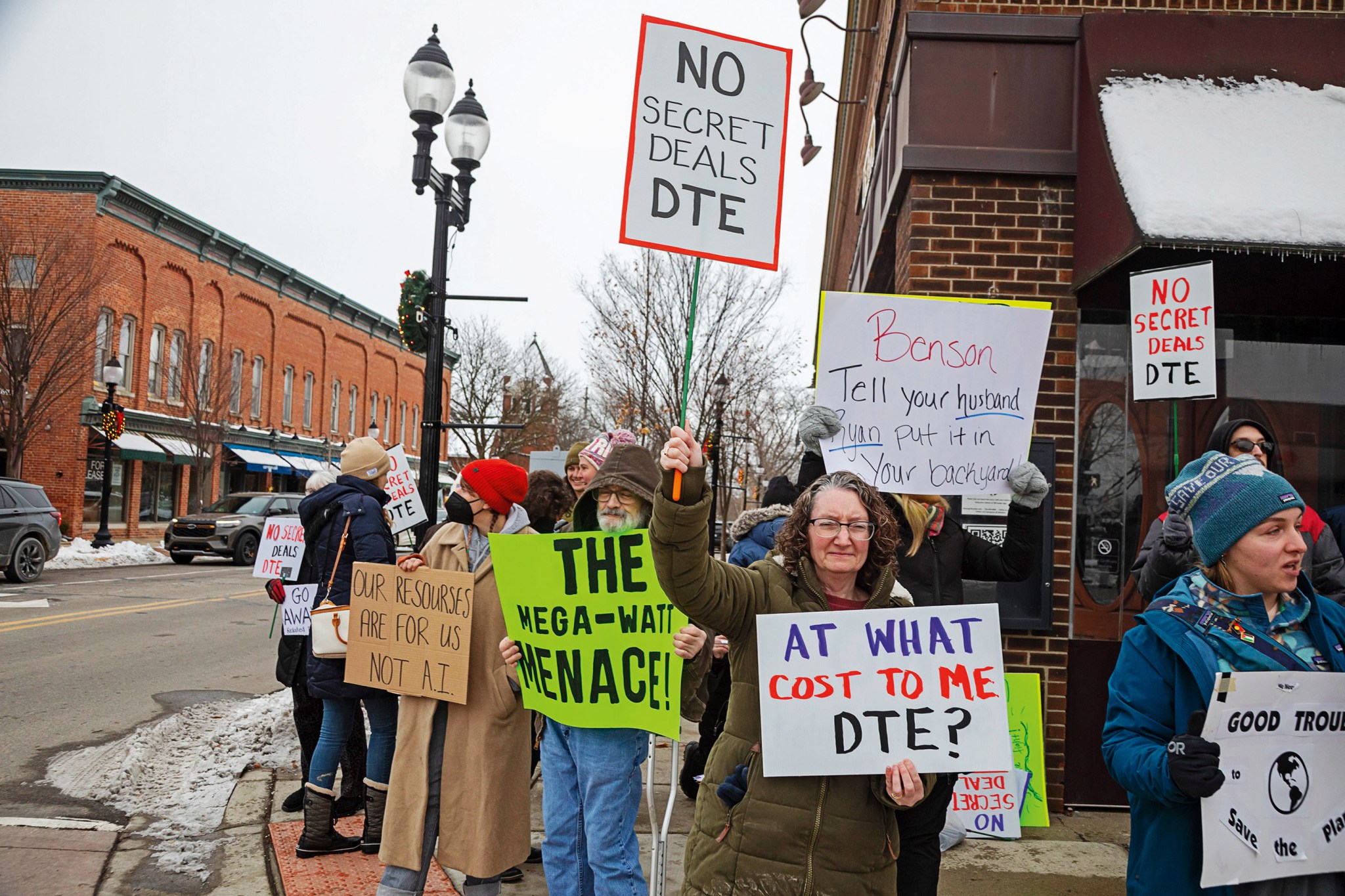
When Democrats won both houses of Congress in the blue wave of November’s midterm elections, some of them did so partly on the strength of campaigns featuring sharp criticism of the AI boom, and particularly the proliferation of gigantic data centers across the nation.
Sherrod Brown won back his Senate seat after calling his Ohio opponent “the face of data centers.” As Abdul El-Sayed, Michigan’s next senator, put it: “People really effing hate data centers.” Indeed, of 41 local data center measures on midterm ballots in 10 states, voters sided against the industry in 40. And in a March Gallup poll, 71% of Americans opposed a data center in their area, well above the 53% who opposed a nuclear plant.
Some Republicans—likely hearing the same opposition from their constituents—have distanced themselves from the president’s pro-AI rhetoric. In fact, opposition to runaway data center development may be a rare bipartisan stance.
It’s a classic “pocketbook issue”: Wholesale electricity prices near some data centers have risen as much as 267% in five years, according to a Bloomberg analysis, and data center operators are paying for only about 38% of the infrastructure costs linked to their growth, according to Cornell researchers. Meanwhile, the steady drumbeat of dire predictions about how AI will put us all out of work—if it doesn’t decide to kill us—haven’t helped the hyperscalers’ reputation.
Fear and fury over AI may have helped hand Democrats wins, but it also created a conundrum for them and their colleagues across the aisle: What will they—what can they—do about it? What is the path to addressing voters’ complaints about electricity, water, jobs, and doomsday scenarios without choking off a technology that drives growth, and that both Democratic and Republican administrations have argued is central to competing with China?
There are no easy answers, but here are some possible political approaches.
Ban them—at least temporarily
Some lawmakers have called for moratoriums, arguing for a pause to negotiate for better deals. It’s an approach some in both parties had subscribed to even before the election: New York Democratic Gov. Kathy Hochul froze permits for new hyperscale data centers for up to a year, while Texas Republican Gov. Greg Abbott halted new grid connections pending an audit.
After the midterms, Democratic Rep. Yassamin Ansari of Arizona posted: “Democratic agenda on day 1 needs to be a pause on advanced AI development.” Others in the party, including Sen. Bernie Sanders, have advocated for “democratic oversight” instead of an outright ban.
And not everyone wants a moratorium: Unions, especially those in the building trades, see data centers as a jobs bonanza. Even if moratoriums are put in place, the net result may be minimal, as blocked projects relocate to more welcoming communities.
Investigate and legislate
In Washington, Democrats’ leverage—with President Trump holding the veto pen—is mostly oversight and investigation: hearings, subpoenas, confirmations, and the budget. Rep. Greg Casar, who chairs the Progressive Caucus, has said he wants to haul in AI CEOs “to testify under oath.” Massachusetts Sen. Ed Markey warned that executives should “plant new forests for all of the subpoenas we’ll be printing.”
But subpoenas are a slow and blunt instrument. And grilling executives on camera can look like political theater. Voters asked for lower power bills, not viral clips.
Passing laws is harder for the opposition party, but some bills related to AI have bipartisan backing in both chambers. The Create AI Act, sponsored by Republicans and Democrats in both chambers, would make permanent a National Science Foundation program that lends computing power and data to researchers who can’t afford their own, a public counterweight to the handful of companies that control most AI infrastructure. The AI Whistleblower Protection Act would protect workers who report AI risks, and the AI LEAD Act would create a federal right to sue over harmful AI products.
One safeguard sits with an obscure set of officials: state utility regulators, who decide who pays for the power. Regulators can make data centers cover the grid upgrades they trigger, an approach some states are already implementing.
This might be Democrats’ best-case scenario for effecting oversight on the AI build-out, since the president can’t veto a state or local rate decision. It also targets what voters are actually angry about.
Refriend Silicon Valley
Lawmakers may have more luck with the carrot than the stick. Silicon Valley was once a Democratic stronghold, its leaders familiar faces in the White House during the administrations of Presidents Clinton and Obama. But that relationship has soured as tech leaders chafed at regulation that they have said stifled innovation.
Since 2024, many tech leaders have courted Trump, becoming close allies of—and donors to—the president and his campaigns. Most notably, Elon Musk reportedly spent almost $500 million supporting Republican candidates in the midterms.
One of the most consequential regulatory battles ahead is over AI itself. The industry funds groups on both sides of this debate: Leading the Future, a super PAC network backed by Andreessen Horowitz’s founders and OpenAI president Greg Brockman, wants lighter-touch regulation; while Public First, whose donors include the AI company Anthropic, backs stronger safeguards. It remains to be seen whether Democrats can demand accountability from executives who have grown used to a free hand.
Of course the November midterm elections weren’t won or lost entirely because of AI. And amid the ongoing backlash to AI data centers, some companies had already made conciliatory moves. Microsoft pledged in January to cover its own power costs; Meta and Amazon followed with billion-dollar community funds in August and October. Two days after the election, OpenAI rebranded its data centers as “compute campuses.”
Each of these pledges is voluntary. One way to address voters’ concerns would be to make them binding through state law and utility contracts—again, measures that Trump can’t veto.
Follow the money
Over all of this hangs massive, economy-shifting sums of money. The four largest cloud companies expect to spend $720 billion to $740 billion on capital projects in 2026. The Magnificent Seven make up about a third of the S&P 500, which means about a third of a typical index fund. ING estimates that AI-related investment now accounts for 37% of U.S. GDP growth.
If Democrats push too hard, they could end up owning an economic slowdown. If they don’t do enough, they could lose the voters who just elected them.
This article appears in the December 2026/January 2027 issue of Fortune.
This story was originally featured on Fortune.com