


The résumé sits unfinished in a Google Doc. The LinkedIn tab stays open, untouched. For millions of American workers, the search for something better has ground to a halt — not because the jobs aren’t there, but because they’ve done the math. The door, it turns out, is barely open.
More than half of U.S. workers — 53%, according to a new Glassdoor poll of over 1,300 professionals — say they have paused their job search entirely to protect their mental health. It’s a figure that captures something economists rarely quantify: the exhaustion tax. The psychic cost of a labor market that demands constant hustle while delivering, for many, almost nothing in return.
The door is closed from both sides
The structural backdrop helps explain why. Federal Reserve Chair Jerome Powell gave the condition a name last September: the “low-hire, low-fire” economy. The St. Louis Fed has since quantified it: as of late 2025, the hiring rate had fallen to 3.3% — just 0.5 percentage points above the all-time low recorded during the depths of the Great Recession in June 2009. The firing rate, meanwhile, sat at a historically low 1.1%. Workers aren’t stupid. They know that there’s nowhere to go right now.
The quits rate — the single best proxy for worker confidence in labor mobility — dropped to 1.9% in late 2025, tying cycle lows. Americans now believe they have only a roughly 45% chance of finding a new role within three months — a figure lower than during the peak of the COVID pandemic in December 2020, per Federal Reserve Bank of New York data.
Most U.S. CEOs had no plans to increase headcount in 2026, cementing the low-hire environment as a deliberate corporate posture rather than a cyclical dip. Monthly job growth now averages roughly 50,000–100,000 — well below the 150,000–200,000 range considered healthy.
The rational math of burnout
Compounding the immobility: job seekers are being ghosted at a three-year high, with more than half of applicants reporting no response from employers in the past year. Hiring experts connect the trend directly to AI-inflated application volumes overwhelming recruiters — the same feedback loop burning candidates out. Workers send more applications because response rates are low; response rates stay low because volumes are overwhelming. Nobody wins.
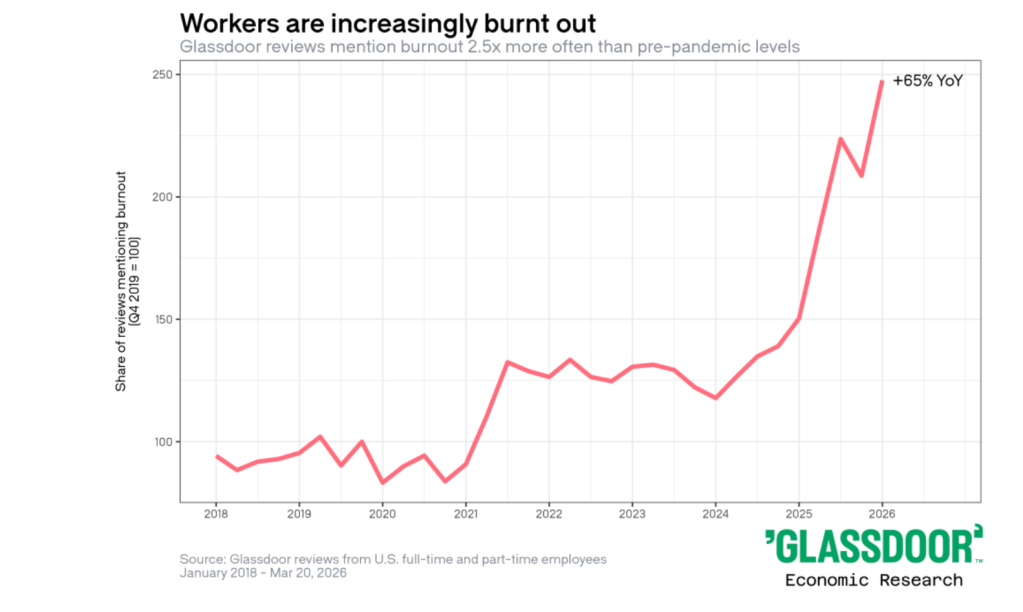
Burnout mentions in Glassdoor company reviews surged 65% year-over-year in Q1 2026. The pressure is sharpest in nonprofit, healthcare, and technology sectors that have seen the steepest increases in exhaustion since 2019.
“One of the biggest signs of exhaustion is noticing a lack of emotional regulation — you’re more irritable, more anxious, more frustrated,” said Jade Walters, a TEDx speaker and founder of career development platform The Ninth Semester. “You have to set boundaries, because if you keep chugging through and you’re feeling burnt out, you’re just going to keep hitting a wall.”
Stuck in the wrong job
For those still employed, the trap has another dimension: they’re locked in roles that don’t fit. In November 2025, the number of workers who wanted full-time positions but could only find part-time work hit 1.65 million — the highest since January 2018. Long-term unemployment is climbing too: about a quarter of unemployed individuals had been jobless for at least 27 weeks as of December 2025, the highest proportion in nearly four years. The 12-month average duration of unemployment stood at 23.9 weeks as of March 2026 — the highest since October 2022 — with hundreds of thousands simply exiting the labor force after unsuccessful searches.
The outcomes, when workers do land something, are increasingly compromised. Only 25.2% of new hires landed their dream job in Q4 2025, down sharply from 36.2% the prior quarter. Over a quarter took pay cuts. Only 30% even negotiated. “We’re seeing more decisions being made out of necessity,” ZipRecruiter economist Nicole Bachaud told Fortune.
Gen Z watches — and walks
The toll falls unevenly, and the youngest workers are drawing the starkest conclusions. Gen Z is encountering a job market dramatically more punishing than the one millennials navigated, facing longer timelines and higher rejection rates. Their response is increasingly radical: nearly one in four Gen Z workers are now actively considering ditching desk jobs for the trades, with three-quarters associating white-collar work with burnout and instability. For a generation that watched millennials grind themselves down at open-plan desks, the corner office — always a stretch — no longer looks worth the cost.
The paradox of the “healing” market
The cruel irony is that by conventional measures, the labor market is technically improving. The April 2026 jobs report showed 115,000 jobs added and unemployment holding at 4.3%. But that headline masks a stark bifurcation: the market is healing for everyone except those in white-collar office roles, where AI-driven restructuring continues to compress opportunities in the very segment of the workforce most likely to be actively searching. J.P. Morgan chief U.S. economist Michael Feroli calls it “resilience in the face of headwinds” — but for workers staring at a 45% job-finding probability, it doesn’t feel like resilience. It feels like standing still.
Organizational psychologist Adam Grant has pointed to research showing the frequency of breaks matters more than their duration for cognitive recovery — that even 5-to-10-minute pauses throughout the day measurably help. The Glassdoor community agrees: the top coping mechanism cited by 39% of job seekers is applying selectively rather than broadly, followed by 28% who swear by structured routines with hard stop times. The new job search wisdom isn’t to push harder. It’s to protect what’s left.
Invisible drag on the economy
For HR chiefs and labor economists, the implications extend beyond individual well-being. A workforce too burned out to job-hunt is also a workforce less likely to self-sort efficiently — staying in mismatched roles, suppressing wage competition, and reducing the economy’s capacity to allocate talent where it’s needed most. The burnout epidemic isn’t just a mental health story. It’s a productivity story, and a macroeconomic one. The stagnation is also producing increasingly unequal outcomes by race, age, and education, as the workers least able to weather a long search are the ones most likely to give up entirely.
The American worker isn’t just burned out at work. They’re burned out on the idea of looking for the next job. And in a low-hire, low-fire market where the math genuinely doesn’t favor moving, that paralysis — quiet, invisible, and structurally rational — may be one of the most consequential labor stories of 2026.
For this story, Fortune journalists used generative AI as a research tool. An editor verified the accuracy of the information before publishing.
This story was originally featured on Fortune.com