

Young women are falling behind young men in the entry-level job market — but it’s not primarily artificial intelligence that’s to blame, according to the researchers behind one of the country’s most closely watched labor-market trackers. The finding comes from new data shared exclusively with Fortune ahead of its public release tomorrow.
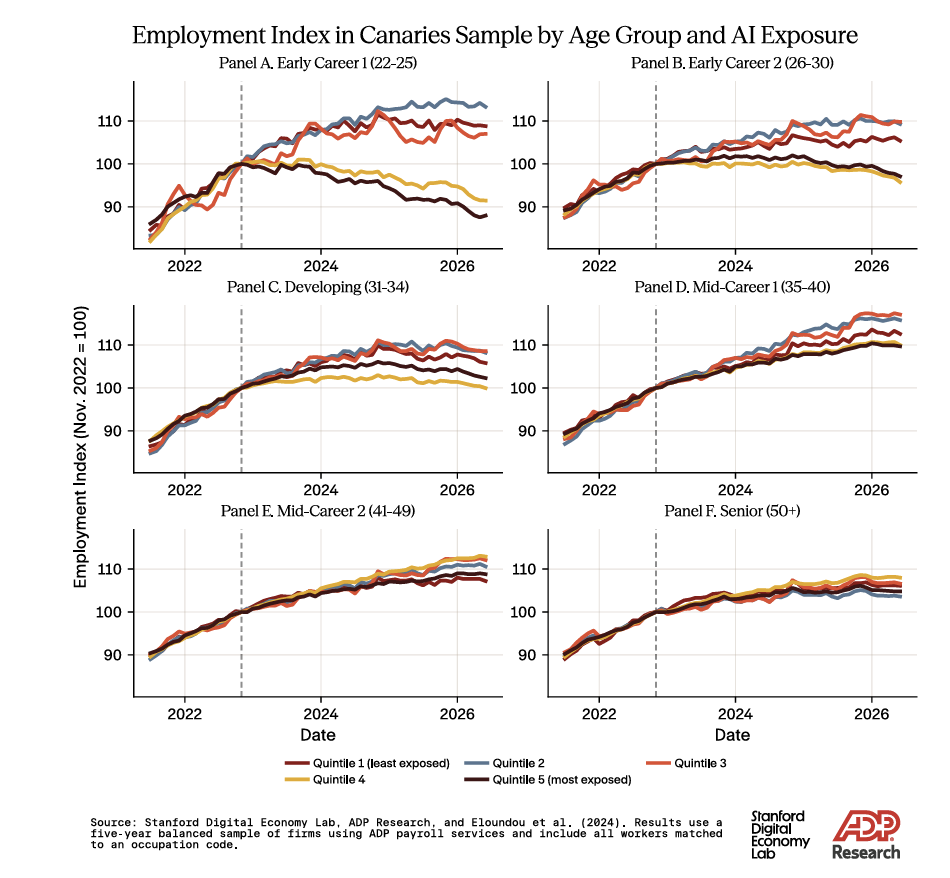
The data comes from an update to the “Canaries Dashboard,” a joint project of the Stanford Digital Economy Lab and ADP Research, led by Erik Brynjolfsson and Nela Richardson that documents how generative AI is reshaping entry-level hiring. Since its debut, the dashboard has established a clear and unsettling pattern: workers age 22 to 25 in the most AI-exposed occupations, like software development and customer service, have seen employment decline sharply since ChatGPT’s late-2022 debut, even as overall U.S. employment growth has stayed healthy. That divergence hasn’t reversed — it’s deepened steadily, growing by roughly half a percentage point per month since the researchers’ original paper last year.
The latest update breaks the numbers down by gender for the first time, and young women in the Canaries sample do show weaker employment growth than young men in the same 22-to-25 age bracket. The researchers found two forces working at once: women are more likely to work in AI-exposed occupations to begin with, and, separately, they see somewhat slower employment growth than men at every level of AI exposure.
Most of the gap traces back to that occupational mix: 43.8% of women work in the most-exposed category of jobs and 21.2% in the second-most-exposed, compared with 32.4% and 18.1% of men.
But when the researchers isolated how much of the growth gap tracked specifically with AI exposure, the connection wasn’t there. Women’s slower growth shows up in low-exposure jobs almost as much as in high-exposure ones**. In** the least-exposed quintile, employment among 22-to-25-year-old women grew just 1.3% a year after late 2022, compared with 2.7% for men — a gap nearly as wide as in the most-exposed category, where women’s employment shrank 4.5% a year against 2.5% for men.
“These gaps are a feature of our broader sample; they are not noticeably correlated with AI exposure,” the researchers wrote in materials shared with Fortune. Their conclusion: “Gender-based differences in the relationship between AI exposure and employment trends appear to be driven primarily by occupational composition, rather than disparate trends within given sets of occupations.”
Why that distinction matters
It would be easy to read the headline composition numbers — women twice as likely as men to work in high-exposure jobs — and assume AI is the story. Prior research has pointed that way: the International Labour Organization has found women’s jobs nearly twice as likely as men’s to be exposed to generative AI, and separate estimates have put women at three times the automation risk of men.
What the Canaries data adds is something those exposure-based studies couldn’t measure: actual, realized employment outcomes, tracked month by month across 4.6 million workers and more than 730 occupations. If AI exposure were driving the gender gap, the gap should widen sharply as exposure rises. It doesn’t — it’s roughly the same whether a job is barely touched by AI or squarely in its path, which is precisely why the research team is looking elsewhere for an explanation.
A story about labor market structure, not AI treatment
The finding doesn’t undercut the dashboard’s broader thesis about entry-level hiring — if anything, it sharpens it. Brynjolfsson and Richardson’s core argument has been that AI is disrupting tasks before it disrupts jobs, hammering the mechanical, easily automated work — summarizing, formatting, scheduling — that typically gets handed to the newest employees on a team, regardless of who they are. Richardson has framed the automation-versus-augmentation distinction as the real variable: occupations where AI augments human work show durable employment growth, while those where it automates tasks outright are contracting — and early-career roles sit disproportionately in that second group.
Women’s overrepresentation in AI-exposed roles means they’re more exposed to that dynamic, too — but as a byproduct of occupational sorting that predates generative AI by decades, not because AI treats women differently once they’re in a given job. What’s actually behind women’s flatter growth curve across the board — education mix, industry concentration, hours worked, return-to-office effects — is a question further research is expected to answer over time.
This story was originally featured on Fortune.com