

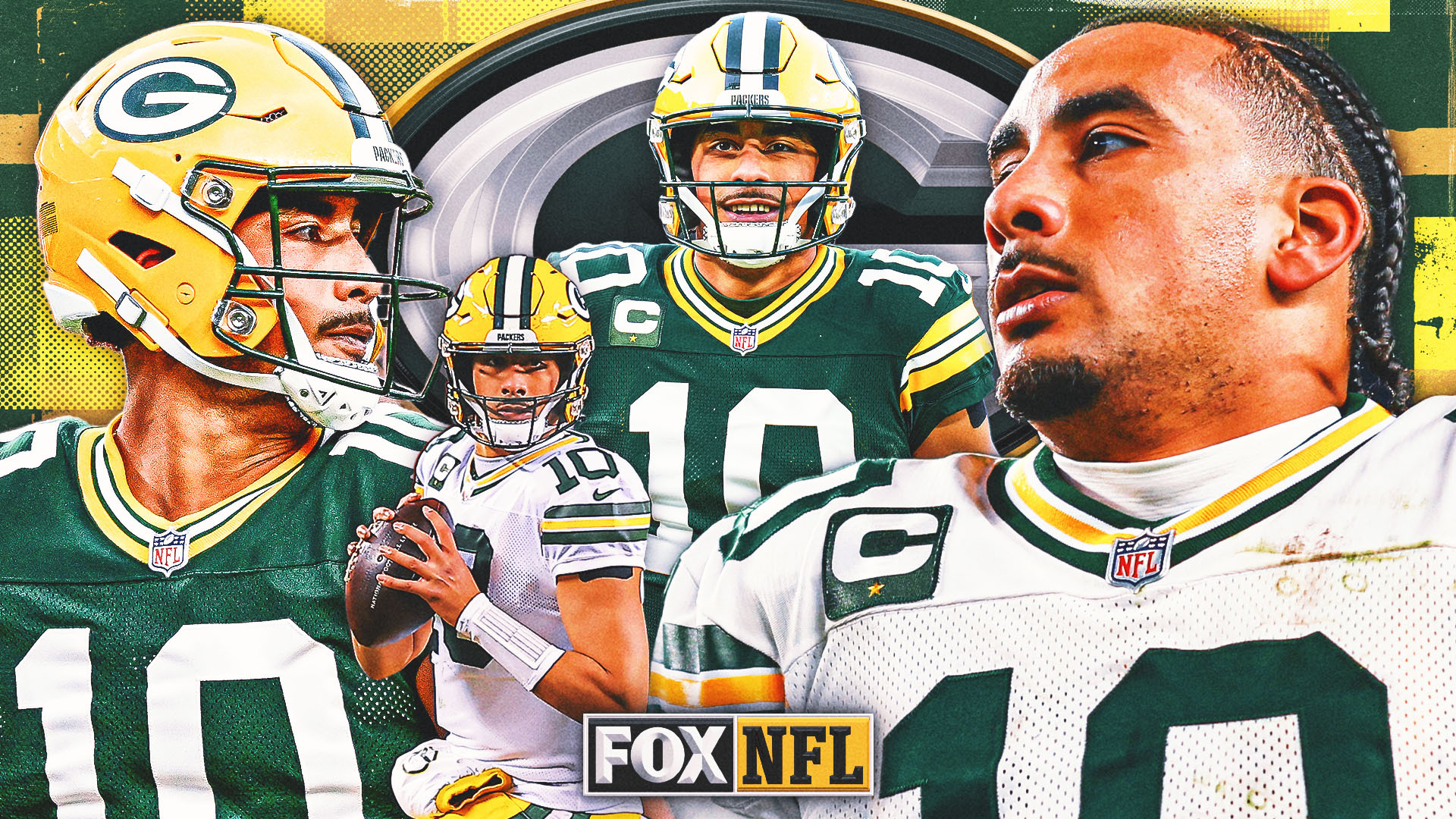
GREEN BAY, Wis. — The story of Jordan Love’s development has long been that he had the luxury of sitting safely behind Aaron Rodgers for two years, learning from a master while avoiding bad habits and delaying the pressure of the pass-rush and the immediate weight of NFL stardom. But that narrative isn’t true. Not exactly. Love was Green Bay’s starter in 2021 for one game. And it was a catastrophe for the rookie quarterback. Even he’ll admit it. In a Week 9 matchup, with Rodgers sidelined, the Kansas City Chiefs overwhelmed Love with the most predictable concept you can throw at a rookie: the all-out blitz. He wasn’t ready for it. So the Chiefs kept doing it. They blitzed him on 54% of his dropbacks and pressured him on 46%. Love completed only 55.9% of his passes and threw an interception. It was ugly, and the Packers lost 13-7. “I didn’t have answers where I could change the play at the line of scrimmage and feel comfortable enough to do that stuff in that game,” Love told me during training camp. “That was kind of a wake-up call.” That was the moment that Love started to become an NFL quarterback. It wasn’t from sitting and watching. It was from playing and failing. “In that moment, you feel like you let the team down,” Love told me. “For me watching it back, there was just so much good stuff to learn from and grow from. A team in the NFL — if you’re not able to beat whatever they’re giving you, they’re gonna keep coming with it, and that’s what they did.” He added: “I’m glad it happened.” When Love returned to the starting lineup two years later, he was prepared. He had answers for the blitz. Love had made it his mission to have full command at the line of scrimmage to set his offensive line protection, to audible to a “kill” call or to change the routes of individual receivers. When it comes to beating the blitz, he’s now the NFL’s best, tied with Rams QB Matthew Stafford, the reigning MVP. Last season, they both had a .30 expected points added per dropback against the blitz, per Next Gen Stats. Love generated explosive plays on 21.3% of his dropbacks against the blitz, and completed 6.2% of his passes over expected, per NGS. And Love did it last year without any one receiver who could’ve been Stafford’s WR2, with Davante Adams ranking above Christian Watson, Romeo Doubs and the Packers’ other receivers from 2025. It’s Love’s ability to beat the blitz that has quietly made him one of the NFL’s most underrated players. “That’s where I’ve grown the most,” Love told me. “That’s Aaron’s specialty [at the line of scrimmage]. And all that stuff stems from him seeing pre-snap, ‘OK, this is going to be a bad play. Let me change it. Let me get to something else I like.’ And everybody being on the same page when he’s signaling stuff out. “I’ve had to grow into that.” Here’s an example. A few Packers offensive linemen brought this play up when I spoke with them in the locker room. Green Bay was playing the Bears in Week 14 when, on third-and-10 in the red zone, Love recognized pre-snap what was once his Achilles heel: the all-out blitz. So the Packers QB calmly signaled to his top receiver, Christian Watson, to adjust his route. With seven rushers coming, Love took just 2.6 seconds to throw. Fading away, he lofted the ball to Watson, who was open for an easy touchdown. “If the quarterback doesn’t see it … the play’s screwed,” Packers guard Aaron Banks said. “We don’t really care if they blitz or not. To be honest, we trust [Love]. We trust that he’s going to make the right decision, put the ball in the right place, and he trusts us to pick up the blitz.” It must be frustrating for a defensive coordinator — developing and designing a play for months, only to see it defeated handily. Defensive coordinators only get to run 10 to 15 plays per game, often trotting out their base defense with standard assignments and rules. So when they get that chance, the play shouldn’t crash and burn. Love makes sure that it does. It must be even worse for the pass-rushers. “From my personal experience, I don’t think so,” Packers superstar edge Micah Parsons said, jokingly, when I asked him if it was difficult to rush Love. But … well, the stats don’t lie, my man. When Parsons was a Dallas Cowboy, he played against Love once. Parsons rushed Love 19 times and managed just one pressure. That was, at the time, the lowest pressure rate of his entire career. And so it made sense that Parsons finally conceded the difficulty. “That six-foot-five frame. He’s super elusive in the pocket. He can really just make any throw. Watching it from the sidelines in the family, I don’t think people grasp how good he is against the blitz,” Parsons said. “He has that ability to look over and still find guys that he needs to.” Love has so many redemptive qualities — the physical gifts (like height), the work ethic, the high football IQ and the unique arm talent. They all blend together to make Love into a one-man blitz-beater. Packers offensive coordinator Adam Stenavich called it Love’s most underrated quality. “That’s probably it,” Stenavich told me. “His ability to stand in the pocket and make those throws for sure. … He has no fear.” Love is such a quick thinker and processor — and not just against the rush. Stenavich said he trusts Love to absorb plays in just one day. In rare cases, they’ve put new plays into their game plan in the middle of a game. “He’s able to see a picture and then visualize it in his brain and then go out and execute,” Stenavich told me. The knock on Love is the counting stats. And with so much focus on fantasy football, that might be all that matters to some fans. He finished the 2025 season with 3,381 passing yards, 23 passing touchdowns and six interceptions in 15 games. It is, frankly, nothing special. In 2025, Love didn’t throw the ball all that often when compared to Stafford, for example. It’s what has kept Love out of the MVP conversation for the past few years. Still, in 2025, Love’s EPA/dropback (.19) tied Stafford for second in the NFL. Patriots QB Drake Maye, the MVP runner-up, finished first at .25. In advanced metrics and efficiency stats, Love is keeping pace with MVP-caliber quarterbacks. “He may not lead the league in passing yards or anything like that, but I think the biggest thing is, like you said, the EPA. When we are throwing the ball, what happens?” Stenovich said. Love’s game might be an acquired taste when you compare him or Josh Allen or even Maye. But it wasn’t long ago that Love had 4,159 passing yards, 36 total touchdowns and 11 interceptions in 2023. All these numbers fail to represent all the progress Love has made at the line of scrimmage — which reveals all the progress he’s made behind the scenes in the meeting rooms and on the practice field. Which reveals the quiet truth. He’s elite. Love entered the league as a highly-touted but equally-doubted prospect out of Utah State. (That’s right: Utah State.) At that point, it didn’t take much to stop him — it took just the simplest blitz in a coach’s playbook. Now? You can’t fool Love. Not with the blitz. Not when you drop seven or eight into coverage. Not when you throw him wrinkles. Yes, he learned from those two years on the bench. But that one time the Packers threw the rookie into action might’ve put him on the fast track for the MVP hunt in 2026.