

It’s cold, it’s very, very noisy, and—if I can be quite honest with you—I’m not feeling super relaxed.
I’m currently around 300 meters, or 1,000 feet, beneath the North Sea, in a dark, dank cave. It smells weird. And I am increasingly aware of the pressure from millions of tons of seawater just above my head, pushing down with a force of more than 500 pounds per square inch. Picture a baby rhino standing on a postage stamp.
Only fabulous engineering is keeping me from being crushed, drowned, disappeared. My safety goggles are foggy.
Just a few hundred meters away, someone is about to blow up a giant rock wall. Luckily, earlier that day I was given a full safety briefing, and I’ve got a special hard hat on. “Don’t worry—if you don’t make it, we’ll have your stuff sent back to your office,” geologist Anne-Merete Gilje tells me, straight-faced. Ah, Norwegian humor.
“It’s kind of a lifestyle. You have to be a little bit crazy to work underground all the time.”
Niclas Brusehed, tunnel foreman, Implenia
I’m in this odd situation under the iconic fjords of Norway to visit what will soon become the world’s longest and deepest subsea road tunnel, called Rogfast (short for “Rogaland Fixed Link”). I want to understand how you make something as audacious as a 26.7-kilometer (16.6-mile) highway that sits 390 meters (1,280 feet) below the sea at its deepest point. And also—at a time when it can feel hard to get anything done, especially in the US—to reassure myself that ambitious engineering is still possible. That we can still make things.
The Norwegians already have the world’s longest subsea tunnel, the 14.4-kilometer Ryfylke, though Rogfast will dwarf it. Their expertise has attracted attention from Japan, Spain, Morocco, and even a number of US states, whose representatives were due to visit the site in May, just weeks after I went. They, too, want to know how Norway does it.
The answer: tons of explosives.
The entire endeavor feels like an obstinate refusal to give in to physics and geology. “It’s always exciting,” Niclas Brusehed, a tunnel foreman at Implenia, a Swiss firm involved in the project, tells me. “Every blast creates a new world.” There’s not just the blasting of the tunnel itself—although that is an epic project on its own—but an immense logistics challenge involving huge ventilation shafts, extreme pressure, underground roundabouts, and the complex Norwegian geology. Oh, and the water. So much water.
“This is the longest continuous blast on the sea,” says John Olaf Østerhus, assistant project manager at Implenia. “Never been done before. We can’t buy a book to see how we do this.”
All right, time to fish my phone out of my safety suit—don’t want to forget this.
On another planet
Arriving at the rock face where the tunnel hits seabed feels like being on the moon. It’s a huge slab of stone at the end of a long, dark, wet, wide passageway that’s lit (barely) by electric lights. Giant vehicles carting tons of rocks rumble past periodically, and we pull to the side of the road to let them by.

Workers clock in for 12-hour shifts, 6 a.m. until 6 p.m., deep in the bowels of the Earth where no natural light can reach. Twelve days on, 16 days off. They eat their lunch at a table in this damp cave surrounded by portacabins plastered with safety notices. “It’s kind of a lifestyle,” says Brusehed, laughing. “You have to be a little bit crazy to work underground all the time.”
These crazy engineers are here to make tunnels the Norwegian way. The nation frequently uses what’s known as the drill-and-blast method instead of the tunnel-boring machines that are more typical elsewhere. This approach offers more flexibility for long, complex operations with varied rock types. Each blast adds about five to six meters to the tunnel.
Rogfast is being built inward from the ends to speed things up. The construction company Skanska is leading from the north, coming from the island of Vestre Bokn; Implenia has joined a company called Stangeland to tunnel from Randaberg in the south, which is where I am. Both teams use multiple laser scans each day to consistently measure their orientation and check that the tunnel is exactly where it should be. The two ends should meet sometime in 2029, with no more than just a few centimeters of deviation.

Norway has constructed more than a thousand kilometers of tunnels over the past several decades. The depth and length of these make the best efforts to date of Elon Musk’s Boring Company—a mere 2.7-kilometer tunnel in Las Vegas that is just 3.6 meters wide—look rather pathetic. The country’s spectacular setting makes such builds necessary; while Norwegians are proud of having the second-longest coastline in the world after Canada, getting up and down the west coast requires multiple ferry rides between islands, which can move extra slowly when the weather’s bad.
After it’s completed, which is scheduled to happen in 2033, Rogfast should help eliminate two ferry routes and cut the five-hour journey between the southwestern cities of Stavanger and Bergen by 40 minutes. It will funnel four lanes of traffic deep beneath the fjords of Boknafjord and Kvitsøyfjord, and at one section a relatively scant 50 meters of rock will separate the drivers speeding through the tunnel from the bottom of the North Sea. There are also, delightfully, two undersea roundabouts located 220 meters below sea level.
But the first job is to contend with all that water.
The never-ending battle
Subsea tunneling is defined by a constant, ultimately unwinnable battle with the ocean. The sheer weight of the sea above you, and the crushing pressure, means the water will always find a way in. “It’s the volume and the pressure that’s the biggest risk,” says Ole Magne Rønning, project leader for Implenia/Stangeland.
So before tunnel engineers blow stuff up, they need to check for leaks. Into the rock face ahead of them, they drill a number of narrow holes that go 25 to 30 meters deep to see how much water comes through. Even a small probe can unleash a torrent within seconds, says Rønning. When road traffic eventually rumbles through these tubes, water will still trickle from the rocks; it will be redirected into mini reservoirs dotted throughout the tunnel network before being pumped back out.
Since stopping the water entirely is impossible, the game is instead to push it away as best you can. If the leakage in front of the rock face exceeds a certain limit—around four liters per hole per minute—then the next stage is “grouting”: pumping a mixture of cement-like sludge into new holes that fan out in the ceiling above and around the face. Ideally, you address the leaks that are ahead of you; “it’s a lot more difficult to stop a leak that’s behind you,” says Rønning.
At one point deep below the sea, I chat with Tarald Johan Nomeland, the project’s grouting specialist. He’s big and bearded, perhaps one of the most Norwegian-looking men I’ve ever met. He stands, towering above me, and shakes my hand in his giant bear-like paw. Grouting is in Nomeland’s family; his dad did it too. He loves it. “There’s not necessarily just one solution to a problem,” he says, eyes flashing with delight as he describes fighting the interminable battle with the water. “There may be many solutions.”
The amount of grouting needed determines how fast the project can move. On the Skanska side, for example, some weeks the face moves 30 meters; others, as few as 10.
This isn’t made any easier by the rock itself. The seabed around Norway was shaped by glaciers during the Ice Age. As the ice retreated, it dragged softer rock with it, carving out the fjords for which the nation is so famous. But this legacy makes digging subsea tunnels particularly gnarly. Much of what’s left is the hard, difficult-to-break stuff.
And it’s not just one type of rock, either. There are “big wide areas where we don’t know what’s down there,” says Gilje, the geologist who is a project manager for the Norwegian Public Roads Administration, which is in charge of the entire project. Before any construction started, boats took core samples from the seabed along the planned tunnel route. Seismic surveys from the ocean surface—like those that look for oil in the region—helped fill in the gaps.
Each kind of rock presents its own challenges, so the engineers “have different techniques for different problems,” Gilje explains. For example, they found that one southern section contains a lot of phyllite. Phyllite is considered “nice” to work with. It is formed from a combination of shale, siltstone, and mud over time and is pretty compact, with few cracks to let water through. Its compact nature means it requires more explosives per blast, however. It also contains a lot of quartz, which is toxic when released into the air during blasting. So workers wear monitors to measure their exposure, and a curtain of water sprayed in front of the rock face helps prevent too much from drifting into the tunnel.
The northernmost part of the route, meanwhile, is made mostly of solid granite and a similar rock called gneiss. Both are hard but contain fractures that allow the seawater to trickle through.
The rock type can also change over just a short distance. So during the dig, every 80 meters or so, an engineer sends sound waves through the face to expose its secrets and help evaluate its structural integrity. The rock is graded on a scale of 1 to 5, with 5 being the worst and least stable. “When you are reaching class 5, then it’s almost like soil. It’s not rock anymore,” says Rønning.
This investigation informs the kinds of structural supports each section will need—from steel rods that fan out above the rock face like an umbrella, for the strongest rock, to reinforced-concrete arches that hold up the weakest. To seal everything off, the team sprays a substance called “shotcrete,” liquid concrete mixed with reinforced-steel fibers, onto the walls throughout. A plastic membrane and concrete panels are fitted later.
“It’s going to be a very safe tunnel,” Gilje says. “It’s going to last for 100 years.”
Strange dangers
While I may not be brave, at least I don’t get seasick. Back at the surface, I board a small ferry that putters and sloshes its way from the mainland to Kvitsøy, a sparsely populated municipality made up of 365 separate islands and islets—something its 550 or so inhabitants are very proud of, even though most of these islands are uninhabited chunks of rock.
For the next few years, Kvitsøy’s population will experience a tiny boom as its largest island hosts a semipermanent encampment of contractors and engineers working on what is probably the most complex part of the Rogfast project: the giant ventilation shafts that will sit roughly halfway along the tunnel’s length to bring fresh air into the entire network, and remove the stale air in turn.
It’s also one of the reasons why road tunnels are much more complex than rail tunnels. Cars pump out fumes that have to be vented away. During construction, fresh air flows in via huge plastic tubes suspended from the ceiling, but eventually, Rogfast’s air will come in through two nine-meter-wide shafts that will bore down from Kvitsøy’s surface: one to bring it in, one to take it out.

Creating these shafts is a wild process. First, narrow boreholes are drilled from the ground down into the tunnel 210 meters below the surface. A vertical drill rig is then pulled up through the hole from the bottom, widening the shaft to 2.4 meters as it ascends.
Then explosives are set off on the island’s surface, bashing down through the rock to widen the shaft. A large digger pushes the resulting debris down the narrower, not-yet-exploded length of shaft below, sending rocks barreling toward the tunnel at the bottom like socks tumbling down a laundry chute. Trucks haul away the fallen rocks. This process happens in stages, repeating at regular intervals, opening up the passage a bit deeper with each pass. Once it’s all done, steel rods are installed in the shaft’s walls to keep it secure.
Down below, I stand beneath one of the narrow guide holes for one of the two ventilation shafts. The ceiling soars overhead—a strangely beautiful cathedral, cragged and shadowed by lamplight.
Besides poisonous air, the epic nature of these engineering projects throws up other surprising dangers. For example, Rogfast will take about 30 minutes to drive through. It doesn’t seem that long, but the project’s designers worry that the monotonous environment may lull some drivers to sleep.
Engineers faced this problem with Ryfylke—which, as the current longest subsea road tunnel, has been a testing ground for its bigger sibling. It relieves the tedium with a large hall that opens up in the middle of the tunnel, lit by colored lights that change each day. When Rogfast is finished, artists will be invited to do something similar, using lights, colors, and shapes to keep drivers alert.
Then there are the environmental risks. What is there to do with all the loose rock created by the blasts? The engineers predict 8.5 million cubic meters’ worth. That’s enough to fill more than 2,500 Olympic-sized swimming pools. The solution is to bring it back to the surface, where it can be used to create new land. To do this, the project employs a giant barge designed to split open and dump 350 tons of rock in one go.
But adding more rock particles to the water can make it hard for fish to breathe, says Elizabeth Austdal Paulen, Implenia’s environment lead on the project and my fellow passenger on the windy (and soon to be redundant) ferry over to Kvitsøy. Her team monitors their levels in real time: If the particulate count is too high, the drops must pause until the new rock has settled on the seabed. The goal is to protect lobster fishing, a vital part of the local economy, and to safeguard the breeding time for cod, which was an issue when I visited.
Finally, of course, on top of all this are the many hazards for the people who are actually doing all this blasting and digging and hauling. Or, say, for the visitors who are finding their inner nine-year-old getting a little too giddy about what’s next.
Time to blow
Before I’m allowed underground, I must sit through a short safety briefing, where I learn there are multiple hazards when you’re that deep. Fires, for instance, can break out, exacerbated by the way the salt water affects electronics. Just a week earlier, a car caught fire somewhere deep within the network. “You have to be aware all the time,” says Anne Brit Moen, the project lead for Skanska. “It’s a very harsh, harsh climate.”
After the session, I’m given a hi-viz suit, the hard hat (which has built-in ear protectors), gloves, safety glasses, and reinforced boots. I get instructions on how to operate the oxygen mask that will be in the car with me, and a device to put in my pocket that will track my exact location on screens in the control room. The device also acts as a personal warning system: If it vibrates and a blue light appears, then a blast is imminent and I must get to safety; if it vibrates and glows red, umm, well, that’s bad news and it’s time to evacuate.
“If you’re the first to the rescue chamber, press the green button … close the hatch and sit down and be calm.”
Ketil Myklebost, project manager, Implenia
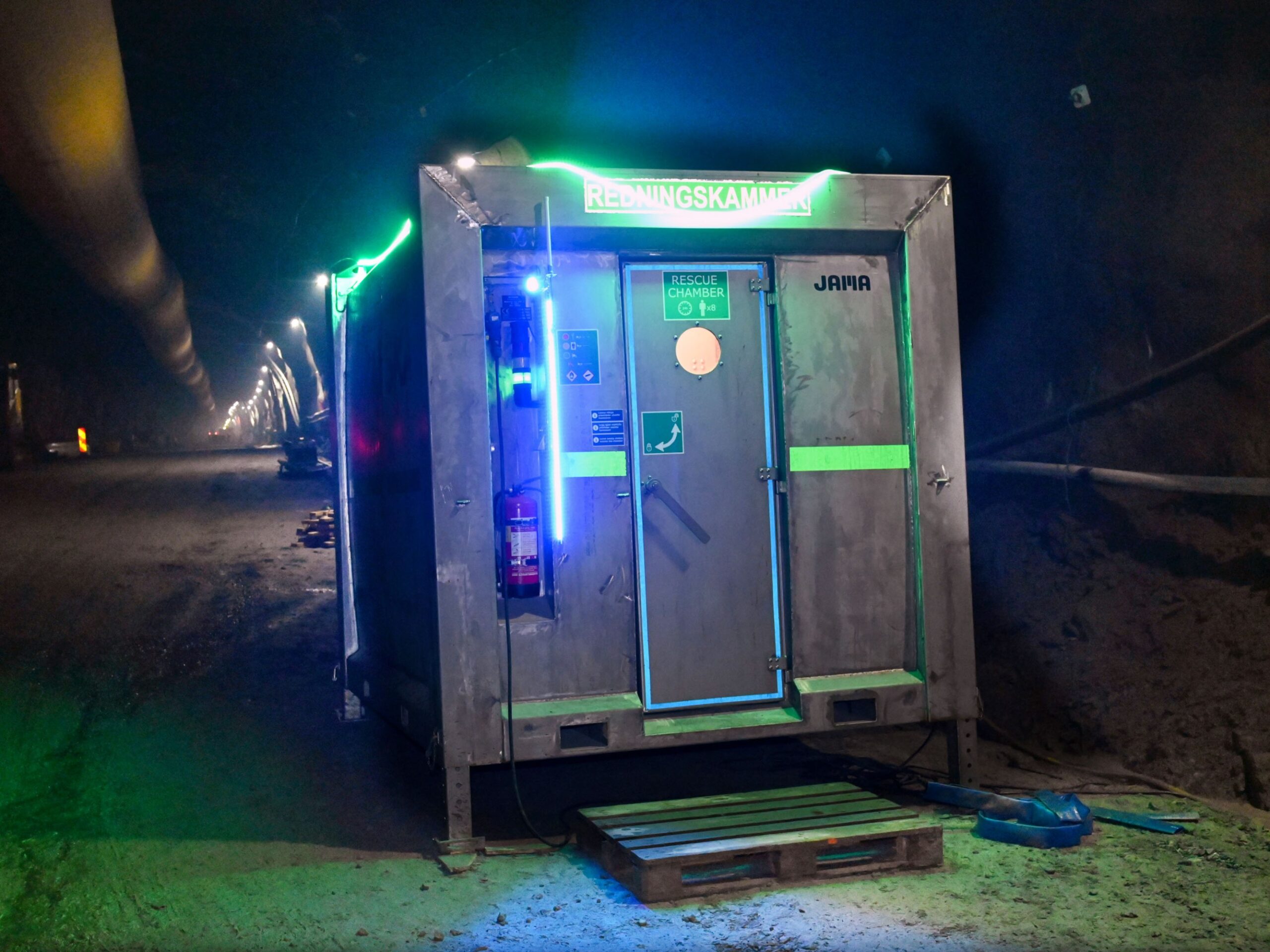
But let’s say I can’t—I’m too deep underground. Then there is a second, less fun option. I’m given instructions on how to access the rescue chambers. These metal boxes—about the size of a large van—can squeeze in around 16 people, and each contains chocolate, water, radio equipment, a defibrillator, and enough oxygen for 24 hours. I see them dotted throughout the tunnels as we drive through. Worst-case scenario, I’m supposed to get to the nearest one, sit tight, and hope to get rescued.
“If you’re the first to the rescue chamber, press the green button for 15 seconds to release pressure,” says Ketil Myklebost, a project manager at Implenia. “And then close the hatch and sit down and be calm.”
Calm, right. Okay.
In the hours before my visit, a huge drilling “jumbo” rig puts as many as 180 holes deep into the rock face. The number, angle, depth, and spacing of the holes is calculated in advance using software but finalized at the face—here, they’re almost six meters deep. At one point, I clamber up into the jumbo and inspect the pattern on its screen, matching it against what I can see on the huge rock face, which stands more than 12 meters tall and wide.
The holes have been stuffed with an explosive slurry. (Someone quips that if I get any on my clothes, I’ll be stopped at the airport as a terrorist. A Norwegian joke, again.) As I watch, workers in a kind of cherry picker fit each hole with a detonator and make sure they’re all connected to one another by wire, ready to be triggered remotely.
Then my personal safety device starts vibrating. When I take it out of my pocket, it’s blinking blue. Showtime.
How far back do I need to be? “It’s dangerous in this direction 500 to 600 meters, but if you’re around the corner you can be closer,” says Sveinung Brude, project manager for the Norwegian Public Roads Administration.

I stand by the worker who will trigger the blast from what looks like a small briefcase with an antenna. Then he presses the button.
The shock wave hits me before I hear it. My chest vibrates. In the first few milliseconds, a propulsive thump briefly stuns my senses, followed immediately by a rolling, crumpled thunder.
Just a moment later—almost instantly, really—wind billows through the cavern. Rocks clatter as they crash off the walls. I try not to show any panic. (That was meant to sound like that, right?) A hush falls, and there’s just the tinkling of stones as they bounce and skip amid the rubble.
Dust rises into the air, and there is a strange smell.
Through my ear protection it sounds like the end of the world.

The explosion itself is a beautiful choreography: Blasts are initiated one after another, starting from the center. In video footage, you can just about hear the sequential pitter-patter of the charges as they go off. (In person, it’s a bit more all-at-once and overwhelming.)
Rogfast has just crept another few meters closer to completion.
I find myself grinning. Maybe there’s something extremely primal about being near an explosion? I’m not sure. I look down at my hand, where I have my phone out, recording the intensity of the moment.
Except … I wasn’t recording. The stupid rubber safety gloves I’m wearing must have stopped the command from going through.
Oh no. Oh no.
A once-in-a-lifetime opportunity, and I, uh, blew it. “I WASN’T RECORDING!” I shriek.
“It’s better that way,” says Rønning, walking off into the gloom. “You’ll remember it.” How very Norwegian.