

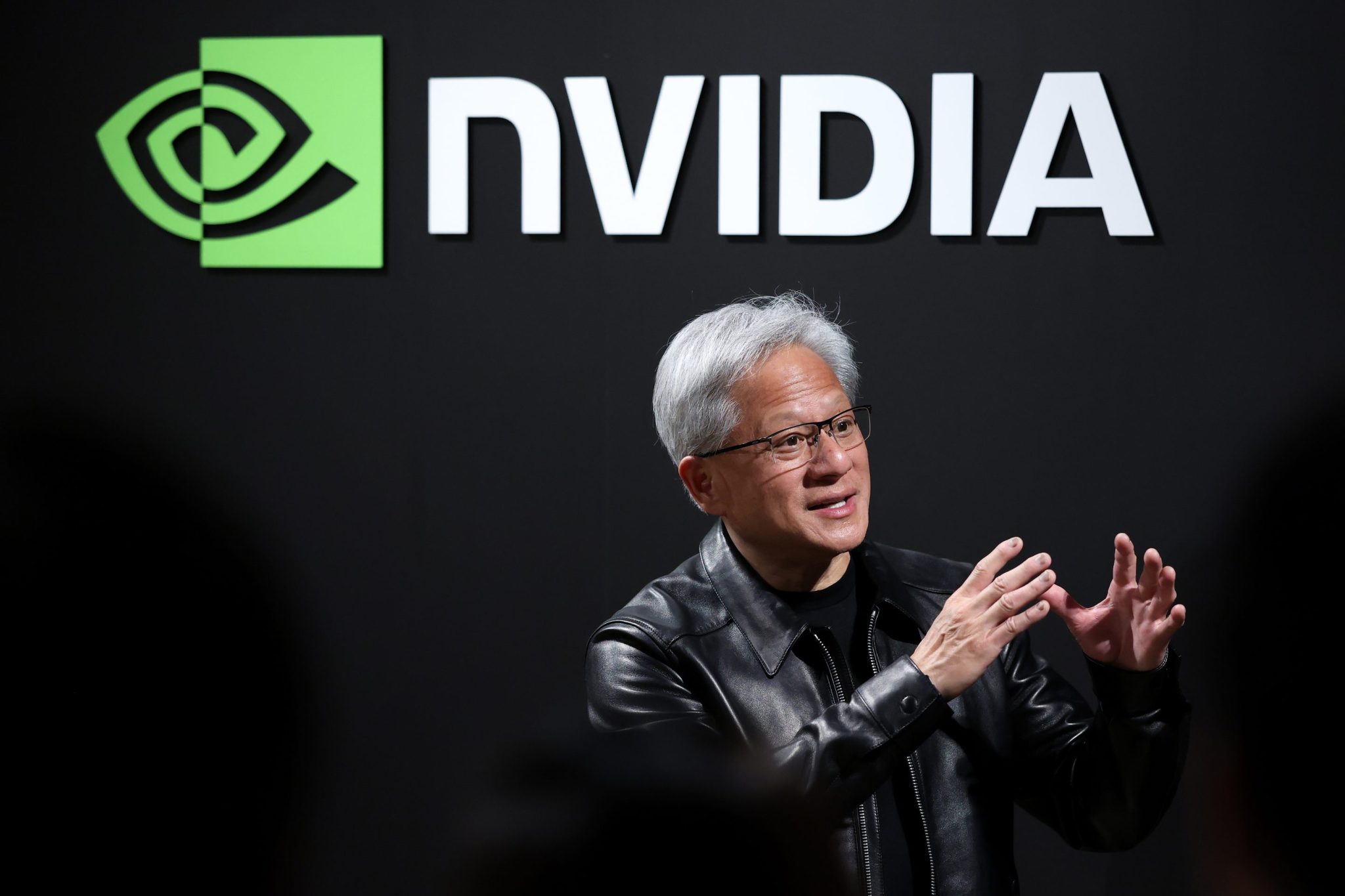
The semiconductor industry is notorious for going through boom-and-bust cycles, but Nvidia CEO Jensen Huang doesn’t think a downturn is imminent, although he echoed reasoning that’s been used to justify past bubbles.
After chip stocks soared on the AI frenzy, they have sold off hard in recent weeks amid renewed fears about the sustainability of massive capital expenditures. That’s despite strong earnings and guidance from top chipmakers as well as persistent shortages due to insatiable demand.
In an interview with Axios cofounder Mike Allen, Huang was asked if the sector is due for a bust, and he replied “no, not for a while.” Allen then offered “so this time is different?”
“This time is different because this is not demand driven,” Huang said. “This time is different because it’s not seasonal. It’s not demand driven means seasonal-demand driven. This is industrially driven, meaning the fundamental technology of computers is changing.”
He added that the world needs a whole new layer of infrastructure, namely AI, which requires chips, estimating that the industry must become five to 10 times larger over the next decade.
Of course, coming from the CEO of the top AI chip supplier, such optimism is not surprising. But what’s notable is his endorsement of “this time is different.”
That’s been used in the past to argue why astronomical gains can continue on their trajectory and continue defying fundamentals or logic, such as during the dot-com bubble.
The phrase is now so infamous it’s considered a red flag whenever there’s even a hint of it creeping into buoyant forecasts, similar to now-rueful declaration of “mission accomplished.”
Meanwhile, hyperscalers have been committing hundreds of billions of dollars a year on capital expenditures to build out AI infrastructure as quickly as possible.
While they previously drew on their enormous cash-generating operations for the capex, it’s no longer enough anymore, and even Alphabet recorded negative cash flow. As a result, tech giants are issuing more debt.
Huang was pressed on whether he’s worried that Nvidia’s customers are tapping the bond market to buy his chips. He answered that he’s not, pointing to the shift in computing.
“So this future is a whole new way of doing computing that’s fundamentally different than the past, and we need a lot more computers,” he explained.
AI has also been profitable for companies like Anthropic, especially as customers discover how useful agents can be, Huang noted. AI is now at an inflection point, where more of the technology must be built as it generates profits and boosts productivity.
He acknowledged that the bubble will burst someday, but it won’t happen anytime soon as the AI buildout is still in the early stages.
And the limited supplies of chips, land, power, and construction workers that are holding back even faster growth are actually beneficial, as they push out the timeline when supply eventually exceeds demand, Huang argued.
“We basically are constrained in every single direction, in every single way,” he said. “That constraint is good. That constraint is what holds the system back. So that gives us plenty of time to go build out these infrastructure.”
This story was originally featured on Fortune.com