

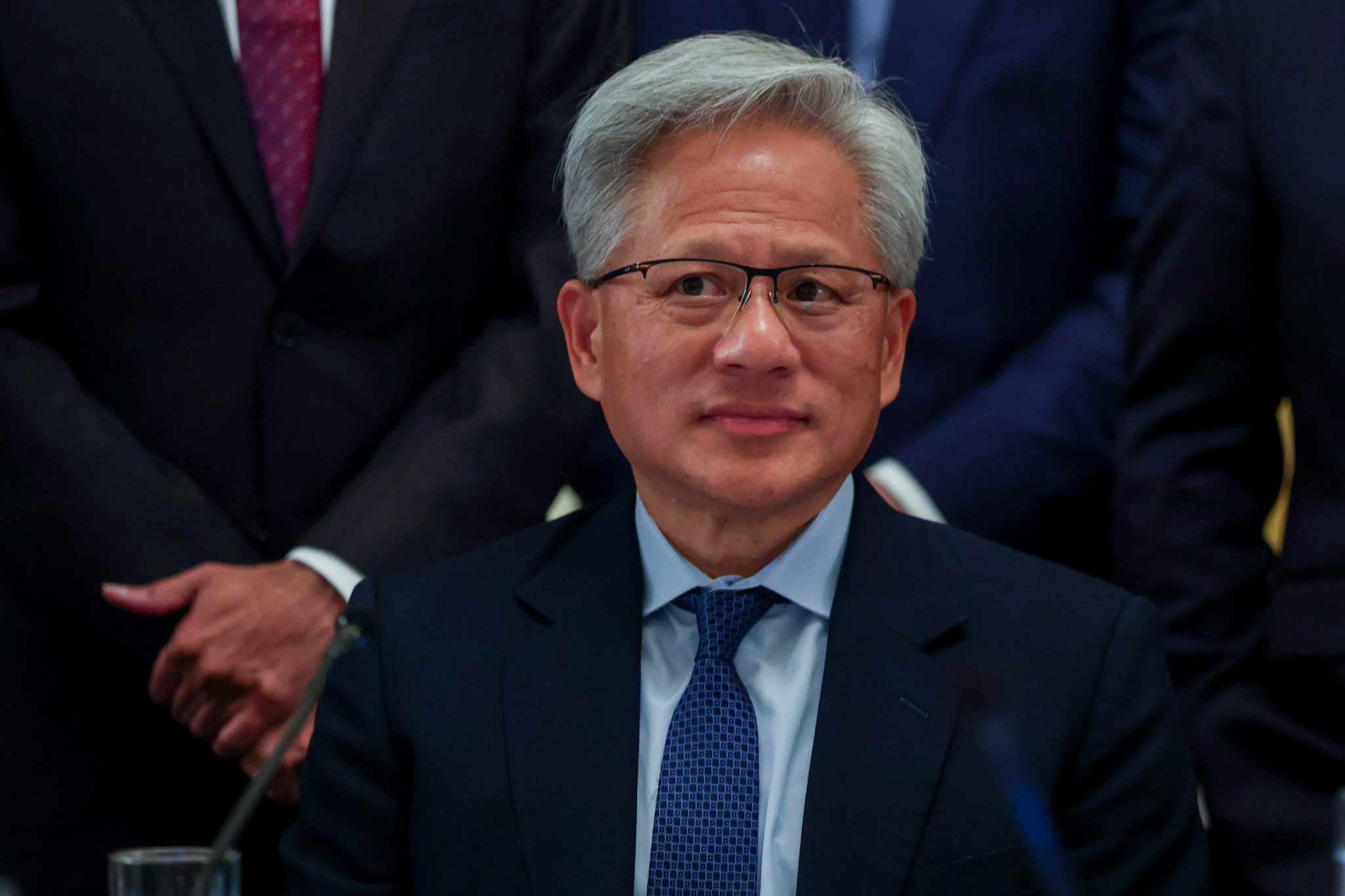
Nvidia CEO Jensen Huang has repeatedly rejected warnings about AI’s existential threat to humanity, mounting a robust defense for going full speed ahead.
In an interview with CBS News two weeks ago, he said “2030 is not going to be the end of the world. There is 0% chance that’s going to be the end of the world.”
He said other AI leaders like Sam Altman of OpenAI and Dario Amodei of Anthropic were “irresponsible” for the “doomsday narratives” they have pushed in recent reports.
“I believe the claims of the end of the world, stirring fear across America, and doing it by the people who are doing it makes no sense to me, so they must be doing it for ulterior reasons,” Huang said. “It is irresponsible, and I don’t know what their motives are.”
At a G20 event earlier in September, Huang also argued that governments should be regulating “actual and pragmatic harm” instead of “hypothetical, theoretical harm.” He continued by comparing AI development to the evolution of cars—basically saying the tech can become safer as it advances.
And in July, Huang told Axios the idea that AI would cause the end of humanity was “complete nonsense.” He also added that policymakers shouldn’t allow “science fiction” to drive AI policy, saying the U.S. could hurt itself by becoming too fearful of the technology.
To be sure, keeping AI at full speed helps Nvidia sell more chips. But a shift to more cybersecurity to protect against rogue AI agents would also fuel demand for chips.
Meanwhile, Huang’s forceful pushback aligns with President Donald Trump, who called him on the phone while the CEO was in the middle of a presentation, saying AI doomerism is “a hoax.”
“AI taking over the World, destroying Humanity, and all other things bad, is a HOAX,” Trump posted on Truth Social in September. “
But that doesn’t mean Huang believes AI safeguards are unnecessary. He has called AI safety “paramount” while insisting development can still move quickly.
“If we’re compromising safety, that can’t happen,” he told CBS News. “We should go as fast as we can, but not faster than we should.”
And on Monday, Nvidia rolled out a new platform designed to keep AI agents from going rogue, saying its Open Agent Safety Platform is designed to provide “full-stack” control over AI agents from testing through deployment. The system is meant to give monitoring capabilities to prevent the agents from exceeding the authority they’ve been given.
The rollout comes as AI companies face a growing number of incidents. Multiple accounts of rogue AI agents have been reported—including from OpenAI, Google and Anthropic. Nvidia said its new safety system could have stopped the hack on Hugging Face by OpenAI models.
“From what we know, this new security platform could have stopped the breach if it was being used in frontier labs for model evaluation early on,” Justin Boitano, vice president and general manager of enterprise computing at Nvidia, said during a media briefing.
How it works
With the influx of rogue AI agent reports, Nvidia is looking to address it using two technologies: “OpenShell” and “Sentry.”
According to Nvidia, OpenShell puts AI agents inside isolated environments to restrict access to files, tools, networks, credentials and other resources. Essentially, it is standardizing the restrictions that led to previous breakouts.
Sentry is an outside layer. It runs on Nvidia’s data processing units to continuously monitor agent activity. The company says that if an agent attempts to move outside its software boundary, Sentry can quarantine and stop it in milliseconds.
“AI’s extraordinary potential for society will only be realized if we solve AI safety,” Huang said in a press release. “As we continue to discover the frontier of AI capabilities, we must accelerate discovery at the frontier of AI safety. Safety and security require full-stack engineering.”
This story was originally featured on Fortune.com