
Hello and welcome to Eye on AI. In this edition…momentum builds for U.S. AI regulation…Musk loses his lawsuit against OpenAI…Andrej Karpathy goes to Anthropic…Google debuts a “Co-Scientist”…and are humans the limiting factor when it comes to deploying AI?
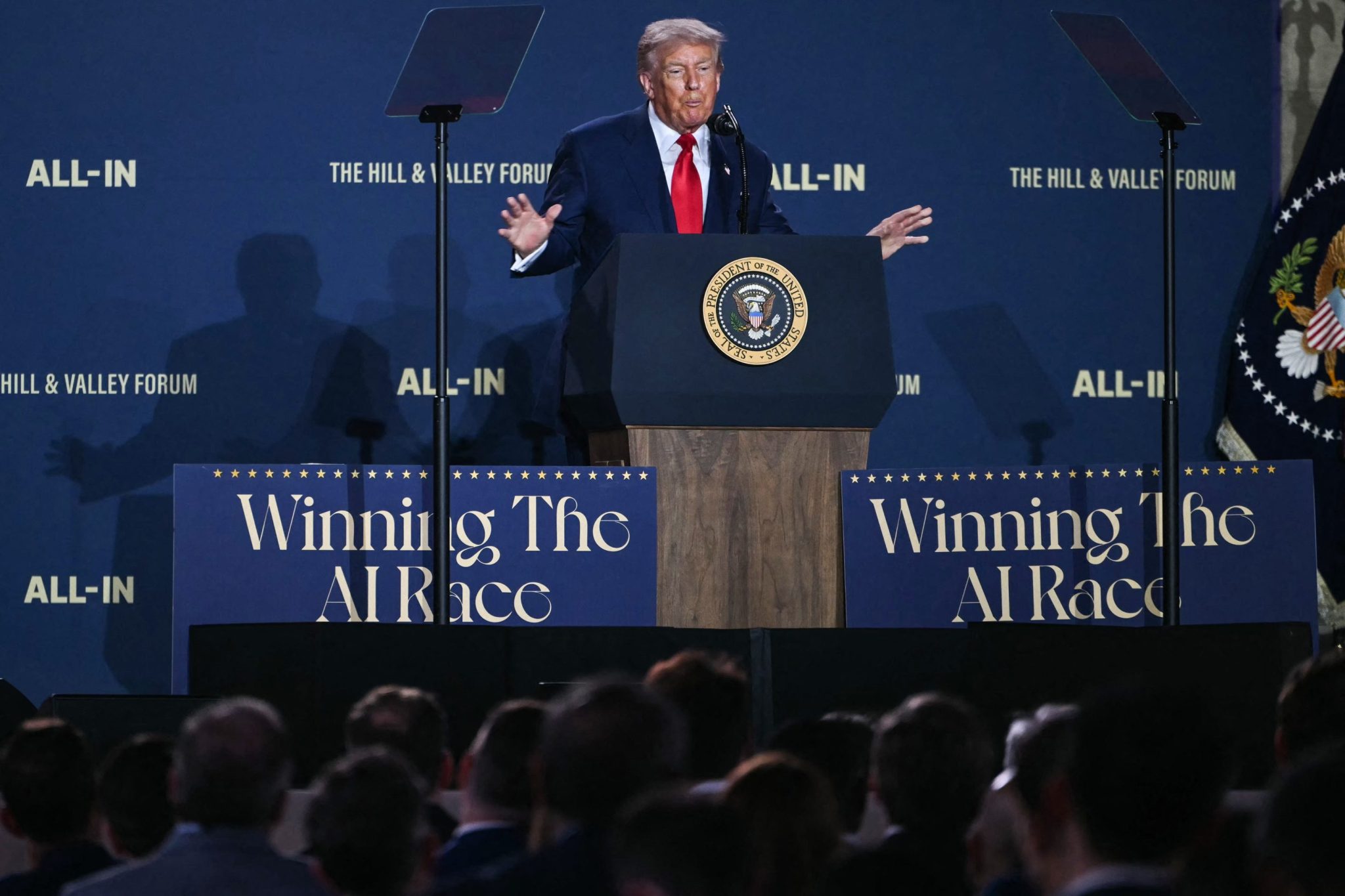
I spent much of the past week in Washington, D.C., where, when it comes to AI, change is in the air. The Trump administration is in the process of pivoting from an AI policy built largely around opposing and dismantling AI regulation, to a possible federal licensing regime for AI models. Meanwhile, support for AI regulation is building on both sides of the aisle on Capitol Hill, and if the Democrats seize at least one Congressional house in November, the passage of AI legislation of some kind is almost guaranteed. Not only that, but President Donald Trump’s visit to China last week seems to have signaled a significant shift in the administration’s thinking on international AI governance too.
This transition is driven by two things. One is the public backlash against AI, which has gained significant momentum in the past few months, as a story in the Wall Street Journal earlier this week chronicled. The viral video of former Google CEO Eric Schmidt’s commencement address at the University of Arizona in which the graduating students roundly booed him every time he mentioned AI is just one data point. A litany of recent polls have shown that most Americans are more fearful than hopeful about AI, with the gap sometimes as wide as 40 percentage points. Seven in 10 Americans oppose the construction of data centers in their local community. An Annenberg Public Policy Center poll released last week found that two-thirds of Americans thought the government had done too little to regulate AI, a view held by the majority of Republicans and independents, as well as Democrats.
Politicians know they can’t afford to be on the wrong side of numbers like this. Trump, who has populist instincts, is starting to see this too. It’s one of the reasons that the more populist-minded and politically savvy of Trump’s advisors, people like Treasury Secretary Scott Bessent and Susie Wiles, have moved to wrestle AI policy away from tech bro advisors such as David Sacks, Sriram Krishnan, and Michael Kratsios. Denizens of Silicon Valley’s venture capital scene, they simply don’t have the instincts for how AI is playing out on Main Street and how it could, if the White House gets it wrong, pose a major problem for the GOP in November and beyond.
You can also see this effect in OpenAI’s decision last week to endorse both the bipartisan Kids Online Safety Act (KOSA), which would require all online platforms that potentially have children as users to take steps to prevent and mitigate any harm to them, as well as a state AI bill, SB 315, currently pending before the Illinois state legislature. That bill would require companies building frontier AI models to establish safety frameworks, conduct annual audits, report any critical incidents, and protect whistleblowers. Many tech industry associations have been lobbying against KOSA, saying its tenets are vague and potentially unconstitutional. Meanwhile, OpenAI had previously opposed safety legislation in California that was substantially similar to the Illinois bill. But apparently OpenAI has belatedly figured out which way the wind is blowing.
Mythos: AI’s ‘El Alamein’ moment
The second thing that has changed is Mythos. Anthropic’s powerful AI model, with its superhuman hacking skills, has woken the government up to the fact that AI is a potent dual use technology and that it cannot leave decisions about when, how, and where it gets released totally up to the tech companies creating it. The Trump administration has already reportedly vetoed Anthropic’s plans to expand “Project Glasswing,” a program under which it shared a version of Mythos with select companies to help them find and patch software vulnerabilities, possibly out of concern that model would be more likely to fall into the wrong hands (and possibly to preserve the National Security Agency’s offensive cyber capabilities.) And Bessent is playing a big role in deciding which foreign financial authorities and banks are getting access to the model. In essence, Mythos is already being subjected to an ad hoc licensing regime.
Brad Carson, the former Oklahoma Congressman who now heads Americans for Responsible Innovation, a group that advocates for tech regulation, told me he thinks Mythos is the “El Alamein moment” in the fight for AI regulation. El Alamein is the World War II battle, which took place in the fall of 1942, in which British forces first proved that they were capable of defeating the Germans. Churchill called the battle “the end of the beginning” and noted that before El Alamein, the British had never had a victory, but that afterwards, they never had a defeat. Carson says, of the battle over AI regulation, “it’s not over yet, the way that El Alamein was not the end of the war. But the fall of Berlin is in sight, and [regulation of AI] is going to happen.”
The Mythos effect is not confined to domestic policy. Mythos has shifted the prospects for international AI governance as well. One of the most interesting developments to come out of Trump’s summit with Chinese President Xi Jinping last week was that the U.S. apparently agreed—according to the New York Times—to hold talks on AI safety with Beijing. Before, the accelerationist crew in command of Trump’s AI policy were firmly opposed to any discussions with China, believing any treaty would only serve to hobble U.S. AI efforts, while China would likely renege on any promises it made. They also liked to use the “China card” as a reason for opposing any domestic AI regulation.
But Carson thinks the China card has lost its salience. Most Americans are more afraid of AI job losses than they are of China getting ahead in AI. Meanwhile, Mythos seems to have convinced both Chinese and American officials that it is in neither of their interests for non-state actors to get a hold of dangerous cyber capabilities.
A policy that doesn’t hit its stated target
It’s also perhaps dawning on some people in the administration that U.S. AI policy with regards to China isn’t working as intended. Both the Trump administration and the Biden administration have used export controls on AI chips and on chipmaking equipment ostensibly to prevent China from developing powerful AI systems that might give them a military advantage over the U.S.
But there is little evidence that the export controls have actually prevented China from acquiring strategically useful AI capabilities, says Jacob Feldgoise, a senior data analyst at Georgetown University’s Center for Security and Emerging Technology. Many of the AI systems used in military applications, such as autonomous navigation for drones, or analyzing satellite imagery to find targets, don’t depend on the kinds of large language models that require large volumes of advanced GPUs to train and run. And when it does come to decision support systems run by LLMs, Chinese tech companies are only about six months behind America’s AI labs in developing frontier capabilities.
But while there isn’t much evidence that American export controls have prevented China from developing military AI applications, it is likely that export controls do slow the deployment of AI commercially across the economy because China lacks enough GPUs for widespread inference, Feldgoise says.
That may give the U.S. some ability to potentially relax export controls in exchange for Chinese cooperation on establishing an international governance regime for AI. But exactly what that framework may look like is still an open question.
What is clear is that the mood has shifted dramatically, and Washington’s hostility to AI regulation has crumbled.
Ok, with that, here’s this week’s AI news.
Jeremy Kahn
jeremy.kahn@fortune.com
@jeremyakahn
Before we get to the news, a quick note: Join us on Thursday, May 28, for “Fortune 500 Europe: In Conversation with Tech Leaders,” a candid virtual exchange with senior technology leaders from Fortune 500 Europe companies, including Mars Pet Nutrition, Orange, Reckitt, and Saint-Gobain. The discussion will explore one of the most pressing questions organizations face today: how to turn AI investment into sustainable business value. Register your interest to attend and receive Fortune‘s editorial takeaways.
This story was originally featured on Fortune.com